Shimizu Shosei, Mizumoto Masashi, Okumura Toshiyuki, Li Yinuo, Baba Keiichirou, Murakami Motohiro, Ishida Toshiki, Nakamura Masatoshi, Hiroshima Yuichi, Iizumi Takashi, Saito Takashi, Numajiri Haruko, Nakai Kei, Hata Masaharu, Sakurai Hideyuki
Department of Radiation Oncology, Proton Medical Research Center, University of Tsukuba Hospital, Tsukuba, Ibaraki, Japan.
Department of Radiation Oncology, Graduate School of Comprehensive Human Sciences, University of Tsukuba, Tsukuba, Ibaraki, Japan.
Clin Transl Radiat Oncol. 2021 Feb 3;27:152-156. doi: 10.1016/j.ctro.2021.01.014. eCollection 2021 Mar.
Hepatic hemangiomas are benign tumors with a favorable prognosis, but giant hepatic hemangiomas can cause abdominal symptoms and are indicated for treatment. Most cases are treated with surgery, but radiotherapy has also been used. However, to date, there have been no reports of proton beam therapy for a hepatic hemangioma.
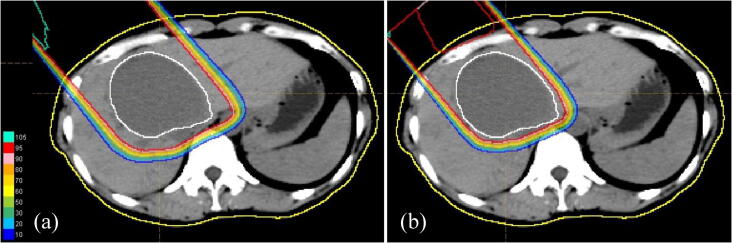
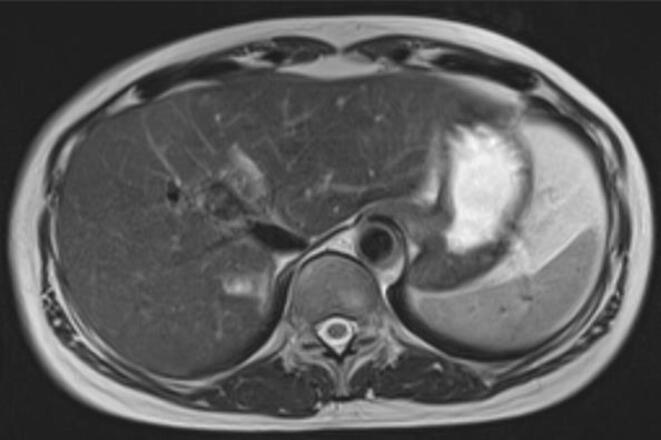
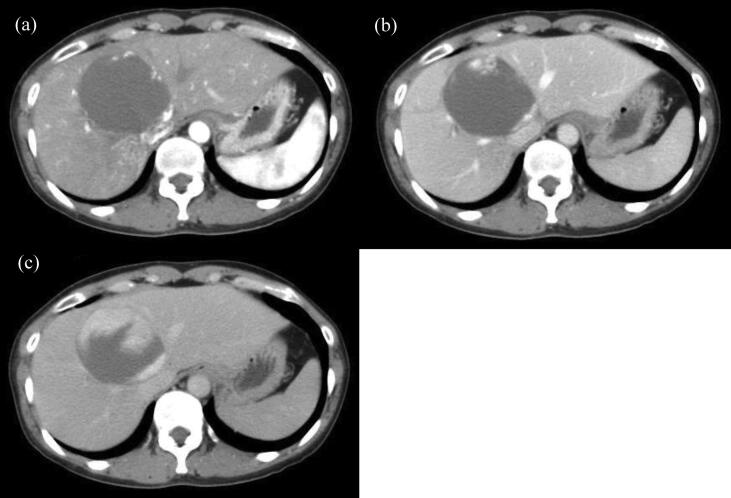
A 46-year-old woman had a tumor of 80 × 80 mm in the left medial lobe of the liver, which was diagnosed as a giant hemangioma based on the contrast pattern. Therapy was required for a giant hepatic hemangioma with symptoms, but the patient refused blood transfusion due to religious reasons, which made surgical resection difficult. Therefore, she was referred to our hospital for proton beam therapy. At her first visit, liver function was Child-Pugh A (5 points) and there was no elevation of tumor markers. Proton beam therapy of 28.6 Gy (RBE) given in 13 fractions was performed without interruption. The only observed acute radiation toxicity was Grade 1 dermatitis. One year after proton beam therapy, the hemangioma had significantly decreased, and a complete response has been maintained for 15 years based on ultrasound and MRI.
This case is the first reported use of proton beam therapy for a hepatic hemangioma. The outcome suggests that this treatment may be effective for a giant liver hemangioma.
肝血管瘤是预后良好的良性肿瘤,但巨大肝血管瘤可引起腹部症状,需要进行治疗。大多数病例采用手术治疗,但也有使用放射治疗的情况。然而,迄今为止,尚无质子束治疗肝血管瘤的报道。
一名46岁女性,肝脏左内侧叶有一个80×80mm的肿瘤,根据增强模式诊断为巨大血管瘤。因巨大肝血管瘤伴有症状需要治疗,但患者因宗教原因拒绝输血,这使得手术切除困难。因此,她被转诊至我院接受质子束治疗。初诊时,肝功能为Child-Pugh A级(5分),肿瘤标志物无升高。给予13次分割的28.6Gy(相对生物效应)质子束治疗,无中断。观察到的唯一急性放射毒性为1级皮炎。质子束治疗1年后,血管瘤明显缩小,基于超声和磁共振成像,完全缓解已维持15年。
本病例是首例报道使用质子束治疗肝血管瘤。结果表明,这种治疗方法可能对巨大肝血管瘤有效。