Lo Chih Hung, Sachs Jonathan N
Department of Biomedical Engineering, University of Minnesota, Minneapolis, MN 55455.
Department of Neurology, Brigham and Women's Hospital, Harvard Medical School, Boston, MA 02115.
J Life Sci (Westlake Village). 2020 Dec;2(4):1-17. doi: 10.36069/jols/20201201.
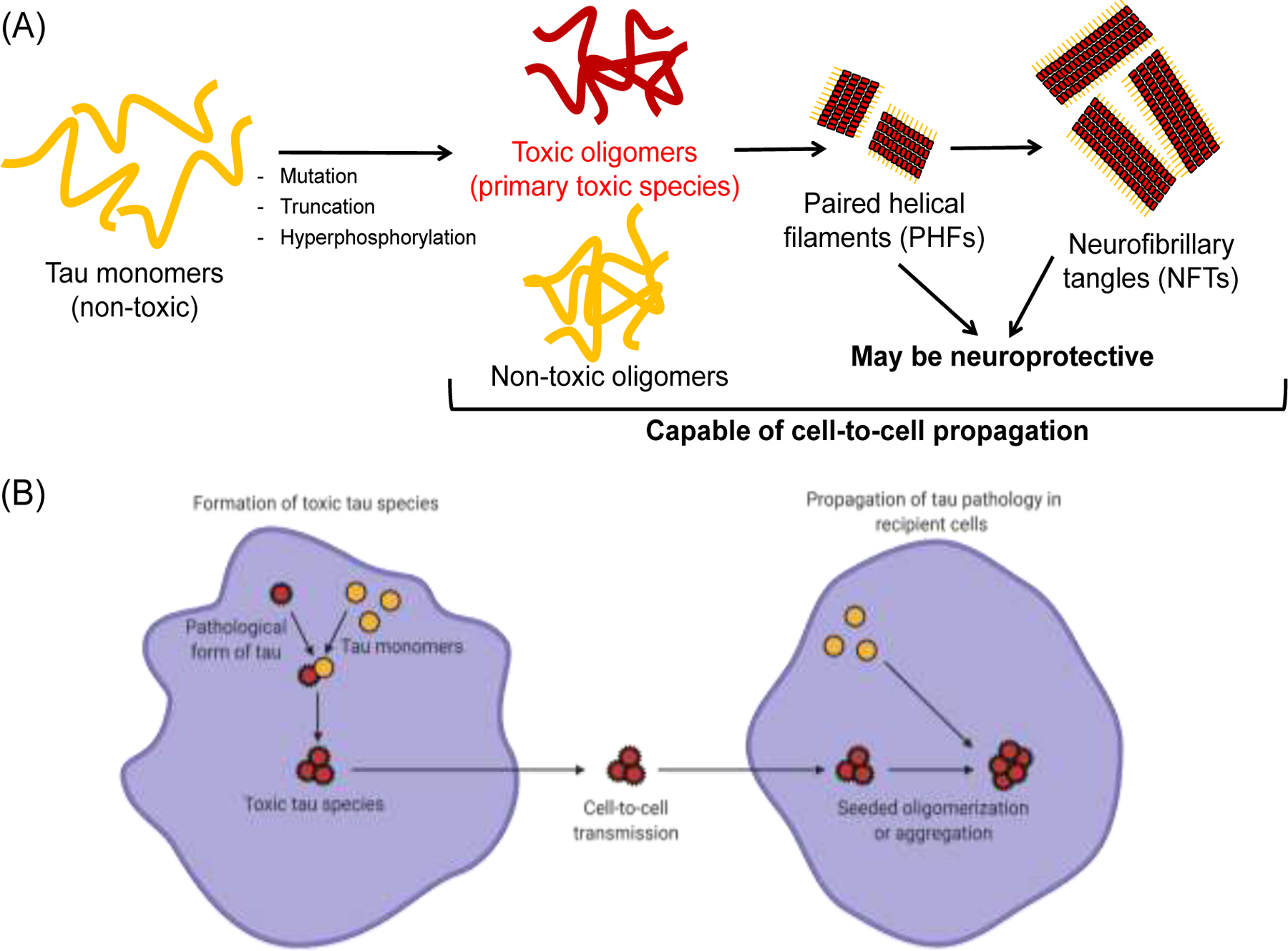
Tau oligomers have recently emerged as the principal toxic species in Alzheimer's disease (AD) and tauopathies. Tau oligomers are spontaneously self-assembled soluble tau proteins that are formed prior to fibrils, and they have been shown to play a central role in neuronal cell death and in the induction of neurodegeneration in animal models. As the therapeutic paradigm shifts to targeting toxic tau oligomers, this suggests the focus to study tau oligomerization in species that are less susceptible to fibrillization. While truncated and mutation containing tau as well as the isolated repeat domains are particularly prone to fibrillization, the wild-type (WT) tau proteins have been shown to be resistant to fibril formation in the absence of aggregation inducers. In this review, we will summarize and discuss the toxicity of WT tau both in vitro and in vivo, as well as its involvement in tau oligomerization and cell-to-cell propagation of pathology. Understanding the role of WT tau will enable more effective biomarker development and therapeutic discovery for treatment of AD and tauopathies.
近年来,tau寡聚体已成为阿尔茨海默病(AD)和tau蛋白病中的主要毒性物质。tau寡聚体是自发自组装的可溶性tau蛋白,在纤维形成之前就已形成,并且已证明它们在动物模型的神经元细胞死亡和神经退行性变诱导中起核心作用。随着治疗模式转向靶向有毒的tau寡聚体,这表明应将研究重点放在不易形成纤维的物种中的tau寡聚化上。虽然截短的、含突变的tau以及分离的重复结构域特别容易形成纤维,但野生型(WT)tau蛋白在没有聚集诱导剂的情况下已被证明对纤维形成具有抗性。在这篇综述中,我们将总结并讨论WT tau在体外和体内的毒性,以及它在tau寡聚化和病理的细胞间传播中的作用。了解WT tau的作用将有助于开发更有效的生物标志物,并为AD和tau蛋白病的治疗发现新的疗法。