O'Connor Lance M, O'Connor Blake A, Zeng Jialiu, Lo Chih Hung
College of Biological Sciences, University of Minnesota, Minneapolis, MN 55455, USA.
School of Pharmacy, University of Wisconsin, Madison, WI 53705, USA.
Brain Sci. 2023 Sep 14;13(9):1318. doi: 10.3390/brainsci13091318.
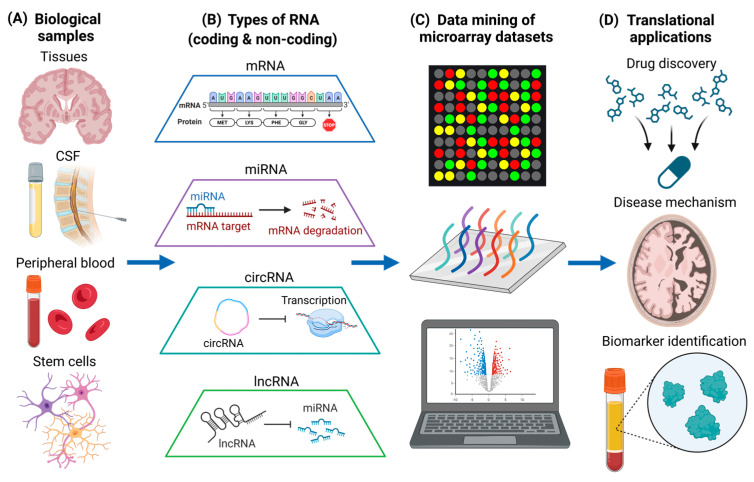
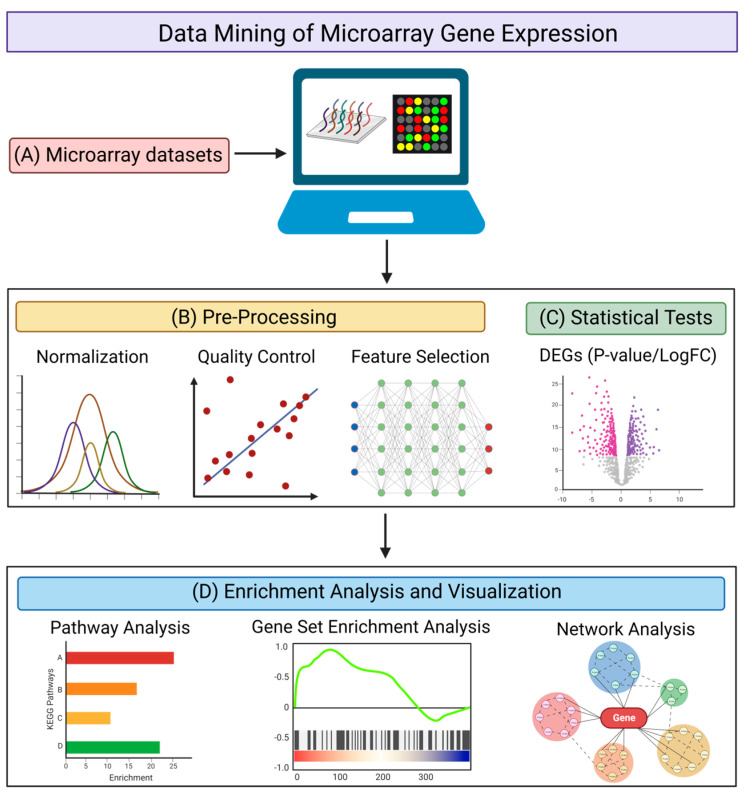
Data mining involves the computational analysis of a plethora of publicly available datasets to generate new hypotheses that can be further validated by experiments for the improved understanding of the pathogenesis of neurodegenerative diseases. Although the number of sequencing datasets is on the rise, microarray analysis conducted on diverse biological samples represent a large collection of datasets with multiple web-based programs that enable efficient and convenient data analysis. In this review, we first discuss the selection of biological samples associated with neurological disorders, and the possibility of a combination of datasets, from various types of samples, to conduct an integrated analysis in order to achieve a holistic understanding of the alterations in the examined biological system. We then summarize key approaches and studies that have made use of the data mining of microarray datasets to obtain insights into translational neuroscience applications, including biomarker discovery, therapeutic development, and the elucidation of the pathogenic mechanisms of neurodegenerative diseases. We further discuss the gap to be bridged between microarray and sequencing studies to improve the utilization and combination of different types of datasets, together with experimental validation, for more comprehensive analyses. We conclude by providing future perspectives on integrating multi-omics, to advance precision phenotyping and personalized medicine for neurodegenerative diseases.
数据挖掘涉及对大量公开可用数据集进行计算分析,以生成新的假设,这些假设可通过实验进一步验证,从而更好地理解神经退行性疾病的发病机制。尽管测序数据集的数量在不断增加,但对各种生物样本进行的微阵列分析代表了大量数据集,有多个基于网络的程序可实现高效便捷的数据分析。在本综述中,我们首先讨论与神经系统疾病相关的生物样本的选择,以及将来自各种类型样本的数据集进行组合以进行综合分析的可能性,以便全面了解所研究生物系统中的变化。然后,我们总结了利用微阵列数据集的数据挖掘来深入了解转化神经科学应用的关键方法和研究,包括生物标志物发现、治疗开发以及神经退行性疾病致病机制的阐明。我们进一步讨论了微阵列研究与测序研究之间需要弥合的差距,以改善不同类型数据集的利用和组合,并结合实验验证进行更全面的分析。我们通过提供关于整合多组学的未来展望来结束本文,以推进神经退行性疾病的精准表型分析和个性化医疗。