Anthropology Program, The Graduate Center, City University of New York, New York, New York, USA.
New York Consortium in Evolutionary Primatology, New York, New York, USA.
Am J Primatol. 2021 May;83(5):e23248. doi: 10.1002/ajp.23248. Epub 2021 Mar 5.
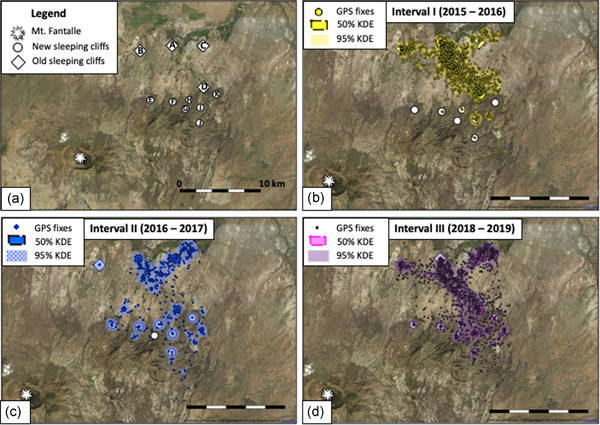
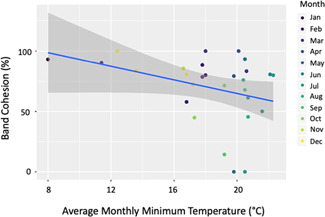
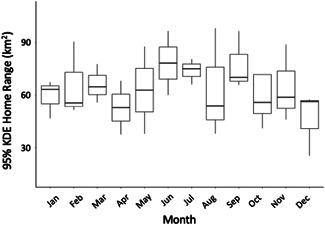
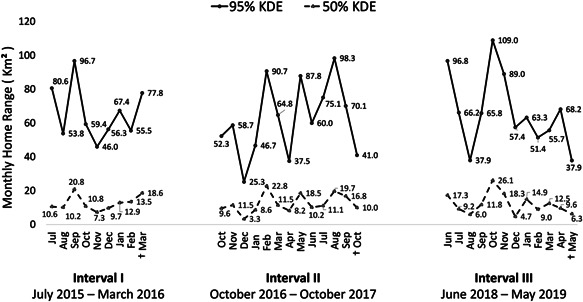
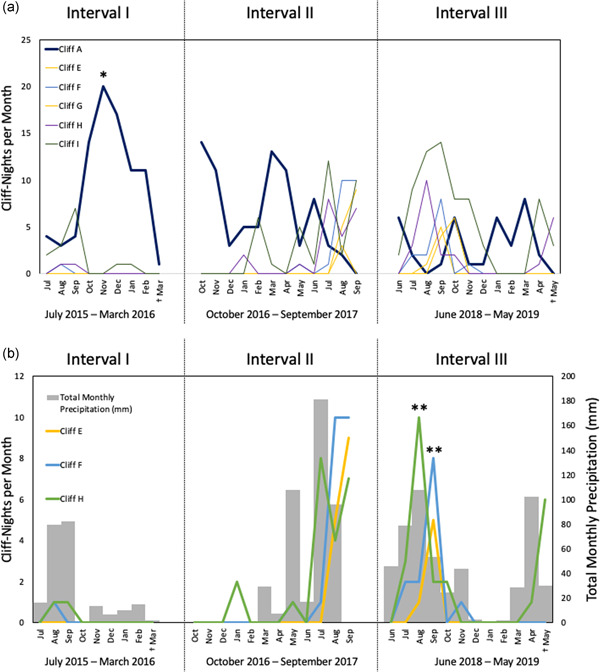
Variation in spatial and temporal distribution of resources drives animal movement patterns. Links between ecology and behavior are particularly salient for the multilevel society of hamadryas baboons, in which social units cleave and coalesce over time in response to ecological factors. Here, we used data from GPS collars to estimate home range size and assess temporal patterns of sleeping site use in a band of hamadryas baboons in Awash National Park, Ethiopia. We used GPS data derived from 2 to 3 collared baboons over three 8-12-month collaring intervals to estimate annual and monthly home ranges using kernel density estimators (KDEs) and minimum convex polygons (MCPs). The 95% KDE home range was 64.11 km for Collaring Interval I (July 2015-March 2016), 85.52 km for Collaring Interval II (October 2016-October 2017), 76.43 km for Collaring Interval III (July 2018-May 2019), and 75.25 km across all three collaring intervals. MCP home ranges were 103.46 km for Collaring Interval I, 97.90 km for Collaring Interval II, 105.22 km for Collaring Interval III, and 129.33 km overall. Ninety-five percent KDE home range sizes did not differ across months, nor correlate with temperature or precipitation, but monthly MCP home ranges increased with monthly precipitation. Our data also revealed a southward home range shift over time and seven previously unknown sleeping sites, three of which were used more often during the wet season. Band cohesion was highest during dry months and lowest during wet months, with fissioning occurring more frequently at higher temperatures. One pair of collared individuals from Collaring Interval III spent 95% of nights together, suggesting they were members of the same clan. Our results both suggest that previous studies have underestimated the home range size of hamadryas baboons and highlight the benefits of remote data collection.
资源的时空分布变化驱动着动物的运动模式。生态学和行为之间的联系在哈姆拉达斯狒狒的多层次社会中尤为明显,在这个社会中,社会单位会随着时间的推移而分裂和合并,以应对生态因素。在这里,我们使用来自 GPS 项圈的数据来估计哈马德拉斯狒狒在埃塞俄比亚阿瓦什国家公园的一个群体中的家域大小,并评估其睡眠点使用的时间模式。我们使用来自 2 到 3 只佩戴项圈的狒狒的数据,在三个 8-12 个月的佩戴间隔中,使用核密度估计器(KDE)和最小凸多边形(MCP)来估计年度和月度家域。在第一佩戴间隔(2015 年 7 月至 2016 年 3 月)中,95%的 KDE 家域为 64.11km;在第二佩戴间隔(2016 年 10 月至 2017 年 10 月)中,95%的 KDE 家域为 85.52km;在第三佩戴间隔(2018 年 7 月至 2019 年 5 月)中,95%的 KDE 家域为 76.43km;在所有三个佩戴间隔中,95%的 KDE 家域为 75.25km。在第一佩戴间隔中,MCP 家域为 103.46km;在第二佩戴间隔中,MCP 家域为 97.90km;在第三佩戴间隔中,MCP 家域为 105.22km;在所有三个佩戴间隔中,MCP 家域为 129.33km。95%的 KDE 家域大小在不同月份之间没有差异,也与温度或降水无关,但每月的 MCP 家域大小随着每月的降水而增加。我们的数据还揭示了家域随时间的向南迁移以及七个以前未知的睡眠点,其中三个在湿季使用得更频繁。在旱季,群体的凝聚力最高,在雨季最低,在温度较高时分裂更频繁。第三佩戴间隔中的一对佩戴项圈的个体有 95%的夜晚都在一起,这表明它们是同一个族群的成员。我们的结果表明,先前的研究低估了哈姆拉达斯狒狒的家域大小,并强调了远程数据收集的好处。