Department of Psychology, University of California, Berkeley, Berkeley, California, United States of America.
Helen Wills Neuroscience Institute, University of California, Berkeley, Berkeley, California, United States of America.
PLoS Biol. 2021 Mar 5;19(3):e3001147. doi: 10.1371/journal.pbio.3001147. eCollection 2021 Mar.
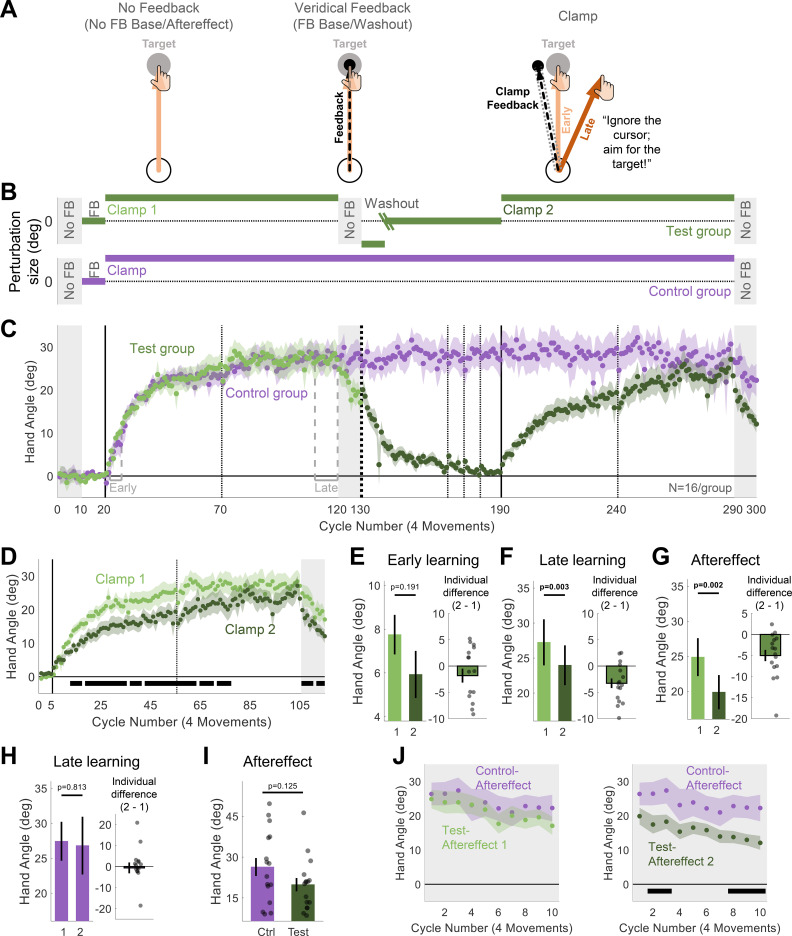
The motor system demonstrates an exquisite ability to adapt to changes in the environment and to quickly reset when these changes prove transient. If similar environmental changes are encountered in the future, learning may be faster, a phenomenon known as savings. In studies of sensorimotor learning, a central component of savings is attributed to the explicit recall of the task structure and appropriate compensatory strategies. Whether implicit adaptation also contributes to savings remains subject to debate. We tackled this question by measuring, in parallel, explicit and implicit adaptive responses in a visuomotor rotation task, employing a protocol that typically elicits savings. While the initial rate of learning was faster in the second exposure to the perturbation, an analysis decomposing the 2 processes showed the benefit to be solely associated with explicit re-aiming. Surprisingly, we found a significant decrease after relearning in aftereffect magnitudes during no-feedback trials, a direct measure of implicit adaptation. In a second experiment, we isolated implicit adaptation using clamped visual feedback, a method known to eliminate the contribution of explicit learning processes. Consistent with the results of the first experiment, participants exhibited a marked reduction in the adaptation function, as well as an attenuated aftereffect when relearning from the clamped feedback. Motivated by these results, we reanalyzed data from prior studies and observed a consistent, yet unappreciated pattern of attenuation of implicit adaptation during relearning. These results indicate that explicit and implicit sensorimotor processes exhibit opposite effects upon relearning: Explicit learning shows savings, while implicit adaptation becomes attenuated.
运动系统展现出了一种精妙的适应环境变化的能力,并且在这些变化是暂时的情况下能够迅速重置。如果未来遇到类似的环境变化,学习可能会更快,这种现象被称为节省。在感觉运动学习的研究中,节省的一个核心组成部分归因于任务结构的明确回忆和适当的补偿策略。隐性适应是否也有助于节省仍然存在争议。我们通过在一个视觉运动旋转任务中并行测量显性和隐性适应性反应来解决这个问题,采用的协议通常会产生节省。虽然在第二次受到干扰时,学习的初始速度更快,但对这两个过程进行分析表明,这种好处仅与显性重新瞄准有关。令人惊讶的是,我们发现,在无反馈试验中,后效幅度在重新学习后会显著下降,这是隐性适应的直接衡量标准。在第二个实验中,我们使用固定的视觉反馈来隔离隐性适应,这种方法已知可以消除显性学习过程的贡献。与第一个实验的结果一致,参与者在适应函数和重新从固定反馈学习时的后效方面表现出明显的减少。受这些结果的启发,我们重新分析了之前研究的数据,并观察到在重新学习期间隐性适应的衰减存在一致但未被认识到的模式。这些结果表明,显性和隐性感觉运动过程在重新学习时表现出相反的效果:显性学习显示出节省,而隐性适应则减弱。