Department of Family and Community Medicine, School of Medicine, University of Missouri, Columbia, MO 65212, USA.
Psychology Department, University of Texas, El Paso, TX 79902, USA.
Int J Environ Res Public Health. 2021 Feb 13;18(4):1821. doi: 10.3390/ijerph18041821.
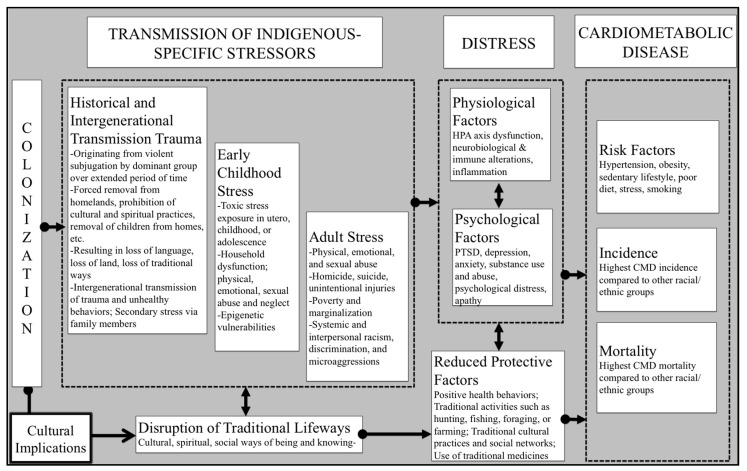
Indigenous people experience the greatest cardiometabolic disease disparity in the Unites States, yet high cardiometabolic disease risk factors do not fully explain the extent of the cardiometabolic disease disparity for Indigenous people. Stress, trauma, and racism occur at high rates within Indigenous communities and have not been well explored as significant contributors to cardiometabolic disease disparities despite emerging literature, and therefore will be described here.
This descriptive study explores the relationship between cardiometabolic disease risks and Indigenous-specific stressors (e.g., early childhood stress and trauma, adulthood stress and trauma, and historical and intergenerational trauma) using current literature. Indigenous-specific protective factors against cardiometabolic disease are also reviewed.
Increasing research indicates that there is a relationship between Indigenous-specific stressful and traumatic life experiences and increased cardiometabolic disease risk. Mental health and psychophysiology play an important role in this relationship. Effective interventions to reduce cardiometabolic disease risk in Indigenous communities focus on ameliorating the negative effects of these stressors through the use of culturally specific health behaviors and activities.
There is increasing evidence that cultural connection and enculturation are protective factors for cardiometabolic disease, and may be galvanized through Indigenous-led training, research, and policy change.
在美国,原住民经历着最大的心血管代谢疾病差异,但心血管代谢疾病的高风险因素并不能完全解释原住民心血管代谢疾病差异的程度。压力、创伤和种族主义在原住民社区中发生率很高,尽管有新的文献,但它们并没有被很好地探索为导致心血管代谢疾病差异的重要因素,因此将在这里描述。
本描述性研究使用现有文献探讨了心血管代谢疾病风险与原住民特有的压力源(如儿童期早期压力和创伤、成年期压力和创伤以及历史和代际创伤)之间的关系。还审查了针对心血管代谢疾病的原住民特有的保护因素。
越来越多的研究表明,原住民特有的压力和创伤性生活经历与心血管代谢疾病风险增加之间存在关联。心理健康和心理生理学在这种关系中起着重要作用。减少原住民社区心血管代谢疾病风险的有效干预措施侧重于通过使用文化特异性的健康行为和活动来减轻这些压力源的负面影响。
越来越多的证据表明,文化联系和融入是心血管代谢疾病的保护因素,并且可以通过原住民主导的培训、研究和政策变革来加强。