Asadpoor Mostafa, Ithakisiou Georgia-Nefeli, Henricks Paul A J, Pieters Roland, Folkerts Gert, Braber Saskia
Division of Pharmacology, Utrecht Institute for Pharmaceutical Sciences, Faculty of Science, Utrecht University, Universiteitsweg 99, 3584 CG Utrecht, The Netherlands.
Division of Medicinal Chemistry and Chemical Biology, Utrecht Institute for Pharmaceutical Sciences, Faculty of Science, Utrecht University, Universiteitsweg 99, 3584 CG Utrecht, The Netherlands.
Toxins (Basel). 2021 Feb 25;13(3):175. doi: 10.3390/toxins13030175.
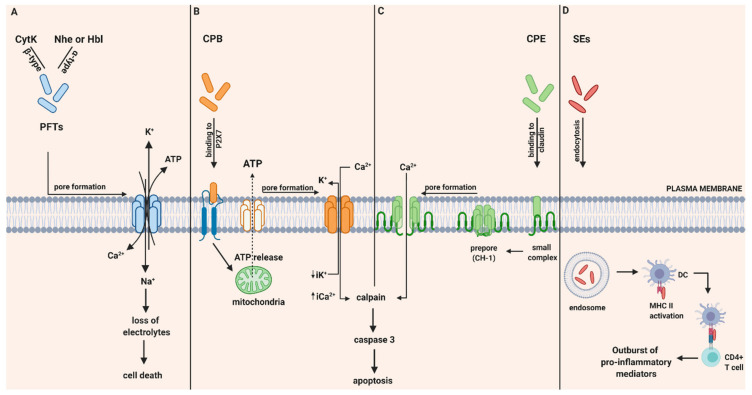
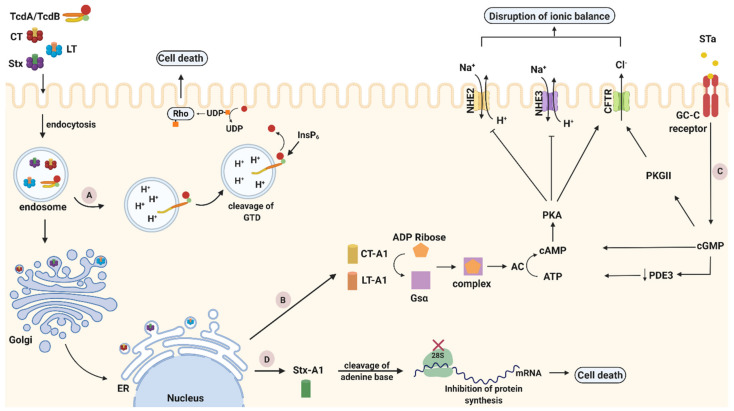
Enterotoxin-producing bacteria (EPB) have developed multiple mechanisms to disrupt gut homeostasis, and provoke various pathologies. A major part of bacterial cytotoxicity is attributed to the secretion of virulence factors, including enterotoxins. Depending on their structure and mode of action, enterotoxins intrude the intestinal epithelium causing long-term consequences such as hemorrhagic colitis. Multiple non-digestible oligosaccharides (NDOs), and short chain fatty acids (SCFA), as their metabolites produced by the gut microbiota, interact with enteropathogens and their toxins, which may result in the inhibition of the bacterial pathogenicity. NDOs characterized by diverse structural characteristics, block the pathogenicity of EPB either directly, by inhibiting bacterial adherence and growth, or biofilm formation or indirectly, by promoting gut microbiota. Apart from these abilities, NDOs and SCFA can interact with enterotoxins and reduce their cytotoxicity. These anti-virulent effects mostly rely on their ability to mimic the structure of toxin receptors and thus inhibiting toxin adherence to host cells. This review focuses on the strategies of EPB and related enterotoxins to impair host cell immunity, discusses the anti-pathogenic properties of NDOs and SCFA on EPB functions and provides insight into the potential use of NDOs and SCFA as effective agents to fight against enterotoxins.
产肠毒素细菌(EPB)已形成多种机制来破坏肠道内稳态,并引发各种病理状况。细菌细胞毒性的主要部分归因于包括肠毒素在内的毒力因子的分泌。根据其结构和作用方式,肠毒素侵入肠道上皮,导致诸如出血性结肠炎等长期后果。多种不可消化的低聚糖(NDOs)及其作为肠道微生物群产生的代谢产物的短链脂肪酸(SCFA)与肠道病原体及其毒素相互作用,这可能导致细菌致病性受到抑制。具有多样结构特征的NDOs,要么通过抑制细菌黏附、生长或生物膜形成直接阻断EPB的致病性,要么通过促进肠道微生物群间接阻断。除了这些能力外,NDOs和SCFA还可与肠毒素相互作用并降低其细胞毒性。这些抗毒作用大多依赖于它们模拟毒素受体结构从而抑制毒素黏附宿主细胞的能力。本综述聚焦于EPB及相关肠毒素损害宿主细胞免疫的策略,讨论NDOs和SCFA对EPB功能的抗致病特性,并深入探讨将NDOs和SCFA用作对抗肠毒素的有效剂的潜在用途。