Rauner Martina, Taipaleenmäki Hanna, Tsourdi Elena, Winter Elizabeth M
Divisions of Endocrinology and Molecular Bone Biology, Department of Medicine III, Medical Center, Technische Universität Dresden, 01307 Dresden, Germany.
Molecular Skeletal Biology Laboratory, Department of Trauma and Orthopedic Surgery, University Medical Center Hamburg-Eppendorf, 20246 Hamburg, Germany.
J Clin Med. 2021 Feb 16;10(4):787. doi: 10.3390/jcm10040787.
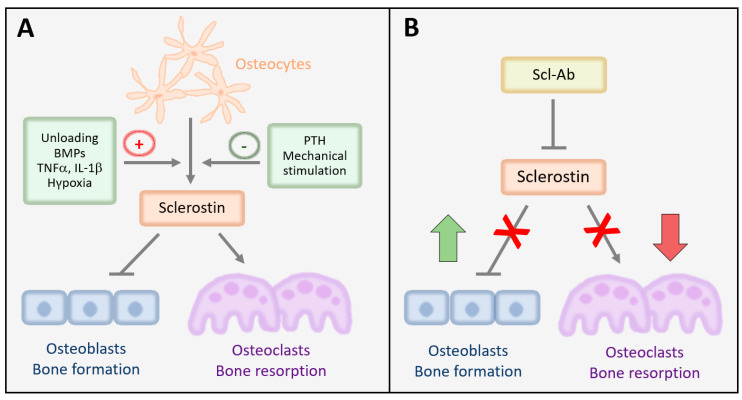
Osteoporosis is characterized by reduced bone mass and disruption of bone architecture, resulting in increased risk of fragility fractures and significant long-term disability. Although both anti-resorptive treatments and osteoanabolic drugs, such as parathyroid hormone analogues, are effective in fracture prevention, limitations exist due to lack of compliance or contraindications to these drugs. Thus, there is a need for novel potent therapies, especially for patients at high fracture risk. Romosozumab is a monoclonal antibody against sclerostin with a dual mode of action. It enhances bone formation and simultaneously suppresses bone resorption, resulting in a large anabolic window. In this opinion-based narrative review, we highlight the role of sclerostin as a critical regulator of bone mass and present human diseases of sclerostin deficiency as well as preclinical models of genetically modified sclerostin expression, which led to the development of anti-sclerostin antibodies. We review clinical studies of romosozumab in terms of bone mass accrual and anti-fracture activity in the setting of postmenopausal and male osteoporosis, present sequential treatment regimens, and discuss its safety profile and possible limitations in its use. Moreover, an outlook comprising future translational applications of anti-sclerostin antibodies in diseases other than osteoporosis is given, highlighting the clinical significance and future scopes of Wnt signaling in these settings.
骨质疏松症的特征是骨量减少和骨结构破坏,导致脆性骨折风险增加和严重的长期残疾。尽管抗吸收治疗和骨合成代谢药物(如甲状旁腺激素类似物)在预防骨折方面均有效,但由于对这些药物缺乏依从性或存在禁忌证,仍存在局限性。因此,需要新的有效疗法,特别是对于骨折风险高的患者。罗莫单抗是一种抗硬化蛋白单克隆抗体,具有双重作用模式。它可增强骨形成并同时抑制骨吸收,从而产生较大的合成代谢窗口。在这篇基于观点的叙述性综述中,我们强调了硬化蛋白作为骨量关键调节因子的作用,并介绍了硬化蛋白缺乏的人类疾病以及转基因硬化蛋白表达的临床前模型,这些模型促成了抗硬化蛋白抗体的研发。我们回顾了罗莫单抗在绝经后和男性骨质疏松症背景下骨量增加和抗骨折活性方面的临床研究,介绍了序贯治疗方案,并讨论了其安全性概况和使用中可能存在的局限性。此外,还展望了抗硬化蛋白抗体在骨质疏松症以外疾病中的未来转化应用,强调了这些情况下Wnt信号通路的临床意义和未来研究范围。