Maruyama Tsuyoshi E, Ueno Saneyoshi, Hosoi Yoshihisa, Miyazawa Shin-Ichi, Mori Hideki, Kaneeda Takumi, Bamba Yukiko, Itoh Yukiko, Hirayama Satoko, Kawakami Kiyohisa, Moriguchi Yoshinari
Department of Research Planning and Coordination, Forestry and Forest Products Research Institute, Matsunosato 1, Tsukuba 305-8687, Japan.
Department of Forest Molecular Genetics and Biotechnology, Forestry and Forest Products Research Institute, Matsunosato 1, Tsukuba 305-8687, Japan.
Plants (Basel). 2021 Feb 19;10(2):398. doi: 10.3390/plants10020398.
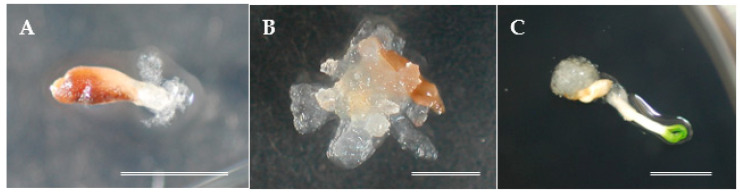
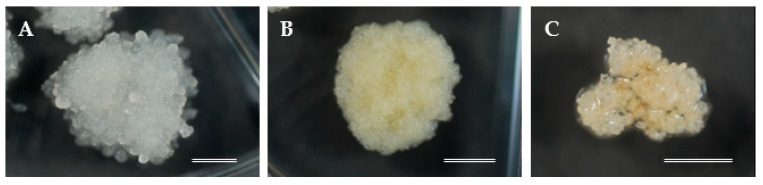
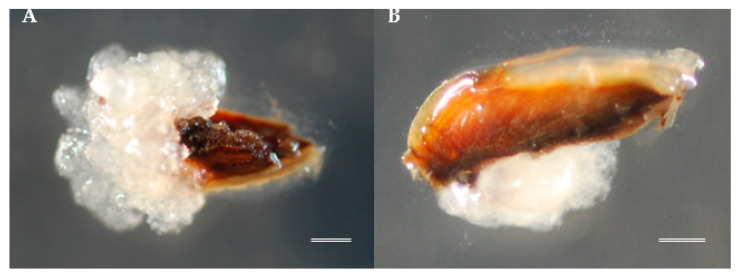
This study aimed to obtain information from several embryogenic cell (EC) genotypes analyzing the factors that affect somatic embryogenesis (SE) initiation in sugi ( Cupressaceae) to apply them in the improvement of protocols for efficient induction of embryogenic cell lines (ECLs). The results of several years of experiments including studies on the influence of initial explant, seed collection time, and explant genotype as the main factors affecting SE initiation from male-fertile, male-sterile, and polycross-pollinated-derived seeds are described. Initiation frequencies depending on the plant genotype varied from 1.35 to 57.06%. The best induction efficiency was achieved when seeds were collected on mid-July using the entire megagametophyte as initial explants. The extrusion of ECs started approximately after 2 weeks of culture, and the establishment of ECLs was observed mostly 4 weeks after extrusion on media with or without plant growth regulators (PGRs). Subsequently, induced ECLs were maintained and proliferated on media with PGRs by 2-3-week-interval subculture routines. Although, the initial explant, collection time, and culture condition played important roles in ECL induction, the genotype of the plant material of sugi was the most influential factor in SE initiation.
本研究旨在通过分析影响日本柳杉(柏科)体细胞胚胎发生(SE)起始的因素,从几种胚性细胞(EC)基因型中获取信息,以便将其应用于改进高效诱导胚性细胞系(ECL)的方案。描述了多年实验的结果,包括对初始外植体、种子采集时间和外植体基因型等作为影响来自雄性可育、雄性不育和多交授粉种子的SE起始的主要因素的研究。取决于植物基因型的起始频率在1.35%至57.06%之间变化。当在7月中旬采集种子并使用整个雌配子体作为初始外植体时,可实现最佳诱导效率。EC的挤出大约在培养2周后开始,并且在挤出后4周左右,在添加或不添加植物生长调节剂(PGR)的培养基上观察到ECL的建立。随后,通过每2 - 3周间隔的继代培养程序,在含有PGR的培养基上维持和增殖诱导的ECL。虽然初始外植体、采集时间和培养条件在ECL诱导中起重要作用,但日本柳杉植物材料的基因型是SE起始中最有影响的因素。