Maruyama Tsuyoshi E, Ueno Saneyoshi, Mori Hideki, Kaneeda Takumi, Moriguchi Yoshinari
Department of Research Planning and Coordination, Forestry and Forest Products Research Institute, Matsunosato 1, Tsukuba 305-8687, Japan.
Department of Forest Molecular Genetics and Biotechnology, Forestry and Forest Products Research Institute, Matsunosato 1, Tsukuba 305-8687, Japan.
Plants (Basel). 2021 Apr 26;10(5):874. doi: 10.3390/plants10050874.
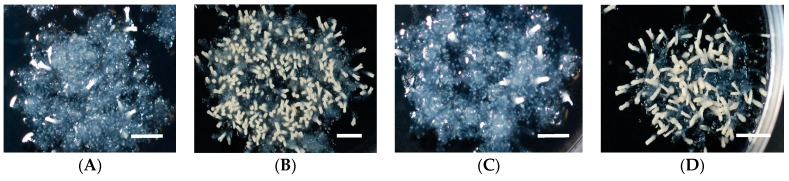
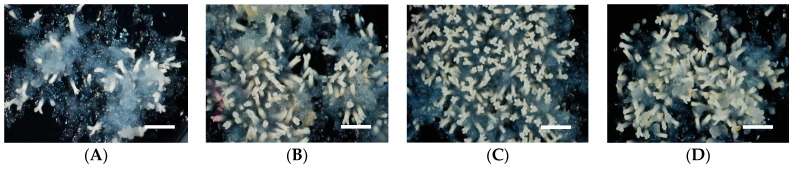
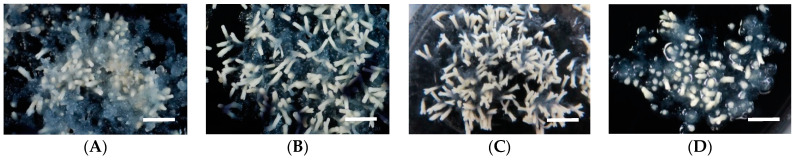
This paper presents the results of several experiments identifying basal salts (BS) contained in maturation medium, polyethylene glycol (PEG) concentration, abscisic acid (ABA) concentration, additional supplementation with potassium chloride (KCl), amino acid (AA) concentration, and proliferation culture medium (PCM) as the main culture factors affecting somatic embryo maturation in sugi (Japanese cedar, Cupressaceae). Highly efficient embryo maturation was achieved when embryogenic cell lines (ECLs) were cultured on media supplemented with a combination of PEG, ABA, and AAs. More than 1000 embryos per gram of fresh weight (FW) can be produced on EM maturation medium supplemented with 175 g L PEG, 100 µM ABA, 2 g L glutamine, 1 g L asparagine, and 0.5 g L arginine.
本文介绍了几项实验的结果,这些实验确定了成熟培养基中所含的基础盐(BS)、聚乙二醇(PEG)浓度、脱落酸(ABA)浓度、氯化钾(KCl)的额外添加、氨基酸(AA)浓度以及增殖培养基(PCM)是影响日本柳杉(柏科)体细胞胚胎成熟的主要培养因素。当胚性细胞系(ECL)在添加了PEG、ABA和AA组合的培养基上培养时,可实现高效的胚胎成熟。在添加175 g/L PEG、100 µM ABA、2 g/L谷氨酰胺、1 g/L天冬酰胺和0.5 g/L精氨酸的EM成熟培养基上,每克鲜重(FW)可产生1000多个胚胎。