Sonoda Shiro, Kuramochi Jin, Matsuyama Yusuke, Miyazaki Yasunari, Fujiwara Takeo
Kuramochi Clinic Interpark, Utsunomiya, Tochigi 321-0114, Japan.
Department of Global Health Promotion, Tokyo Medical and Dental University, Tokyo 113-8519, Japan.
J Clin Med. 2021 Feb 19;10(4):854. doi: 10.3390/jcm10040854.
Coronavirus disease 2019 (COVID-19) has spread worldwide, including Japan. However, little is known about the clinical symptoms which discriminate between COVID-19 and non-COVID-19 among outpatients in general practitioner clinics, which is important for efficient case detection. The aim of this study was to investigate the clinical symptoms to discriminate between COVID-19 and non-COVID-19 cases among outpatients in general practitioner clinics during the second wave of the COVID-19 pandemic in Japan in August 2020.
The records of 360 patients who visited a clinic with suspicion of infectious disease and underwent COVID-19 PCR test between 1 and 14 August 2020 were used. The patients filled out a questionnaire on possible clinical symptoms and transmission routes. Multivariate logistic regression was used to investigate the association between clinical symptoms and COVID-19 status.
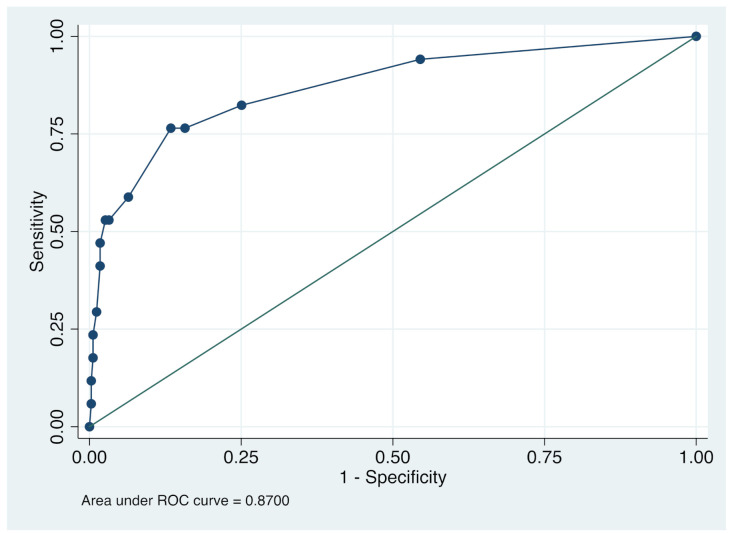
COVID-19-positive patients were 17 (4.7%). Multiple logistic regression analyses showed that anosmia (odds ratio (OR), 25.94 95% confidence interval (CI), 7.15-94.14; < 0.001), headache (OR, 3.31 95% confidence interval (CI), 0.98-11.20; = 0.054), sputum production (OR, 3.32 CI, 1.01-10.90; = 0.048) and history of visiting an izakaya or bar (OR, 4.23 CI, 0.99-18.03; = 0.051) were marginally significantly associated withbeing COVID-19 positive. This model showed moderate predictive power (area under receiver operating characteristic curve = 0.870 CI, 0.761 to 0.971).
We found that anosmia, headache, sputum production, history of visiting an izakaya or bar were associated with COVID-19, which can be used to detect patients with COVID-19 in out-patient clinics in Japan. The findings of this study need to be verified in other clinics and hospitals in Japan and other countries with universal healthcare coverages.
2019冠状病毒病(COVID-19)已在全球范围内传播,包括日本。然而,在全科诊所的门诊患者中,对于区分COVID-19和非COVID-19的临床症状知之甚少,而这对于高效病例检测很重要。本研究的目的是调查2020年8月日本COVID-19大流行第二波期间,全科诊所门诊患者中区分COVID-19和非COVID-19病例的临床症状。
使用了2020年8月1日至14日期间因怀疑感染疾病就诊并接受COVID-19 PCR检测的360例患者的记录。患者填写了一份关于可能的临床症状和传播途径的问卷。采用多因素逻辑回归分析临床症状与COVID-19状态之间的关联。
COVID-19阳性患者有17例(4.7%)。多因素逻辑回归分析显示,嗅觉丧失(优势比(OR),25.94;95%置信区间(CI),7.15 - 94.14;P < 0.001)、头痛(OR,3.31;95%置信区间(CI),0.98 - 11.20;P = 0.054)、咳痰(OR,3.32;CI,1.01 - 10.90;P = 0.048)以及去过居酒屋或酒吧的经历(OR,4.23;CI,0.99 - 18.03;P = 0.051)与COVID-19呈边缘显著相关。该模型显示出中等预测能力(受试者工作特征曲线下面积 = 0.870;CI,0.761至0.971)。
我们发现嗅觉丧失、头痛、咳痰、去过居酒屋或酒吧的经历与COVID-19相关,可用于在日本的门诊诊所检测COVID-19患者。本研究结果需要在日本其他诊所和医院以及其他有全民医保覆盖的国家进行验证。