ARC Industrial Transformation Training Centre for Uniquely Australian Foods, Queensland Alliance for Agriculture and Food Innovation, The University of Queensland, 39 Kessels Rd, Coopers Plains, Brisbane, QLD 4108, Australia.
Centre for Nutrition and Food Sciences, Queensland Alliance for Agriculture and Food Innovation, The University of Queensland, St. Lucia, Brisbane, QLD 4072, Australia.
Sensors (Basel). 2021 Feb 18;21(4):1413. doi: 10.3390/s21041413.
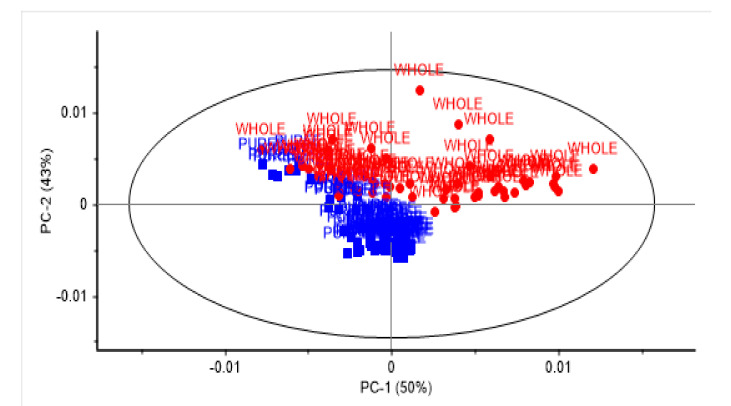
Kakadu plum (KP; Exell, Combretaceae) is an emergent indigenous fruit originating from Northern Australia, with valuable health and nutritional characteristics and properties (e.g., high levels of vitamin C and ellagic acid). In recent years, the utilization of handheld NIR instruments has allowed for the in situ quantification of a wide range of bioactive compounds in fruit and vegetables. The objective of this study was to evaluate the ability of a handheld NIR spectrophotometer to measure vitamin C and ellagic acid in wild harvested KP fruit samples. Whole and pureed fruit samples were collected from two locations in the Kimberley region (Western Australia, Australia) and were analysed using both reference and NIR methods. The standard error in cross validation (SECV) and the residual predictive deviation (RPD) values were 1.81% dry matter (DM) with an RPD of 2.1, and 3.8 mg g DM with an RPD of 1.9 for the prediction of vitamin C and ellagic acid, respectively, in whole KP fruit. The SECV and RPD values were 1.73% DM with an RPD of 2.2, and 5.6 mg g DM with an RPD of 1.3 for the prediction of vitamin C and ellagic acid, respectively, in powdered KP samples. The results of this study demonstrated the ability of a handheld NIR instrument to predict vitamin C and ellagic acid in whole and pureed KP fruit samples. Although the RPD values obtained were not considered adequate to quantify these bioactive compounds (e.g., analytical quantification), this technique can be used as a rapid tool to screen vitamin C in KP fruit samples for high and low quality vitamin C.
卡卡杜李(KP;Exell,山龙眼科)是一种源自澳大利亚北部的新兴土著水果,具有宝贵的健康和营养特性和性质(例如,高维生素 C 和鞣花酸水平)。近年来,手持式近红外仪器的应用使得能够原位定量测定水果和蔬菜中的多种生物活性化合物。本研究的目的是评估手持式近红外分光光度计测量野生采集的 KP 果实样品中维生素 C 和鞣花酸的能力。从西澳大利亚金伯利地区的两个地点采集了整个和泥状的果实样品,并使用参考和近红外方法进行了分析。维生素 C 和鞣花酸的验证集标准误差(SECV)和剩余预测偏差(RPD)值分别为 1.81%干物质(DM)和 2.1,3.8mg g DM 和 1.9,分别用于预测整个 KP 果实中的维生素 C 和鞣花酸。对于预测 KP 粉末中的维生素 C 和鞣花酸,SECV 和 RPD 值分别为 1.73%DM 和 2.2,5.6mg g DM 和 1.3。本研究的结果表明,手持式近红外仪器能够预测整个和泥状 KP 果实样品中的维生素 C 和鞣花酸。尽管获得的 RPD 值不足以定量这些生物活性化合物(例如,分析定量),但该技术可用作快速工具,用于筛选 KP 果实样品中的维生素 C,以确定维生素 C 的高低质量。