Guérin Alizée, Bridier Arnaud, Le Grandois Patricia, Sévellec Yann, Palma Federica, Félix Benjamin, Roussel Sophie, Soumet Christophe
Fougères Laboratory, Antibiotics, Biocides, Residues and Resistance Unit, French Agency for Food, Environmental and Occupational Health (ANSES), 35133 Fougères, France.
Maisons-Alfort Laboratory of Food Safety, University Paris-Est, French Agency for Food, Environmental and Occupational Health (ANSES), 94700 Maisons-Alfort, France.
Pathogens. 2021 Feb 18;10(2):220. doi: 10.3390/pathogens10020220.
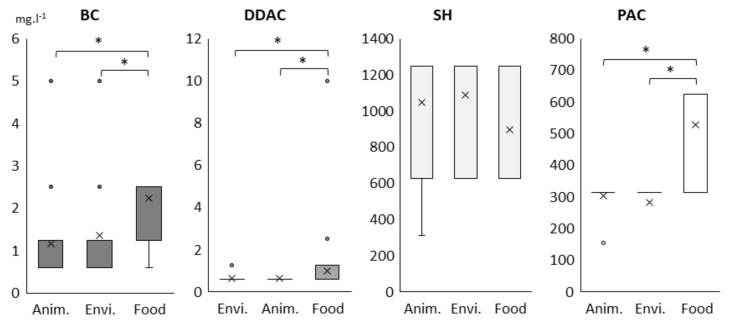
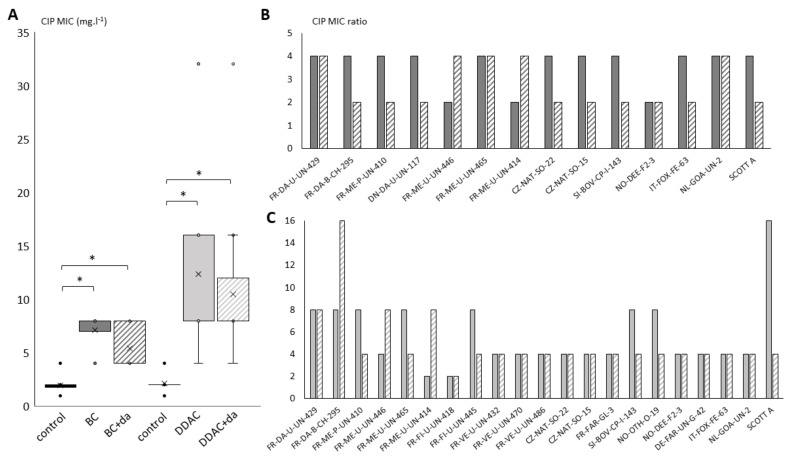
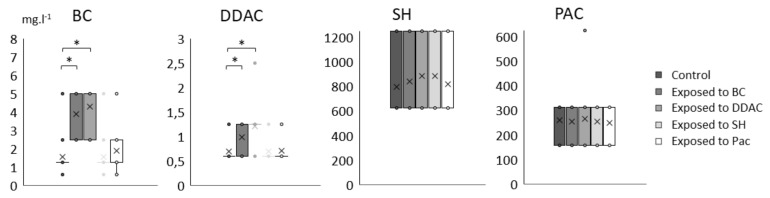
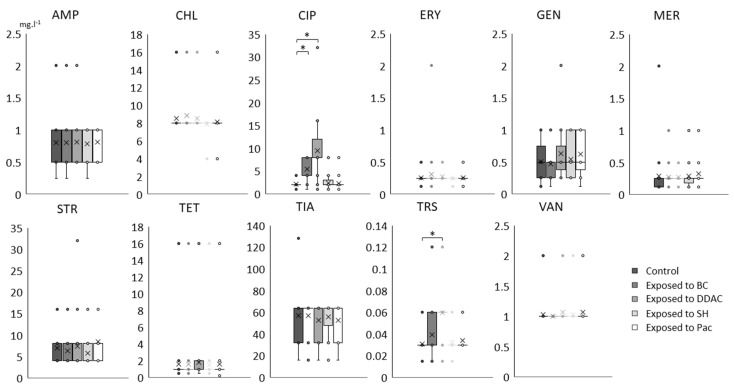
In this contribution, the antimicrobial susceptibility toward 11 antibiotics and four biocides of a panel of 205 Listeria monocytogenes (Lm) strains isolated from different ecological niches (i.e., food, animals and natural environment) was evaluated. The impact of exposure to biocides on the antibiotic susceptibilities of Lm was also investigated. Lm strains isolated from food exhibited overall a lower susceptibility (higher minimal inhibitory concentrations, MIC) for ammonium quaternary compounds (QACs) and peracetic acid (PAC) than strains isolated from animals and natural environments. Conversely, the ecological origins of Lm strains did not significantly affect their susceptibilities towards antibiotics. Interestingly, repeated exposure to QACs recurrently led to a decrease in susceptibility toward ciprofloxacin (CIP), a fluoroquinolone antibiotic, largely used in human medicine. Moreover, these lower levels of susceptibility to CIP remained stable in most Lm strains even after subcultures without biocide selection pressure, suggesting an adaptation involving modifications at the genetic level. Results underlined the ability of Lm to adapt to biocides, especially QACs, and the potential link between this adaptation and the selection of resistance toward critical antibiotics such as ciprofloxacin. These data support a potential role of the extensive use of QACs from "farm to fork" in the selection of biocide and antibiotic resistance in pathogenic bacteria such as Lm.
在本研究中,评估了从不同生态位(即食品、动物和自然环境)分离出的205株单核细胞增生李斯特菌(Lm)对11种抗生素和4种杀菌剂的抗菌敏感性。还研究了接触杀菌剂对Lm抗生素敏感性的影响。从食品中分离出的Lm菌株对季铵化合物(QACs)和过氧乙酸(PAC)的总体敏感性(最低抑菌浓度,MIC)低于从动物和自然环境中分离出的菌株。相反,Lm菌株的生态来源对其对抗生素的敏感性没有显著影响。有趣的是,反复接触QACs会导致对环丙沙星(CIP)(一种广泛用于人类医学的氟喹诺酮类抗生素)的敏感性反复降低。此外,即使在没有杀菌剂选择压力的继代培养后,大多数Lm菌株对CIP的低敏感性水平仍保持稳定,这表明涉及基因水平修饰的适应性变化。结果强调了Lm适应杀菌剂尤其是QACs的能力,以及这种适应与对环丙沙星等关键抗生素耐药性选择之间的潜在联系。这些数据支持了从“农场到餐桌”广泛使用QACs在诸如Lm等病原菌中选择杀菌剂和抗生素耐药性方面的潜在作用。