Schuurman Teska, Zilver Sanne, Samuels Sanne, Schats Winnie, Amant Frédéric, van Trommel Nienke, Lok Christianne
Department of Gynecologic Oncology, Netherlands Cancer Institute, Antoni van Leeuwenhoek, 1066 CX Amsterdam, The Netherlands.
Department of Gynecology, Amsterdam University Medical Center, 1105 AZ Amsterdam, The Netherlands.
Cancers (Basel). 2021 Feb 28;13(5):1008. doi: 10.3390/cancers13051008.
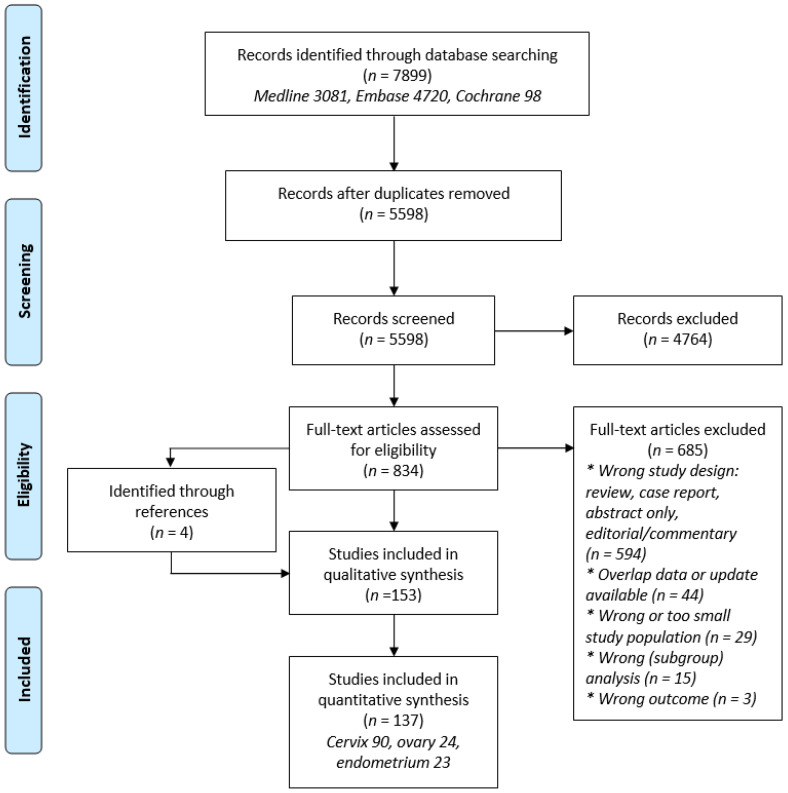
Fertility-sparing surgery (FSS) is increasingly being offered to women with a gynecological malignancy who wish to preserve fertility. In this systematic review, we evaluate the best evidence currently available on oncological and reproductive outcome after FSS for early stage cervical cancer, epithelial ovarian cancer, and endometrial cancer. An extensive literature search was conducted using the electronic databases Medline (OVID), Embase, and Cochrane Library to identify eligible studies published up to December 2020. In total, 153 studies were included with 7544, 3944, and 1229 patients who underwent FSS for cervical, ovarian, and endometrial cancer, respectively. We assessed the different FSS techniques that are available to preserve fertility, i.e., omitting removal of the uterine body and preserving at least one ovary. Overall, recurrence rates after FSS are reassuring and therefore, these conservative procedures seem oncologically safe in the current selection of patients with low-stage and low-grade disease. However, generalized conclusions should be made with caution due to the methodology of available studies, i.e., mostly retrospective cohort studies with a heterogeneous patient population, inducing selection bias. Moreover, about half of patients do not pursue pregnancy despite FSS and the reasons for these decisions have not yet been well studied. International collaboration will facilitate the collection of solid evidence on FSS and the related decision-making process to optimize patient selection and counseling.
对于希望保留生育能力的妇科恶性肿瘤女性,越来越多地提供保留生育功能手术(FSS)。在这项系统评价中,我们评估了目前关于早期宫颈癌、上皮性卵巢癌和子宫内膜癌FSS后肿瘤学和生殖结局的最佳证据。使用电子数据库Medline(OVID)、Embase和Cochrane图书馆进行了广泛的文献检索,以识别截至2020年12月发表的符合条件的研究。总共纳入了153项研究,分别有7544例、3944例和1229例接受宫颈癌、卵巢癌和子宫内膜癌FSS的患者。我们评估了可用于保留生育能力的不同FSS技术,即省略子宫体切除并保留至少一个卵巢。总体而言,FSS后的复发率令人放心,因此,在目前选择的低分期和低级别疾病患者中,这些保守手术在肿瘤学上似乎是安全的。然而,由于现有研究的方法,即大多是回顾性队列研究且患者群体异质性大,会导致选择偏倚,所以应谨慎得出一般性结论。此外,尽管进行了FSS,但约有一半的患者没有追求怀孕,这些决定的原因尚未得到充分研究。国际合作将有助于收集关于FSS及相关决策过程的确凿证据,以优化患者选择和咨询。