Department of Oncology-Pathology, Karolinska Institutet, Stockholm, Sweden.
Department of Gynecology, Division of Gynecology and Reproduction, Karolinska University Hospital, Stockholm, Sweden.
BMC Cancer. 2020 Oct 19;20(1):1009. doi: 10.1186/s12885-020-07511-y.
Epithelial ovarian cancer (EOC) is rare in women of reproductive age and fertility-sparing surgery (FSS) may be applied in early stages. The purpose of this study was to investigate the safety and efficacy of FSS for treatment of EOC.
The Swedish nationwide population-based Quality Register for Gynecological Cancer was used to identify all women 18-40 years of age diagnosed with stage I EOC between 2008 and 2015. Detailed data on surgery, staging, histopathology, and follow-up were extracted and reviewed. Cross-linking of individuals to population-based registries allowed retrieval of data on obstetrical and reproductive outcomes after FSS. Disease-free survival (DFS) and overall survival (OS) rates were compared (Kaplan-Meier method) between women who underwent FSS vs. radical surgery (RS).
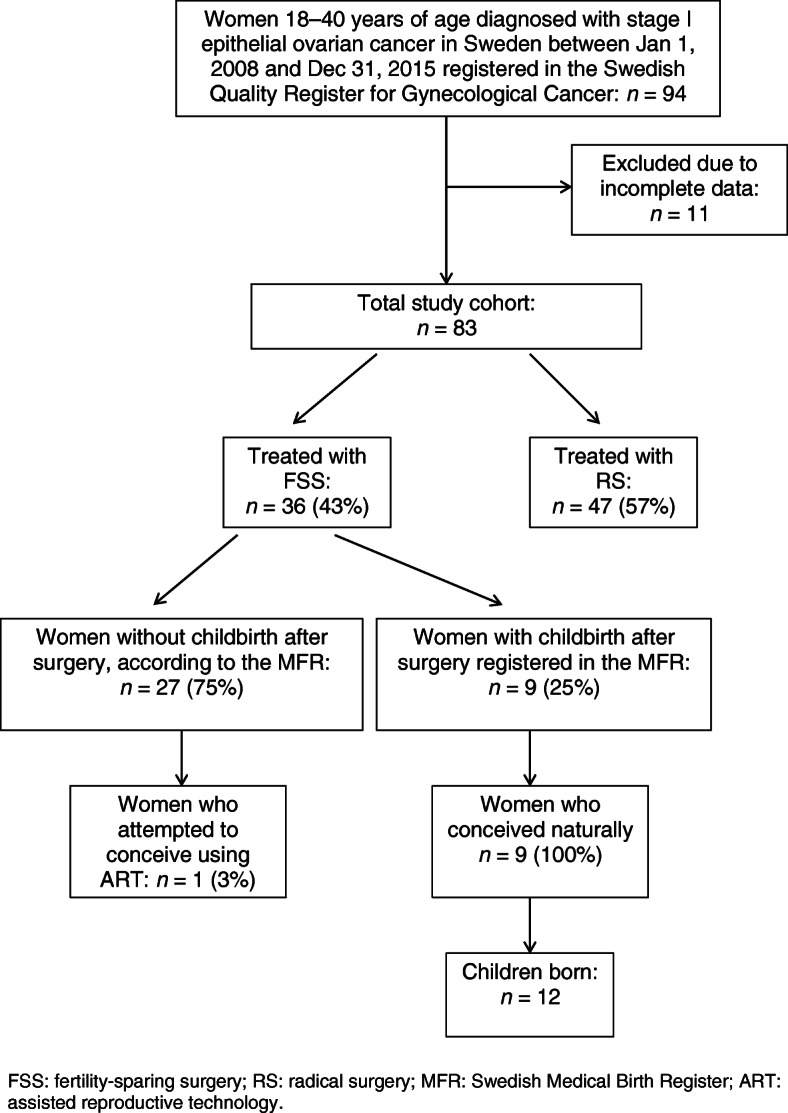
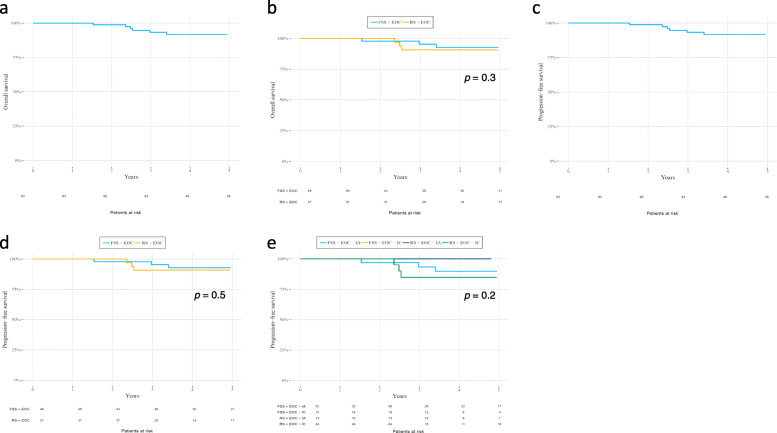
In total 83 women were identified; 36 who had FSS performed and 47 RS. The 5-year OS rate was 92% and no statistical differences between DFS or OS were found between women treated by FSS or RS. The recurrence rate after RS was 13% compared to 6% after FSS. Recurrences were more frequently found in women with stage IC tumor or with histologic subtypes with more aggressive behavior. In the FSS cohort, nine women gave birth to 12 healthy children, all delivered at fullterm. Only one women had received assisted reproductive technology treatment.
In this nationwide population-based cohort study natural fertility was maintained after FSS. Specific histologic subtypes showed greater prognostic impact on the oncological outcome than the use of FSS. Recurrences occurred after FSS, but none in the uterus, which questions the need of hysterectomy in young women with EOC.
This article reports the results of a healthcare intervention using the data prospectively registered in the Swedish population-based registries including the Quality Register for Gynecological Cancer, the National Death Register, the Swedish Medical Birth Register, and the National Quality Register for Assisted Reproduction.
上皮性卵巢癌(EOC)在育龄妇女中罕见,生育保存手术(FSS)可适用于早期阶段。本研究旨在探讨 FSS 治疗 EOC 的安全性和有效性。
利用瑞典全国基于人群的妇科癌症质量登记处,确定了 2008 年至 2015 年间所有诊断为 I 期 EOC 的 18-40 岁女性。提取并回顾了手术、分期、组织病理学和随访的详细数据。个体与基于人群的登记处的交联允许检索 FSS 后产科和生殖结局的数据。比较了接受 FSS 与根治性手术(RS)的女性的无病生存(DFS)和总生存(OS)率(Kaplan-Meier 法)。
共确定了 83 名女性;36 名接受 FSS 治疗,47 名接受 RS 治疗。5 年 OS 率为 92%,DFS 或 OS 无统计学差异。RS 后复发率为 13%,而 FSS 后为 6%。复发更常见于 IC 期肿瘤或具有侵袭性行为的组织学亚型的女性。在 FSS 组中,9 名妇女生育了 12 名健康儿童,均足月分娩。只有 1 名妇女接受了辅助生殖技术治疗。
在这项全国性基于人群的队列研究中,FSS 后自然生育得以维持。特定的组织学亚型对肿瘤学结果的预后影响大于 FSS 的应用。FSS 后发生了复发,但均未发生在子宫内,这质疑了年轻的 EOC 女性是否需要进行子宫切除术。
本文报告了使用前瞻性注册在瑞典基于人群的登记处(包括妇科癌症质量登记处、国家死亡登记处、瑞典医疗出生登记处和辅助生殖质量登记处)的数据进行的医疗干预的结果。