De Luca Ciro, Gori Sara, Mazzucchi Sonia, Dini Elisa, Cafalli Martina, Siciliano Gabriele, Papa Michele, Baldacci Filippo
Laboratory of Morphology of Neuronal Network, Department of Public Medicine, University of Campania "Luigi Vanvitelli", 80138 Napoli, Italy.
Neurology Unit, Department of Clinical and Experimental Medicine, University of Pisa, 56126 Pisa, Italy.
J Clin Med. 2021 Feb 15;10(4):769. doi: 10.3390/jcm10040769.
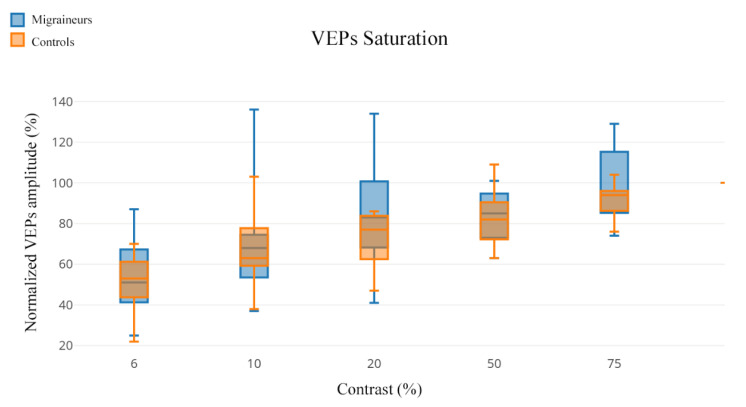
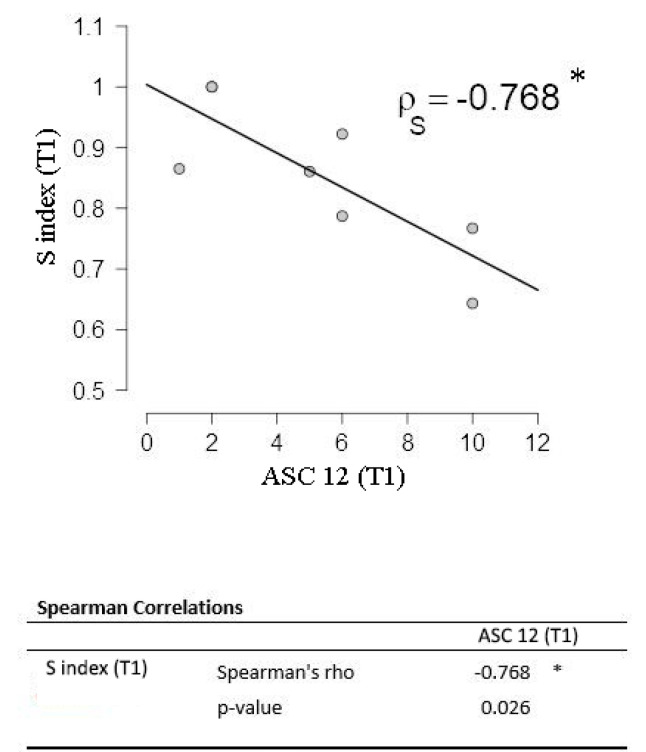
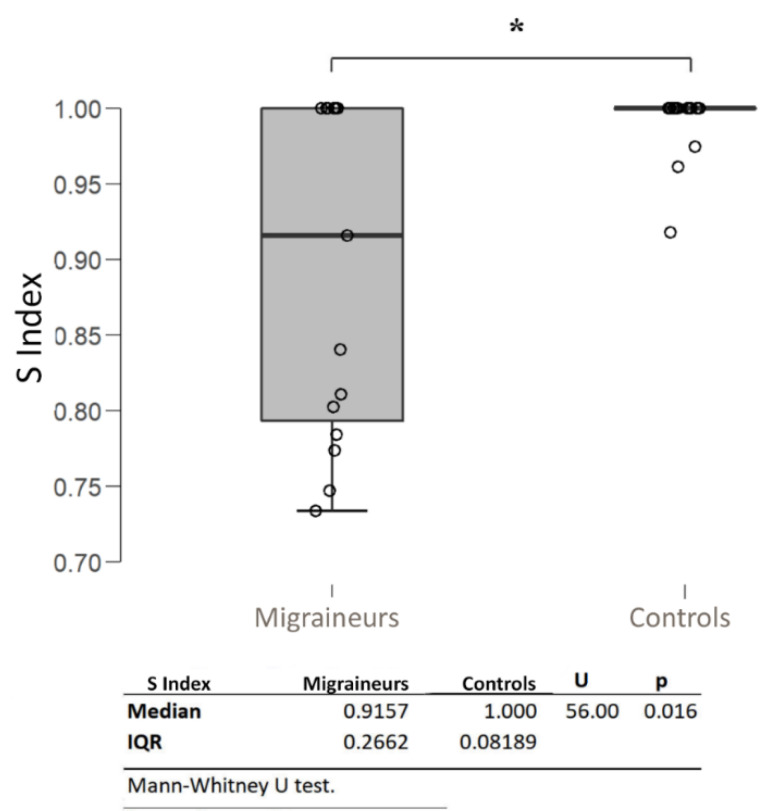
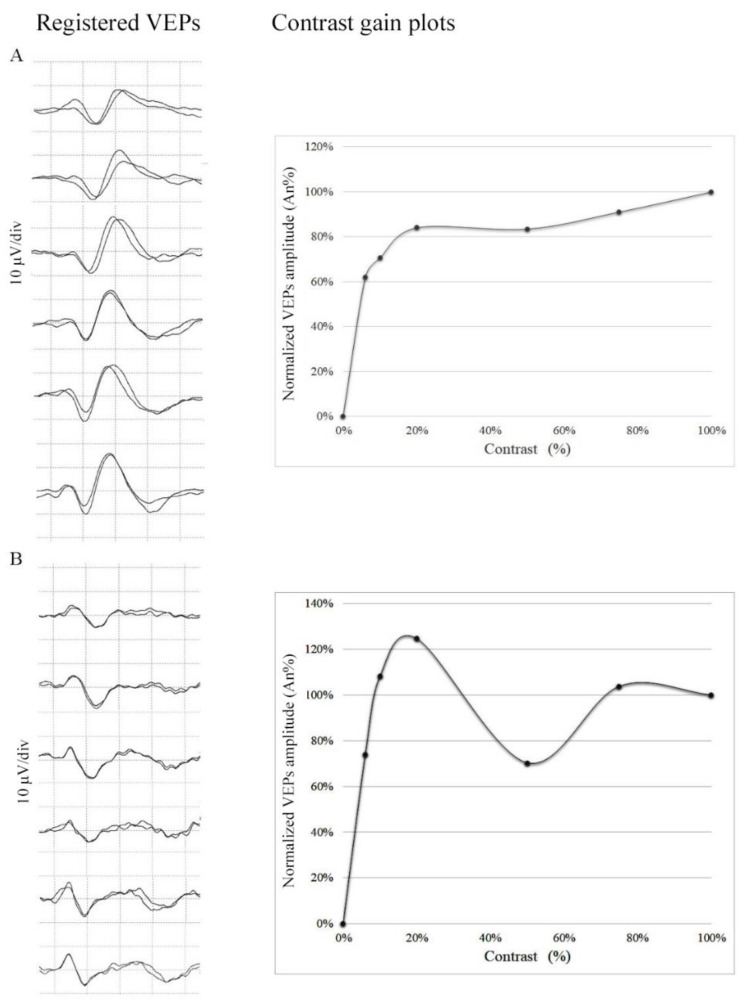
Migraine is a primary headache with high prevalence among the general population, characterized by functional hypersensitivity to both exogenous and endogenous stimuli particularly affecting the nociceptive system. The hyperresponsivity of cortical neurons could be due to a disequilibrium in the excitatory/inhibitory signaling. This study aimed to investigate the anatomo-functional pathway from the retina to the primary visual cortex using visual evoked potentials (VEP). Contrast gain protocol was used in 15 patients diagnosed with migraine without aura (at baseline and after 3 months of topiramate therapy) and 13 controls. A saturation (S) index was assessed to monitor the response of VEP's amplitude to contrast gain. Non-linear nor monotone growth of VEP (S < 0.95) was defined as supersaturation. A greater percentage of migraine patients (53%) relative to controls (7%) showed this characteristic. A strong inverse correlation was found between the S index and the number of days separating the registration of VEP from the next migraine attack. Moreover, allodynia measured through the Allodynia Symptoms Check-list (ASC-12) correlates with the S index both at baseline and after 3 months of topiramate treatment. Other clinical characteristics were not related to supersaturation. Topiramate therapy, although effective, did not influence electrophysiological parameters suggesting a non-intracortical nor retinal origin of the supersaturation (with possible involvement of relay cells from the lateral geniculate nucleus). In conclusion, the elaboration of visual stimuli and visual cortex activity is different in migraine patients compared to controls. More data are necessary to confirm the potential use of the S index as a biomarker for the migraine cycle (association with the pain-phase) and cortical sensitization (allodynia).
偏头痛是一种在普通人群中患病率较高的原发性头痛,其特征是对外源性和内源性刺激具有功能性超敏反应,尤其影响伤害感受系统。皮质神经元的高反应性可能是由于兴奋性/抑制性信号失衡所致。本研究旨在使用视觉诱发电位(VEP)研究从视网膜到初级视觉皮层的解剖功能通路。对比增益方案用于15例诊断为无先兆偏头痛的患者(基线时和托吡酯治疗3个月后)和13名对照。评估饱和度(S)指数以监测VEP振幅对对比增益的反应。VEP的非线性和非单调增长(S < 0.95)被定义为过饱和。与对照组(7%)相比,偏头痛患者中有更大比例(53%)表现出这一特征。发现S指数与记录VEP到下一次偏头痛发作之间间隔的天数呈强烈负相关。此外,通过异常性疼痛症状检查表(ASC-12)测量的异常性疼痛在基线时和托吡酯治疗3个月后均与S指数相关。其他临床特征与过饱和无关。托吡酯治疗虽然有效,但并未影响电生理参数,提示过饱和并非起源于皮质内或视网膜(可能涉及外侧膝状体的中继细胞)。总之,与对照组相比,偏头痛患者对视觉刺激的处理和视觉皮层活动有所不同。需要更多数据来证实S指数作为偏头痛周期(与疼痛期的关联)和皮质致敏(异常性疼痛)生物标志物的潜在用途。