Aldewachi Hasan, Al-Zidan Radhwan N, Conner Matthew T, Salman Mootaz M
Biomolecular Sciences Research Centre, Sheffield Hallam University, Sheffield S1 1WB, UK.
College of Pharmacy, Nineveh University, Mosul 41002, Iraq.
Bioengineering (Basel). 2021 Feb 23;8(2):30. doi: 10.3390/bioengineering8020030.
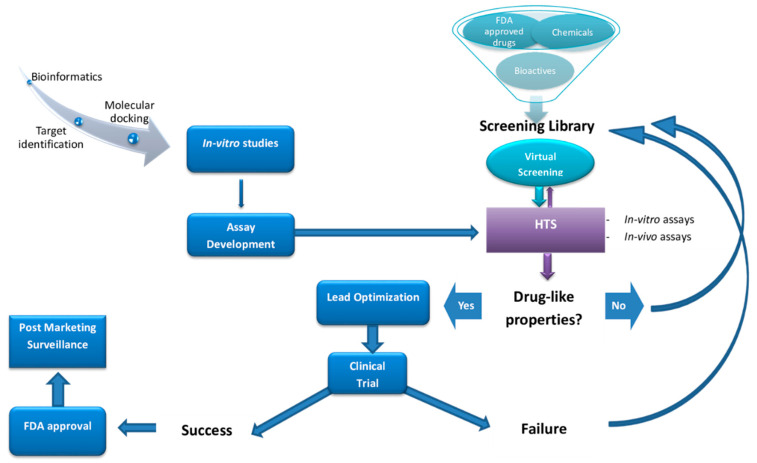
Neurodegenerative diseases (NDDs) are incurable and debilitating conditions that result in progressive degeneration and/or death of nerve cells in the central nervous system (CNS). Identification of viable therapeutic targets and new treatments for CNS disorders and in particular, for NDDs is a major challenge in the field of drug discovery. These difficulties can be attributed to the diversity of cells involved, extreme complexity of the neural circuits, the limited capacity for tissue regeneration, and our incomplete understanding of the underlying pathological processes. Drug discovery is a complex and multidisciplinary process. The screening attrition rate in current drug discovery protocols mean that only one viable drug may arise from millions of screened compounds resulting in the need to improve discovery technologies and protocols to address the multiple causes of attrition. This has identified the need to screen larger libraries where the use of efficient high-throughput screening (HTS) becomes key in the discovery process. HTS can investigate hundreds of thousands of compounds per day. However, if fewer compounds could be screened without compromising the probability of success, the cost and time would be largely reduced. To that end, recent advances in computer-aided design, in silico libraries, and molecular docking software combined with the upscaling of cell-based platforms have evolved to improve screening efficiency with higher predictability and clinical applicability. We review, here, the increasing role of HTS in contemporary drug discovery processes, in particular for NDDs, and evaluate the criteria underlying its successful application. We also discuss the requirement of HTS for novel NDD therapies and examine the major current challenges in validating new drug targets and developing new treatments for NDDs.
神经退行性疾病(NDDs)是无法治愈且使人衰弱的病症,会导致中枢神经系统(CNS)中的神经细胞进行性退化和/或死亡。确定针对中枢神经系统疾病,尤其是神经退行性疾病的可行治疗靶点和新疗法,是药物研发领域的一项重大挑战。这些困难可归因于所涉及细胞的多样性、神经回路的极度复杂性、组织再生能力有限以及我们对潜在病理过程的不完全理解。药物研发是一个复杂的多学科过程。当前药物研发方案中的筛选损耗率意味着,数百万种被筛选的化合物中可能只有一种可行药物,这就需要改进发现技术和方案以应对多种损耗原因。这明确了需要筛选更大的文库,其中高效高通量筛选(HTS)的使用成为发现过程中的关键。高通量筛选每天可研究数十万种化合物。然而,如果在不降低成功概率的情况下能筛选更少的化合物,成本和时间将大幅降低。为此,计算机辅助设计、虚拟文库和分子对接软件的最新进展,再加上基于细胞平台的扩大规模,已发展起来以提高筛选效率,并具有更高的可预测性和临床适用性。在此,我们综述高通量筛选在当代药物研发过程中,特别是对神经退行性疾病而言日益重要的作用,并评估其成功应用的基础标准。我们还讨论了高通量筛选对新型神经退行性疾病疗法的要求,并审视了当前在验证新药物靶点和开发神经退行性疾病新疗法方面的主要挑战。