Zijtregtop Eline A M, van der Strate Iris, Beishuizen Auke, Zwaan Christian M, Scheijde-Vermeulen Marijn A, Brandsma Arianne M, Meyer-Wentrup Friederike
Department of Pediatric Hematology and Oncology, Erasmus Medical Center-Sophia Children's Hospital, 3015 GD Rotterdam, The Netherlands.
Department of Pediatric Hemato-oncology, Princess Máxima Center for Pediatric Oncology, 3584 CS Utrecht, The Netherlands.
Cancers (Basel). 2021 Feb 20;13(4):884. doi: 10.3390/cancers13040884.
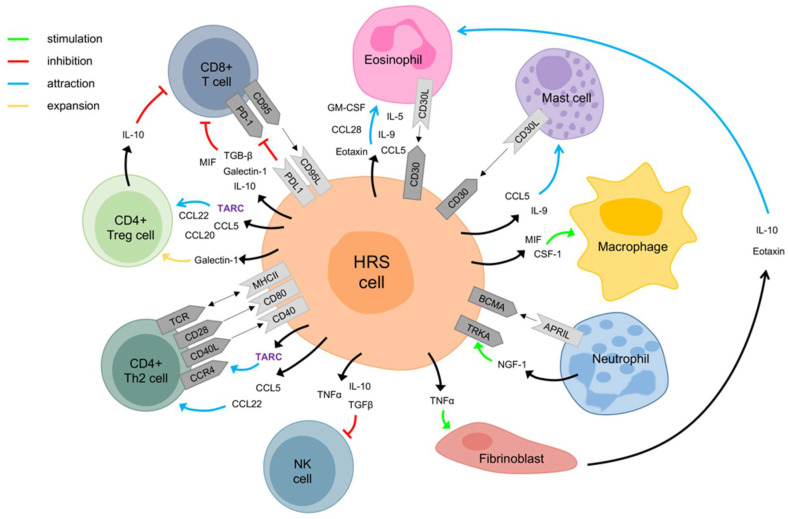
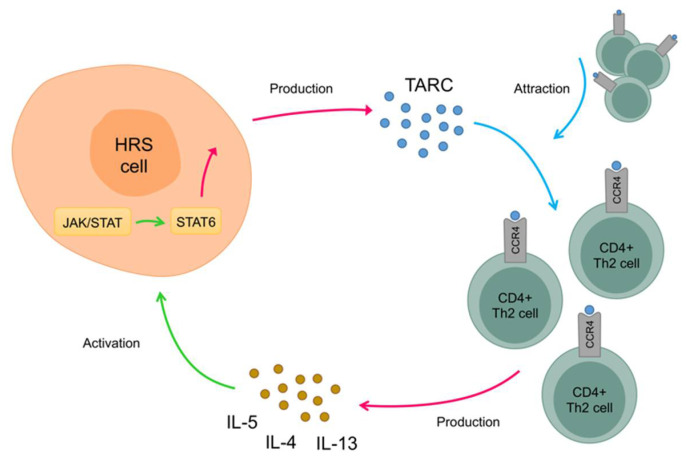
Thymus and activation-regulated chemokine (TARC) is produced by different cell types and is highly expressed in the thymus. It plays an important role in T cell development, trafficking and activation of mature T cells after binding to its receptor C-C chemokine receptor type 4 (CCR4) and consecutive signal transducer and activator of transcription 6 (STAT6) activation. Importantly, TARC is also produced by malignant Hodgkin and Reed-Sternberg (HRS) cells of classical Hodgkin lymphoma (cHL). In cHL, HRS cells survive and proliferate due to the micro-environment consisting primarily of type 2 T helper (Th2) cells. TARC-mediated signaling initiates a positive feedback loop that is crucial for the interaction between HRS and T cells. The clinical applicability of TARC is diverse. It is useful as diagnostic biomarker in both children and adults with cHL and in other Th2-driven diseases. In adult cHL patients, TARC is also a biomarker for treatment response and prognosis. Finally, blocking TARC signaling and thus inhibiting pathological Th2 cell recruitment could be a therapeutic strategy in cHL. In this review, we summarize the biological functions of TARC and focus on its role in cHL pathogenesis and as a biomarker for cHL and other diseases. We conclude by giving an outlook on putative therapeutic applications of antagonists and inhibitors of TARC-mediated signaling.
胸腺与激活调节趋化因子(TARC)由不同细胞类型产生,在胸腺中高度表达。它在T细胞发育、迁移以及成熟T细胞与受体C-C趋化因子受体4(CCR4)结合并激活转录信号转导子和激活子6(STAT6)后发挥重要作用。重要的是,经典霍奇金淋巴瘤(cHL)的恶性霍奇金和里德-斯腾伯格(HRS)细胞也能产生TARC。在cHL中,HRS细胞因主要由2型辅助性T(Th2)细胞组成的微环境而存活和增殖。TARC介导的信号传导启动了一个正反馈回路,这对HRS细胞与T细胞之间的相互作用至关重要。TARC在临床上具有多种应用。它在儿童和成人cHL以及其他Th2驱动的疾病中作为诊断生物标志物很有用。在成年cHL患者中,TARC也是治疗反应和预后的生物标志物。最后,阻断TARC信号传导从而抑制病理性Th2细胞募集可能是cHL的一种治疗策略。在本综述中,我们总结了TARC的生物学功能,并重点关注其在cHL发病机制中的作用以及作为cHL和其他疾病的生物标志物的作用。我们通过展望TARC介导信号传导的拮抗剂和抑制剂的潜在治疗应用来结束本文。