Kaprou Georgia D, Bergšpica Ieva, Alexa Elena A, Alvarez-Ordóñez Avelino, Prieto Miguel
Department of Food Hygiene and Technology, University of León, 24071 León, Spain.
Luxembourg Centre for Systems Biomedicine, University of Luxembourg, L-4367 Belvaux, Luxembourg.
Antibiotics (Basel). 2021 Feb 20;10(2):209. doi: 10.3390/antibiotics10020209.
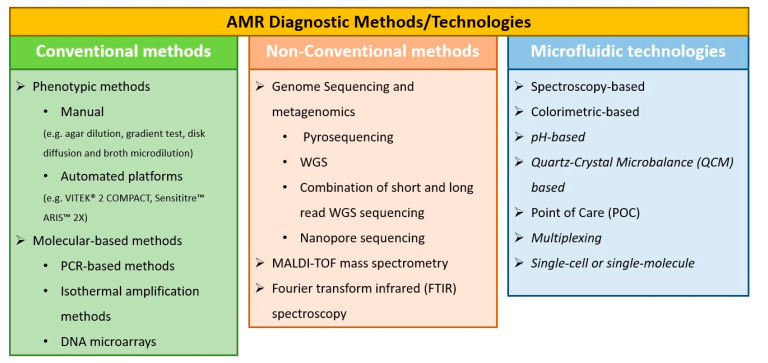
Antimicrobial resistance (AMR) is one of the most challenging threats in public health; thus, there is a growing demand for methods and technologies that enable rapid antimicrobial susceptibility testing (AST). The conventional methods and technologies addressing AMR diagnostics and AST employed in clinical microbiology are tedious, with high turnaround times (TAT), and are usually expensive. As a result, empirical antimicrobial therapies are prescribed leading to AMR spread, which in turn causes higher mortality rates and increased healthcare costs. This review describes the developments in current cutting-edge methods and technologies, organized by key enabling research domains, towards fighting the looming AMR menace by employing recent advances in AMR diagnostic tools. First, we summarize the conventional methods addressing AMR detection, surveillance, and AST. Thereafter, we examine more recent non-conventional methods and the advancements in each field, including whole genome sequencing (WGS), matrix-assisted laser desorption/ionization time-of-flight (MALDI-TOF) spectrometry, Fourier transform infrared (FTIR) spectroscopy, and microfluidics technology. Following, we provide examples of commercially available diagnostic platforms for AST. Finally, perspectives on the implementation of emerging concepts towards developing paradigm-changing technologies and methodologies for AMR diagnostics are discussed.
抗菌药物耐药性(AMR)是公共卫生领域最具挑战性的威胁之一;因此,对能够实现快速抗菌药物敏感性测试(AST)的方法和技术的需求日益增长。临床微生物学中用于AMR诊断和AST的传统方法和技术繁琐,周转时间(TAT)长,而且通常成本高昂。结果,只能开具经验性抗菌治疗处方,导致AMR传播,进而导致更高的死亡率和医疗成本增加。本综述介绍了当前前沿方法和技术的发展情况,这些方法和技术按关键 enabling 研究领域进行组织,旨在通过采用AMR诊断工具的最新进展来应对迫在眉睫的AMR威胁。首先,我们总结了用于AMR检测、监测和AST的传统方法。此后,我们研究了更新的非传统方法以及每个领域的进展,包括全基因组测序(WGS)、基质辅助激光解吸/电离飞行时间(MALDI-TOF)光谱法、傅里叶变换红外(FTIR)光谱法和微流控技术。接下来,我们提供了用于AST的商用诊断平台的示例。最后,讨论了关于实施新兴概念以开发用于AMR诊断的变革性技术和方法的观点。