Center of Molecular Medicine, Central European Institute of Technology, Masaryk University, Kamenice 5, 625 00 Brno, Czech Republic.
Department of Internal Medicine-Hematology and Oncology, University Hospital Brno and Faculty of Medicine, Masaryk University, Jihlavská 20, 625 00 Brno, Czech Republic.
Int J Mol Sci. 2021 Feb 27;22(5):2376. doi: 10.3390/ijms22052376.
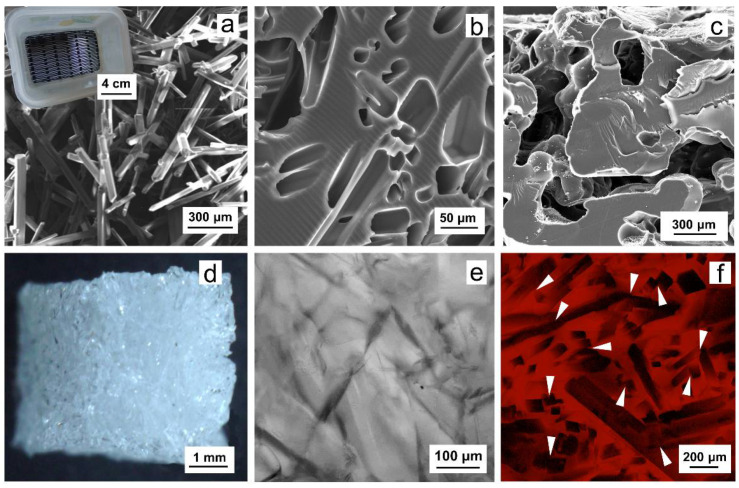
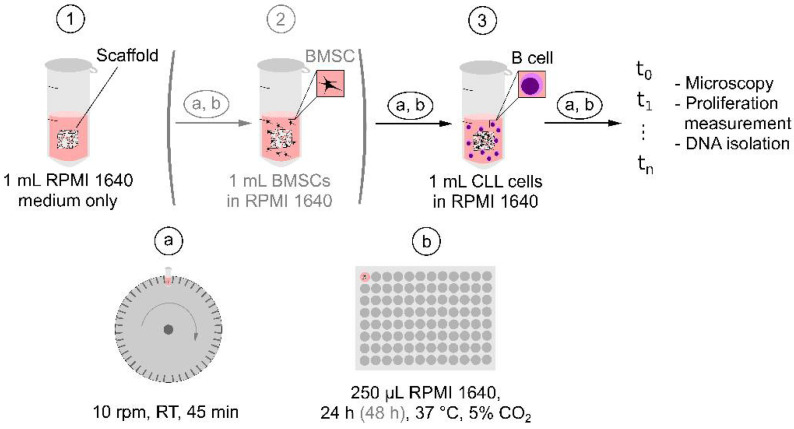
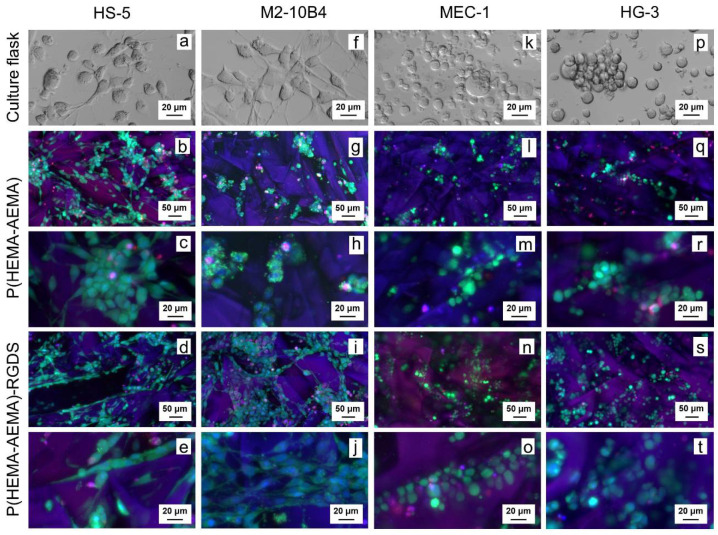
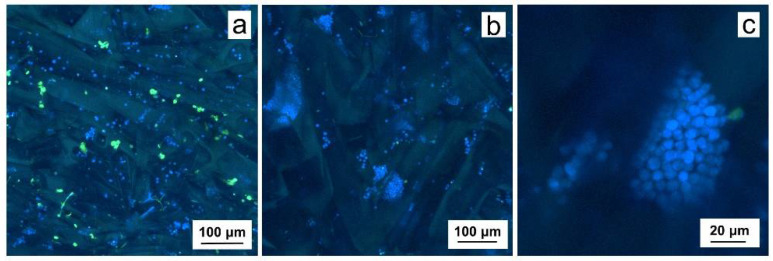
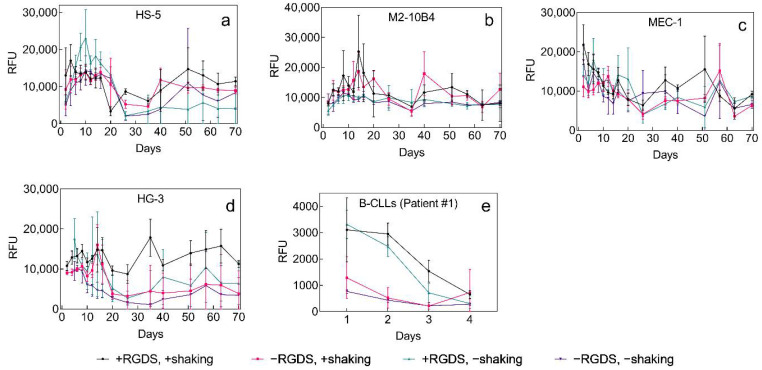
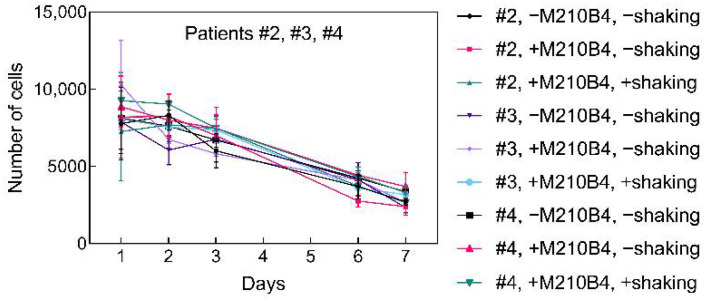
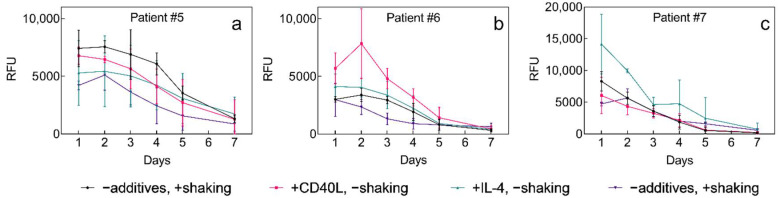
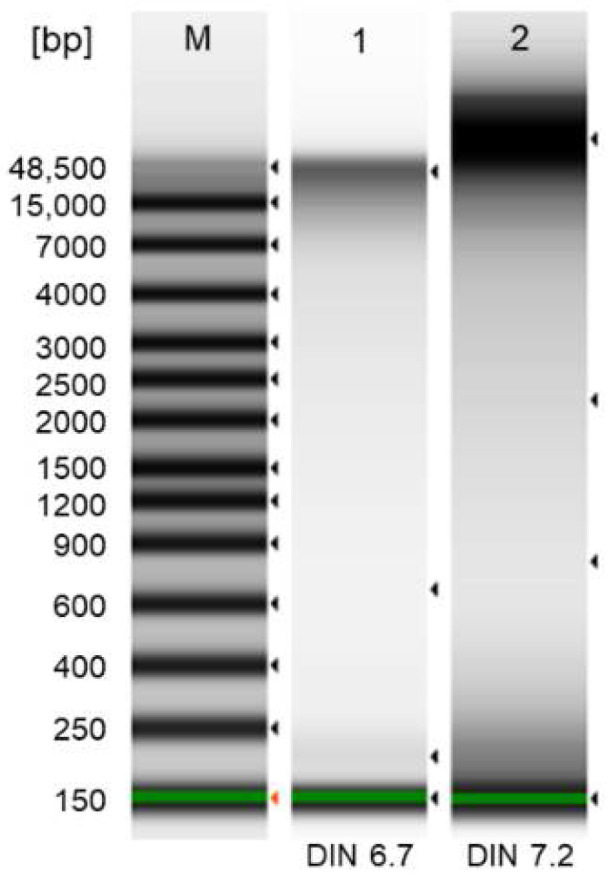
Superporous poly(2-hydroxyethyl methacrylate--2-aminoethyl methacrylate) (P(HEMA-AEMA)) hydrogel scaffolds are designed for in vitro 3D culturing of leukemic B cells. Hydrogel porosity, which influences cell functions and growth, is introduced by adding ammonium oxalate needle-like crystals in the polymerization mixture. To improve cell vitality, cell-adhesive Arg-Gly-Asp-Ser (RGDS) peptide is immobilized on the -(γ-maleimidobutyryloxy)succinimide-activated P(HEMA-AEMA) hydrogels via reaction of SH with maleimide groups. This modification is especially suitable for the survival of primary chronic lymphocytic leukemia cells (B-CLLs) in 3D cell culture. No other tested stimuli (interleukin-4, CD40 ligand, or shaking) can further improve B-CLL survival or metabolic activity. Both unmodified and RGDS-modified P(HEMA-AEMA) scaffolds serve as a long-term (70 days) 3D culture platforms for HS-5 and M2-10B4 bone marrow stromal cell lines and MEC-1 and HG-3 B-CLL cell lines, although the adherent cells retain their physiological morphologies, preferably on RGDS-modified hydrogels. Moreover, the porosity of hydrogels allows direct cell lysis, followed by efficient DNA isolation from the 3D-cultured cells. P(HEMA-AEMA)-RGDS thus serves as a suitable 3D in vitro leukemia model that enables molecular and metabolic assays and allows imaging of cell morphology, interactions, and migration by confocal microscopy. Such applications can prospectively assist in testing of drugs to treat this frequently recurring or refractory cancer.
超级多孔聚(2-羟乙基甲基丙烯酸酯-2-氨基乙基甲基丙烯酸酯)(P(HEMA-AEMA))水凝胶支架专为体外 3D 培养白血病 B 细胞而设计。凝胶的孔隙率通过在聚合混合物中添加草酸铵针状晶体来控制,这会影响细胞的功能和生长。为了提高细胞活力,通过 SH 与马来酰亚胺基团的反应,将细胞黏附肽 Arg-Gly-Asp-Ser(RGDS)固定在-(γ-马来酰亚胺基丁酰氧基)琥珀酰亚胺活化的 P(HEMA-AEMA)水凝胶上。这种修饰特别适合于原发性慢性淋巴细胞白血病细胞(B-CLL)在 3D 细胞培养中的存活。没有其他测试的刺激物(白细胞介素-4、CD40 配体或晃动)可以进一步提高 B-CLL 的存活率或代谢活性。未经修饰和 RGDS 修饰的 P(HEMA-AEMA)支架都可作为 HS-5 和 M2-10B4 骨髓基质细胞系和 MEC-1 和 HG-3 B-CLL 细胞系的长期(70 天)3D 培养平台,尽管附着细胞保留其生理形态,在 RGDS 修饰的水凝胶上更为明显。此外,水凝胶的孔隙率允许直接裂解细胞,随后从 3D 培养的细胞中有效分离 DNA。因此,P(HEMA-AEMA)-RGDS 可用作合适的 3D 体外白血病模型,可进行分子和代谢分析,并通过共聚焦显微镜对细胞形态、相互作用和迁移进行成像。这些应用有望有助于测试治疗这种频繁发生或难治性癌症的药物。