Cukurova University Faculty of Medicine Nuclear Medicine Department of Balcali Hospital and Clinics, Adana, Turkey.
Cukurova University AGENTEM (Adana Genetic Diseases Diagnosis and Treatment Center), Adana, Turkey.
BMC Cancer. 2021 Mar 6;21(1):234. doi: 10.1186/s12885-021-07961-y.
Neuroendocrine tumours (NETs) arise from hormone-producing or nervous system cells and can develop from anywhere in the body. They have heterogeneous origins from skin to gastrointestinal track and a complicated histology. Thus, there is an inevitable need for genomic profiling to determine the exact genetics of each tumour for prognosis and treatment strategies to overcome the disease's complexity. For this purpose, next-generation-sequencing (NGS) is the most reliable methodology for both germ-line and somatic studies to make a clinical diagnosis. In this study, we analyse liquid biopsies, formalin fixed paraffin embedded (FFPE) tissues, and peripheral blood samples for their ability to provide information for actionability.
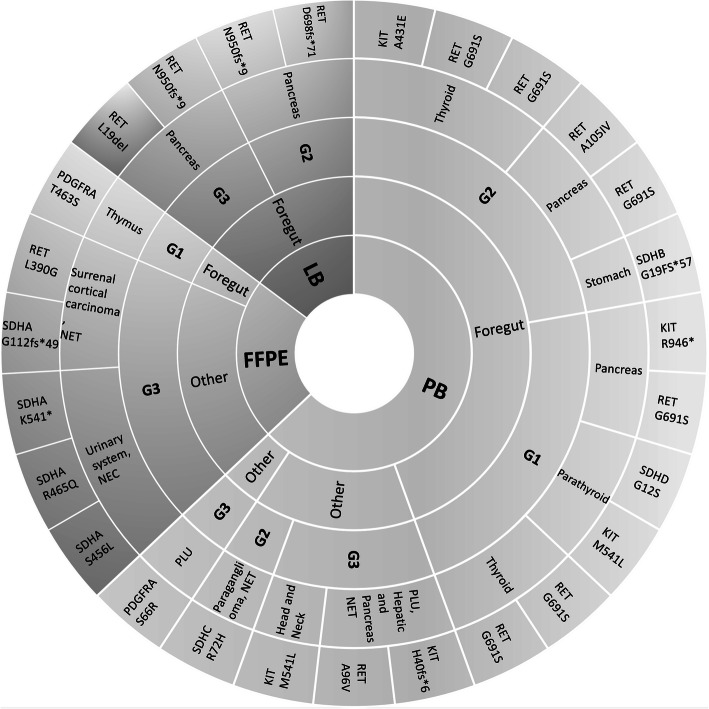
A customized multi-gene panel comprised of Succinate Dehydrogenase Complex Iron Sulfur Subunit B (SDHB), Succinate Dehydrogenase Complex Subunit C (SDHC), Cell Division Cycle 73(CDC73), Calcium Sensing Receptor (CASR), Platelet Derived Growth Factor Receptor Alpha (PDGFRA), Succinate Dehydrogenase Complex Flavoprotein Subunit A (SDHA), Ret Proto-Oncogene (RET), Succinate Dehydrogenase Complex Assembly Factor 2(SDHAF2), Menin 1(MEN1), Succinate Dehydrogenase Complex Subunit D (SDHD), MYC Associated Factor X (MAX) and Protein Kinase CAMP-Dependent Type I Regulatory Subunit Alpha (PRKAR1A) genes was constructed to assess multiple specimen types including: 3 liquid biopsies, 6 FFPE tissues, and 26 peripheral blood samples from 35 unique NET patients. Quality-control and bioinformatics analyses were performed using QCI-Analyze and QCI-Interpret.
The three liquid biopsies and the 6 FFPE tissue samples were evaluated for somatic mutations; while the 26 peripheral blood samples were analysed using the germ-line pipeline. Five (55.6%) of the nine patients that were studied for somatic changes carried actionable mutations related to therapy sensitivities. Through the germ-line studies, we observed a 50% positivity rate for disease predisposition with 16 variants classified according to ACMG (American College of Medical Genetics) Standards and Guidelines.
Genomic profiling medicine is an emerging area of clinical oncology and has become crucial for disease and patient management by providing a precision approach; this is especially true for rare diseases including rare cancers such as NETs. Notably, this study emphasized the relevance of multiple distinctive biological sample types for use in the genetic testing of cancers to help with the choice of therapy to maximize the likelihood of a positive clinical outcome.
神经内分泌肿瘤(NETs)起源于产生激素或神经系统的细胞,可以在体内任何部位发展。它们的起源从皮肤到胃肠道都具有异质性,并且组织学复杂。因此,为了确定每个肿瘤的确切遗传学,以便为预后和治疗策略提供信息,以克服疾病的复杂性,进行基因组分析是必不可少的。为此,下一代测序(NGS)是用于种系和体细胞研究以做出临床诊断的最可靠方法。在这项研究中,我们分析了液体活检、福尔马林固定石蜡包埋(FFPE)组织和外周血样本,以确定它们提供可采取行动的信息的能力。
构建了一个包含琥珀酸脱氢酶复合物铁硫亚基 B(SDHB)、琥珀酸脱氢酶复合物亚基 C(SDHC)、细胞分裂周期 73(CDC73)、钙敏感受体(CASR)、血小板衍生生长因子受体α(PDGFRA)、琥珀酸脱氢酶复合物黄素蛋白亚基 A(SDHA)、Ret 原癌基因(RET)、琥珀酸脱氢酶复合物组装因子 2(SDHAF2)、Menin 1(MEN1)、琥珀酸脱氢酶复合物亚基 D(SDHD)、MYC 相关因子 X(MAX)和蛋白激酶 CAMP-依赖性 I 型调节亚基α(PRKAR1A)的定制多基因panel,用于评估多种标本类型,包括:3 份液体活检、6 份 FFPE 组织和 35 位 NET 患者的 26 份外周血样本。使用 QCI-Analyze 和 QCI-Interpret 进行质量控制和生物信息学分析。
对 3 份液体活检和 6 份 FFPE 组织样本进行了体细胞突变评估;而 26 份外周血样本则通过种系分析进行了分析。在研究体细胞变化的 9 名患者中,有 5 名(55.6%)携带与治疗敏感性相关的可治疗突变。通过种系研究,我们观察到根据 ACMG(美国医学遗传学学院)标准和指南分类的 16 种疾病易感性变体的阳性率为 50%。
基因组分析医学是临床肿瘤学的一个新兴领域,通过提供一种精准的方法,对疾病和患者管理变得至关重要;对于罕见疾病,包括 NET 等罕见癌症,更是如此。值得注意的是,这项研究强调了多种不同生物样本类型在癌症基因检测中的相关性,以帮助选择治疗方法,最大限度地提高阳性临床结果的可能性。