Department of Preventive Medicine, Seoul National University College of Medicine, Seoul, Republic of Korea.
Cancer Research Institute, Seoul National University, Seoul, Republic of Korea.
BMC Public Health. 2021 Mar 6;21(1):459. doi: 10.1186/s12889-021-10490-9.
Obesity is well known as a risk factor for cardiovascular disease. We aimed to determine the performance of and the optimal cutoff values for obesity indices to discriminate the presence of metabolic abnormalities as a primary risk factor for cardiovascular diseases in a Health Examinees study (HEXA).
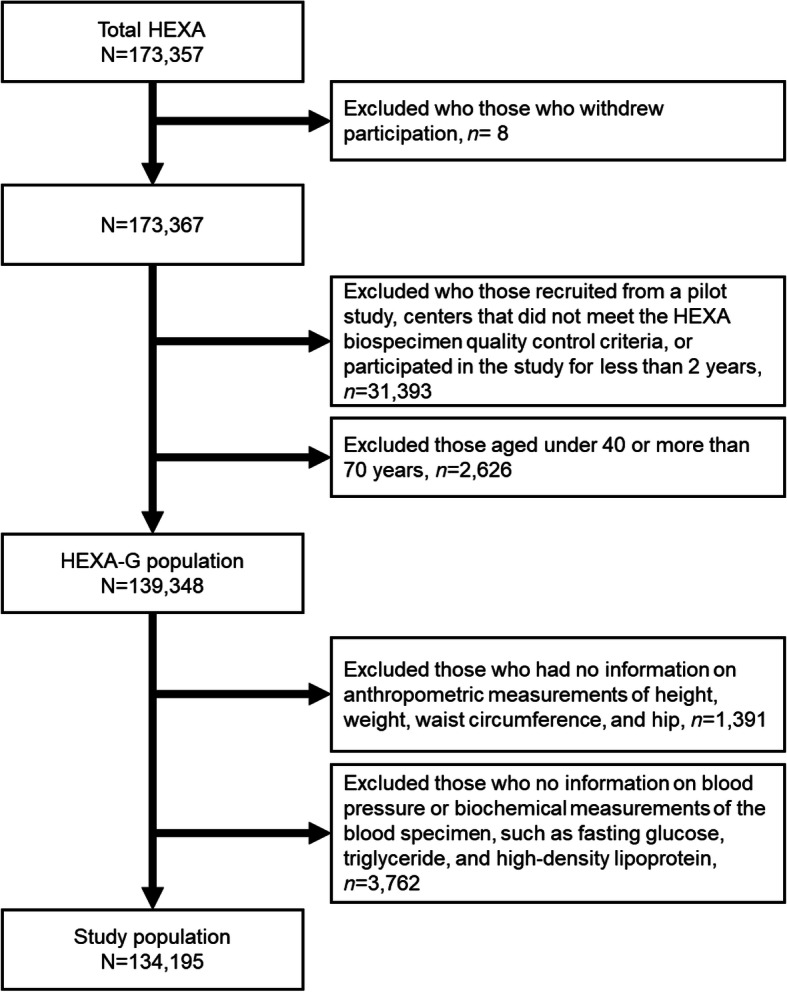
The current study analyzed 134,195 participants with complete anthropometric and laboratory information in a Health Examinees study, consisting of the Korean population aged 40 to 69 years. The presence of metabolic abnormality was defined as having at least one of the following: hypertension, hyperglycemia, or dyslipidemia. The area under the receiver operating characteristic curve (AUC) and 95% confidence intervals (CIs) were calculated for body mass index, waist to hip ratio, waist to height ratio, waist circumference, and conicity index.
The AUC of metabolic abnormalities was the highest for waist-to-height ratio (AUC [95% CIs], 0.677 [0.672-0.683] among men; 0.691 [0.687-0.694] among women), and the lowest for the C index (0.616 [0.611-0.622] among men; 0.645 [0.641-0.649] among women) among both men and women. The optimal cutoff values were 24.3 kg/m for the body mass index, 0.887 for the waist-to-hip ratio, 0.499 for the waist-to-height ratio, 84.4 cm for waist circumference and 1.20 m/kg for the conicity index among men, and 23.4 kg/m for the body mass index, 0.832 for the waist-to-hip ratio, 0.496 for the waist-to-height ratio, 77.0 cm for the waist circumference and 1.18 m/kg for the conicity index among women.
The waist-to-height ratio is the best index to discriminate metabolic abnormalities among middle-aged Koreans. The optimal cutoff of obesity indices is lower than the international guidelines for obesity. It would be appropriate to use the indices for abdominal obesity rather than general obesity and to consider a lower level of body mass index and waist circumference than the current guidelines to determine obesity-related health problems in Koreans.
肥胖是心血管疾病的已知危险因素。我们旨在确定肥胖指数的性能和最佳截断值,以区分代谢异常作为心血管疾病主要危险因素在健康受检者研究(HEXA)中的存在。
本研究分析了健康受检者研究中具有完整人体测量和实验室信息的 134195 名参与者,该研究由年龄在 40 至 69 岁的韩国人群组成。代谢异常的存在定义为至少有以下一种情况:高血压、高血糖或血脂异常。计算了体质指数、腰臀比、腰高比、腰围和凸度指数的受试者工作特征曲线下面积(AUC)和 95%置信区间(CI)。
代谢异常的 AUC 最高的是腰高比(AUC[95%CI],男性为 0.677[0.672-0.683];女性为 0.691[0.687-0.694]),C 指数最低(男性为 0.616[0.611-0.622];女性为 0.645[0.641-0.649])。男性最佳截断值分别为 24.3kg/m 的体质指数、0.887 的腰臀比、0.499 的腰高比、84.4cm 的腰围和 1.20m/kg 的凸度指数,女性最佳截断值分别为 23.4kg/m 的体质指数、0.832 的腰臀比、0.496 的腰高比、77.0cm 的腰围和 1.18m/kg 的凸度指数。
腰高比是区分中年韩国人代谢异常的最佳指标。肥胖指数的最佳截断值低于国际肥胖指南。使用腹部肥胖指数而不是一般肥胖指数,以及考虑使用低于当前指南的体质指数和腰围水平来确定韩国人的肥胖相关健康问题是合适的。