Division of Emergency Medicine, Cohen Children's Medical Center, Northwell Health, Queens, NY, USA.
Division of Emergency Medicine, Cohen Children's Medical Center, Northwell Health, Queens, NY, USA; Donald and Barbara Zucker School of Medicine at Hofstra/Northwell, Northwell Health, Hempstead, NY, USA.
Am J Emerg Med. 2021 Jul;45:100-104. doi: 10.1016/j.ajem.2021.02.029. Epub 2021 Feb 20.
This study describes the utilization of a pediatric emergency department (ED) during the early months of the COVID-19 pandemic in the initial U.S. epicenter, including the impact on visit acuity and incidences of common diagnoses.
We performed an observational retrospective review of patients younger than 18 years old seen in a New York City pediatric ED from March 7th to May 6th 2020, and during the same time period in 2018 and 2019. Demographics, visit details, diagnoses, and dispositions were compared. Validated algorithms were utilized to create practical diagnosis groupings and to determine the probability of a visit requiring emergent evaluation.
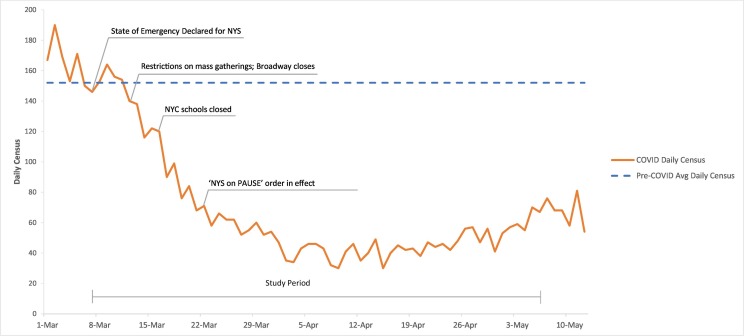
ED visits during the pandemic decreased by 56% to an average daily census of 67 patients, from an anticipated 152. Admission rates rose from 13.3% to 17.4% (p<0.001), and the proportion of triage Emergency Severity Index level 1 and 2 patients increased by 23.7% (p<0.001). Non-emergent visits dropped from 32.3% to 27.5% (p<0.001). Several common, often low-acuity diagnoses saw disproportionate reductions in visits including headache, chest pain, and minor injuries. Concerningly, visits for suicidal ideation, suicide attempt, or self-harm increased by 100% (p<0.001) and visits for evaluating abuse or neglect decreased by 89% (p=0.01).
Pediatric ED utilization substantially deceased during the early months of the COVID-19 pandemic in New York City, but left relatively higher patient acuity. Healthcare systems in early epicenters must also prepare for the disproportionate impact a pandemic has on the most vulnerable pediatric patients, particularly those at risk for self-harm or abuse.
本研究描述了 COVID-19 大流行早期美国最初震中地区儿科急诊部的利用情况,包括对就诊严重程度和常见诊断发病率的影响。
我们对 2020 年 3 月 7 日至 5 月 6 日期间和 2018 年及 2019 年同期在纽约市儿科急诊部就诊的年龄小于 18 岁的患者进行了观察性回顾性研究。比较了人口统计学、就诊详细信息、诊断和处理情况。利用经过验证的算法创建了实用的诊断分组,并确定了需要紧急评估的就诊概率。
大流行期间急诊就诊量下降了 56%,平均每日就诊人数为 67 人,而预期人数为 152 人。入院率从 13.3%上升至 17.4%(p<0.001),1 级和 2 级紧急严重指数(Emergency Severity Index,ESI)患者的比例增加了 23.7%(p<0.001)。非紧急就诊从 32.3%下降至 27.5%(p<0.001)。几种常见的、通常为低严重程度的诊断就诊量大幅减少,包括头痛、胸痛和轻微损伤。令人担忧的是,自杀意念、自杀未遂或自伤就诊量增加了 100%(p<0.001),而评估虐待或忽视的就诊量减少了 89%(p=0.01)。
COVID-19 大流行早期纽约市儿科急诊就诊量大幅下降,但患者严重程度相对较高。早期震中地区的医疗保健系统还必须为大流行对最脆弱的儿科患者(特别是那些有自伤或虐待风险的患者)的不成比例影响做好准备。