Department of Immunology, School of Medicine, Yangtze University, Jingzhou, Hubei 434023, China.
Department of Rheumatology and Immunology, Tongji Hospital, Tongji Medical College, Huazhong University of Science and Technology, Wuhan, Hubei 430030, China.
Mediators Inflamm. 2021 Feb 23;2021:6687412. doi: 10.1155/2021/6687412. eCollection 2021.
Novel coronavirus disease 2019 (COVID-19), an acute respiratory disease caused by severe acute respiratory syndrome coronavirus 2 (SARS-CoV-2), rapidly progressed to a global pandemic. Currently, there are limited effective medications approved for this deadly disease.
To investigate the potential predictors of COVID-19 mortality and risk factors for hyperinflammation in COVID-19.
Retrospective analysis was carried out in 1,149 patients diagnosed with COVID-19 in Tongji Hospital, Wuhan, China, from 1/13/2020 to 3/15/2020.
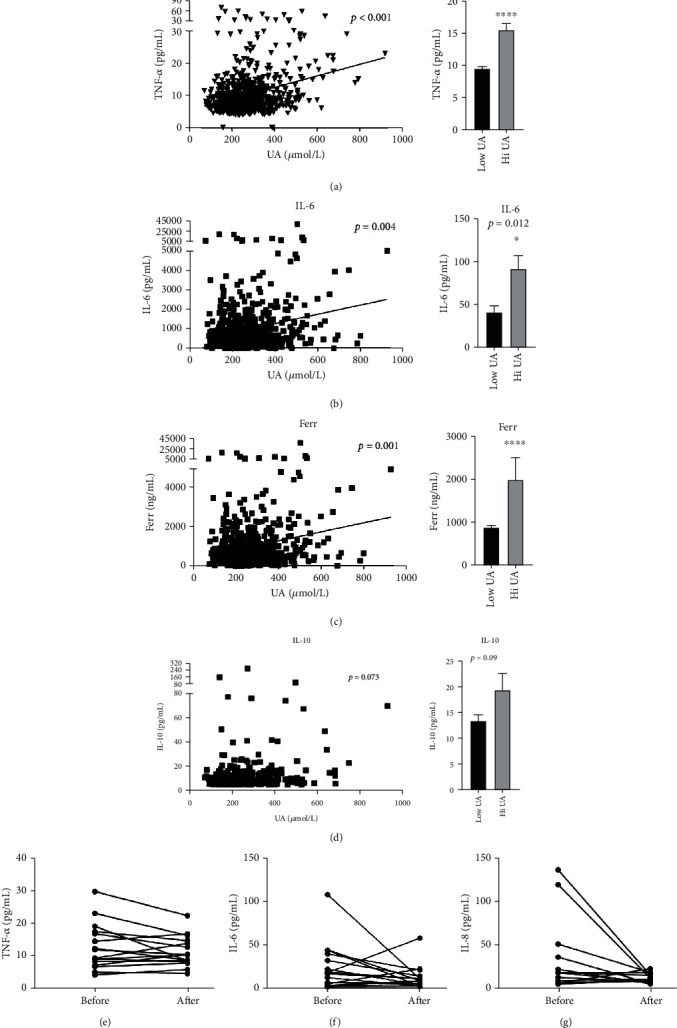
We found significant differences in the rates of hyperuricemia (OR: 3.17, 95% CI: 2.13-4.70; < 0.001) and hypoalbuminemia (OR: 5.68, 95% CI: 3.97-8.32; < 0.001) between deceased and recovered patients. The percentages of hyperuricemia in deceased patients and recovered patients were 23.6% and 8.9%, respectively, which were higher than the reported age-standardized prevalence of 6.2% in Chinese population. Of note, the percentages of both IL-6 and uric acid levels in survived COVID-19 patients were above 90%, suggesting that they might be good specificity for indicators of mortality in COVID-19 patients. The serum level of uric acid (UA) was positively associated with ferritin, TNF-, and IL-6 but not with anti-inflammatory cytokine IL-10. In addition, the levels of these proinflammatory cytokines in COVID-19 patients showed a trend of reduction after uric acid lowering therapy.
Our results suggest that uric acid, the end product of purine metabolism, was increased in deceased patients with COVID-19. In addition, the serum level of uric acid was positively associated with inflammatory markers. Uric acid lowering therapy in COVID-19 patients with hyperuricemia may be beneficial.
由严重急性呼吸综合征冠状病毒 2(SARS-CoV-2)引起的急性呼吸道疾病 2019 年冠状病毒病(COVID-19)迅速发展为全球大流行。目前,批准用于这种致命疾病的有效药物有限。
探讨 COVID-19 死亡率的潜在预测因素和 COVID-19 中过度炎症的危险因素。
对 2020 年 1 月 13 日至 2020 年 3 月 15 日期间在中国武汉同济医院诊断为 COVID-19 的 1149 例患者进行回顾性分析。
我们发现高尿酸血症(OR:3.17,95%CI:2.13-4.70;<0.001)和低白蛋白血症(OR:5.68,95%CI:3.97-8.32;<0.001)在死亡和恢复患者之间存在显著差异。死亡患者和恢复患者的高尿酸血症发生率分别为 23.6%和 8.9%,均高于中国人群中报告的年龄标准化患病率 6.2%。值得注意的是,存活 COVID-19 患者的白细胞介素-6(IL-6)和尿酸水平均超过 90%,这表明它们可能是 COVID-19 患者死亡率的特异性良好指标。尿酸(UA)的血清水平与铁蛋白、TNF-和 IL-6 呈正相关,但与抗炎细胞因子 IL-10 无关。此外,COVID-19 患者的这些促炎细胞因子水平在降尿酸治疗后呈下降趋势。
我们的结果表明,嘌呤代谢的终产物尿酸在 COVID-19 死亡患者中增加。此外,血清尿酸水平与炎症标志物呈正相关。在高尿酸血症的 COVID-19 患者中进行降尿酸治疗可能有益。