Martarelli Corinna S, Pacozzi Simona G, Bieleke Maik, Wolff Wanja
Faculty of Psychology, Swiss Distance University Institute, Brig, Switzerland.
Department for Psychology of Development and Education, Faculty of Psychology, University of Vienna, Vienna, Austria.
Front Psychol. 2021 Feb 18;12:594256. doi: 10.3389/fpsyg.2021.594256. eCollection 2021.
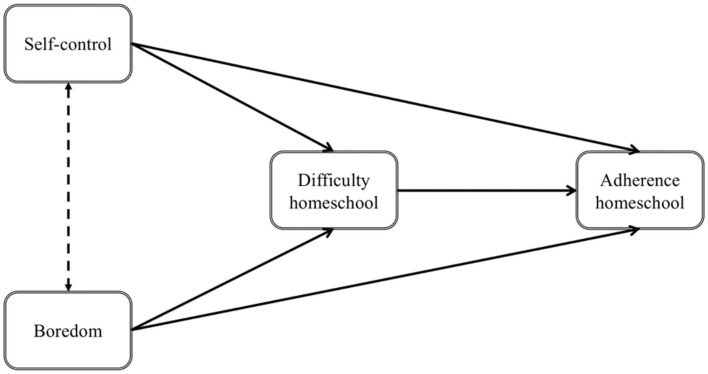
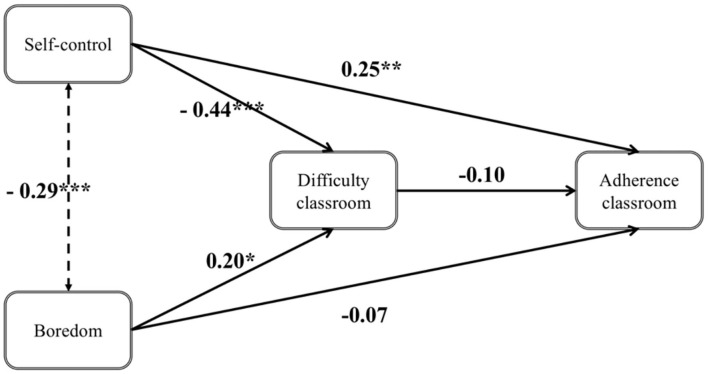
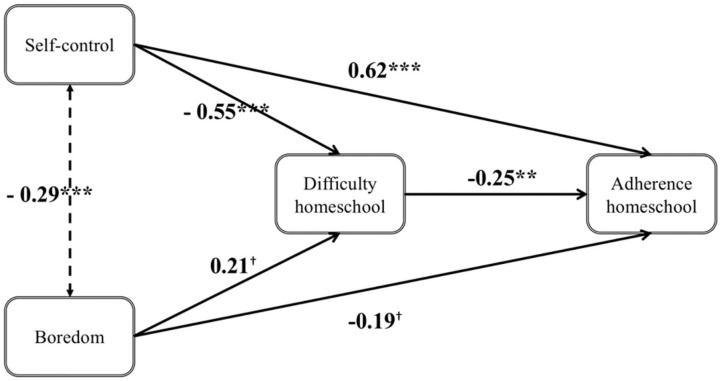
In response to the coronavirus disease 2019 (COVID-19) schools around the world have been closed to protect against the spread of coronavirus. In several countries, homeschooling has been introduced to replace classroom schooling. With a focus on individual differences, the present study examined 138 schoolers (age range = 6 to 21 years) regarding their self-control and boredom proneness. The results showed that both traits were important in predicting adherence to homeschooling. Schoolers with higher levels of self-control perceived homeschooling as less difficult, which in turn increased homeschooling adherence. In contrast, schoolers with higher levels of boredom proneness perceived homeschooling as more difficult, which in turn reduced homeschooling adherence. These results partially hold when it comes to studying in the classroom. However, boredom threatened adherence only in the homeschooling context. Our results indicate that boredom proneness is a critical construct to consider when educational systems switch to homeschooling during a pandemic.
为应对2019冠状病毒病(COVID-19),世界各地的学校已关闭,以防止冠状病毒传播。在一些国家,已引入在家上学以取代课堂教学。本研究关注个体差异,对138名学生(年龄范围为6至21岁)的自我控制能力和无聊倾向进行了调查。结果表明,这两种特质在预测对在家上学的坚持程度方面都很重要。自我控制能力较高的学生认为在家上学难度较小,这反过来又提高了对在家上学的坚持程度。相比之下,无聊倾向较高的学生认为在家上学难度更大,这反过来又降低了对在家上学的坚持程度。在课堂学习方面,这些结果部分成立。然而,无聊感仅在在家上学的背景下对坚持程度构成威胁。我们的结果表明,在大流行期间教育系统转向在家上学时,无聊倾向是一个需要考虑的关键因素。