Department of Viroscience, Erasmus Medical Center, Rotterdam, Netherlands.
Independent Researcher, Rotterdam, Netherlands.
Front Immunol. 2021 Feb 19;12:622516. doi: 10.3389/fimmu.2021.622516. eCollection 2021.
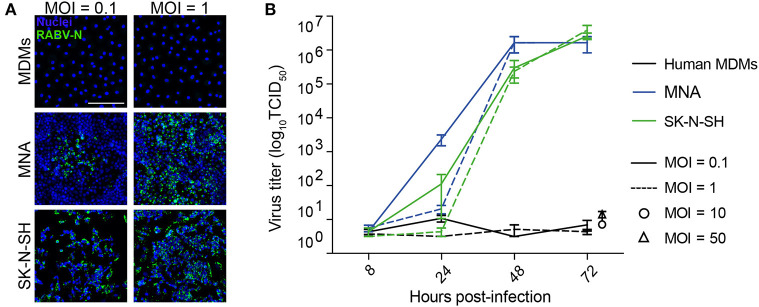
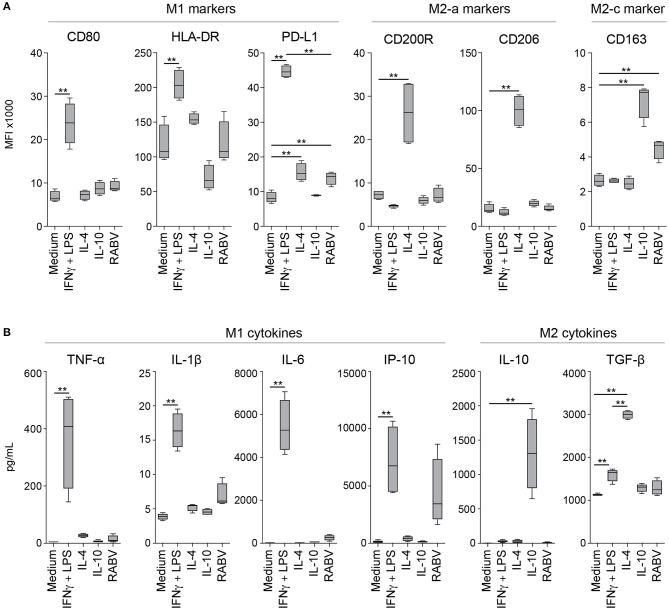
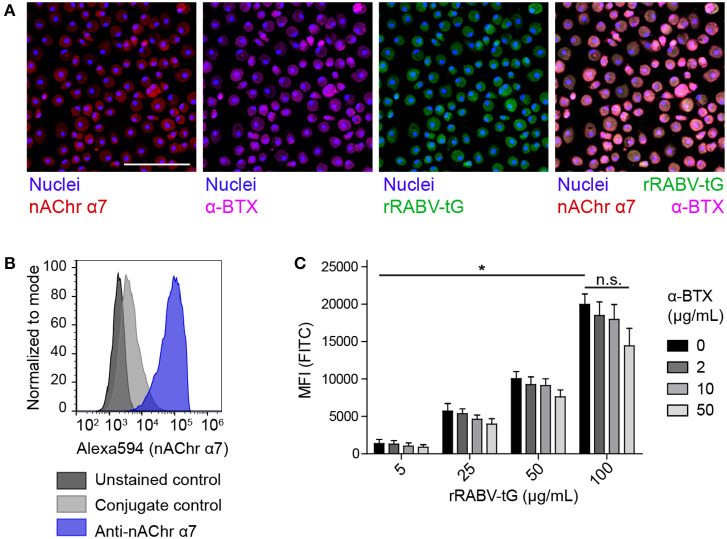
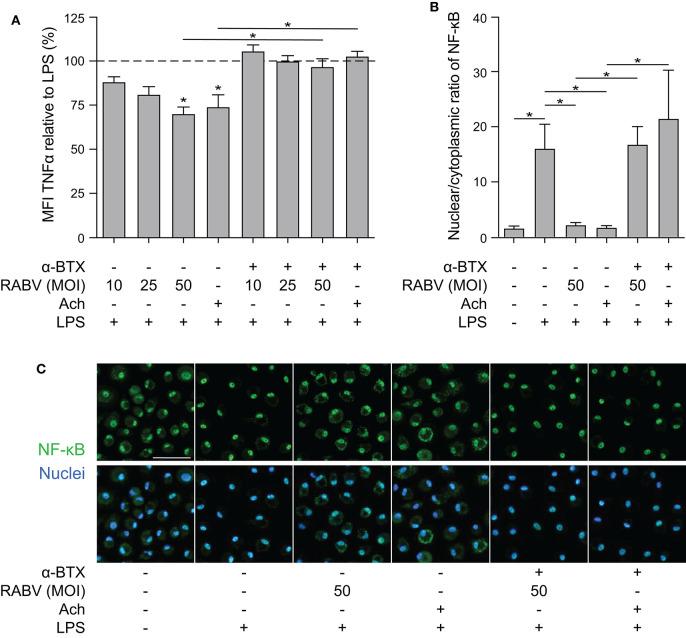
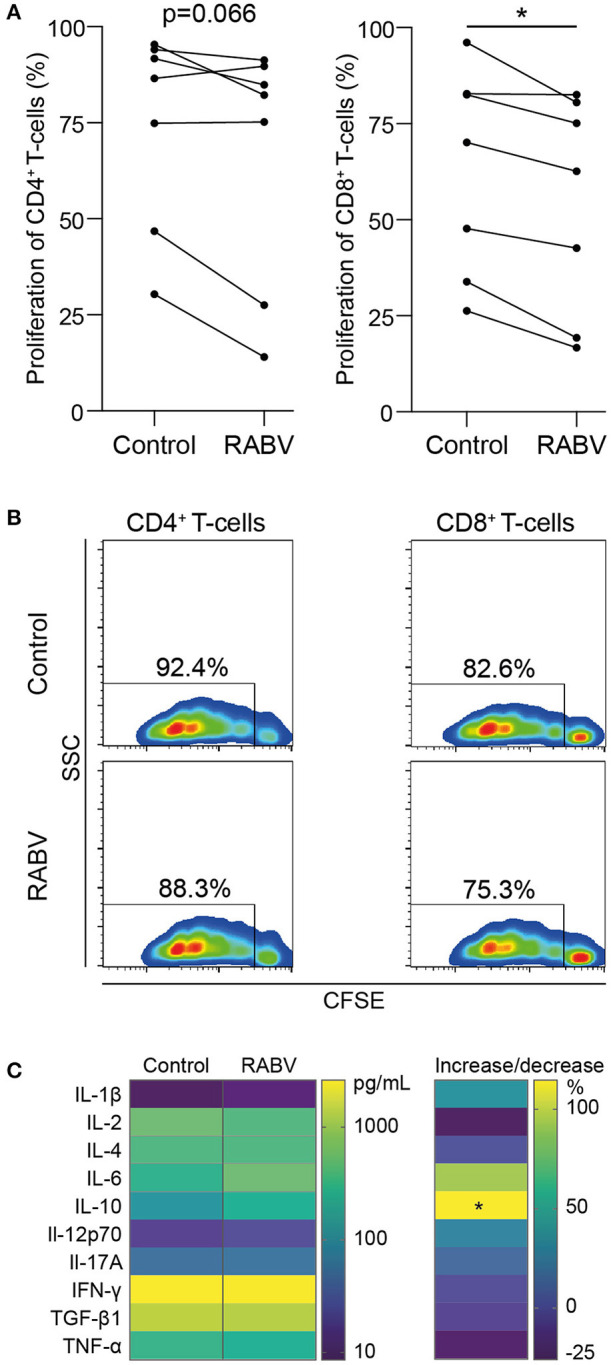
Rabies virus (RABV) is able to reach the central nervous system (CNS) without triggering a strong immune response, using multiple mechanisms to evade and suppress the host immune system. After infection a bite or scratch from a rabid animal, RABV comes into contact with macrophages, which are the first antigen-presenting cells (APCs) that are recruited to the area and play an essential role in the onset of a specific immune response. It is poorly understood how RABV affects macrophages, and if the interaction contributes to the observed immune suppression. This study was undertaken to characterize the interactions between RABV and human monocyte-derived macrophages (MDMs). We showed that street RABV does not replicate in human MDMs. Using a recombinant trimeric RABV glycoprotein (rRABV-tG) we showed binding to the nicotinic acetylcholine receptor alpha 7 (nAChr α7) on MDMs, and confirmed the specificity using the nAChr α7 antagonist alpha-bungarotoxin (α-BTX). We found that this binding induced the cholinergic anti-inflammatory pathway (CAP), characterized by a significant decrease in tumor necrosis factor α (TNF-α) upon LPS challenge. Using confocal microscopy we found that induction of the CAP is associated with significant cytoplasmic retention of nuclear factor κB (NF-κB). Co-cultures of human MDMs exposed to street RABV and autologous T cells further revealed that the observed suppression of MDMs might affect their function as T cell activators as well, as we found a significant decrease in proliferation of CD8 T cells and an increased production of the anti-inflammatory cytokine IL-10. Lastly, using flow cytometric analysis we observed a significant increase in expression of the M2-c surface marker CD163, hinting that street RABV might be able to affect macrophage polarization. Taken together, these results show that street RABV is capable of inducing an anti-inflammatory state in human macrophages, possibly affecting T cell functioning.
狂犬病病毒(RABV)能够到达中枢神经系统(CNS)而不引发强烈的免疫反应,它使用多种机制来逃避和抑制宿主免疫系统。感染后,RABV 通过咬伤或抓伤接触到巨噬细胞,巨噬细胞是首先被招募到该区域的抗原呈递细胞(APC),并在特定免疫反应的发作中发挥重要作用。目前尚不清楚 RABV 如何影响巨噬细胞,以及这种相互作用是否有助于观察到的免疫抑制。本研究旨在表征 RABV 与人类单核细胞衍生的巨噬细胞(MDM)之间的相互作用。我们表明,街头 RABV 不会在人类 MDM 中复制。使用重组三聚体 RABV 糖蛋白(rRABV-tG),我们证明了它与 MDM 上的烟碱型乙酰胆碱受体α7(nAChrα7)结合,并使用烟碱型乙酰胆碱受体α7 拮抗剂α-银环蛇毒素(α-BTX)证实了其特异性。我们发现这种结合诱导了胆碱能抗炎途径(CAP),其特征在于在 LPS 挑战时肿瘤坏死因子α(TNF-α)显著减少。使用共聚焦显微镜,我们发现 CAP 的诱导与核因子κB(NF-κB)的细胞质显著保留有关。暴露于街头 RABV 和自体 T 细胞的人 MDM 共培养物进一步表明,观察到的 MDM 抑制可能也会影响它们作为 T 细胞激活剂的功能,因为我们发现 CD8 T 细胞的增殖显著减少,抗炎细胞因子 IL-10 的产生增加。最后,通过流式细胞术分析,我们观察到表面标志物 M2-c CD163 的表达显著增加,这表明街头 RABV 可能能够影响巨噬细胞极化。总之,这些结果表明,街头 RABV 能够诱导人类巨噬细胞产生抗炎状态,可能影响 T 细胞功能。