Wang Yu-Ming, Chen Ying, Zheng Yan-Jun, Huang Yun-Chuan, Chen Wei-Wei, Ji Ran, Xu Li-Li, Yang Zhi-Tao, Sheng Hui-Qiu, Qu Hong-Ping, Mao En-Qiang, Chen Er-Zhen
Department of Emergency, Ruijin Hospital Affiliated to Shanghai Jiao Tong University School of Medicine, Shanghai 200025, P.R. China.
Department of Critical Care Medicine, Ruijin Hospital Affiliated to Shanghai Jiao Tong University School of Medicine, Shanghai 200025, P.R. China.
Exp Ther Med. 2021 Apr;21(4):387. doi: 10.3892/etm.2021.9818. Epub 2021 Feb 23.
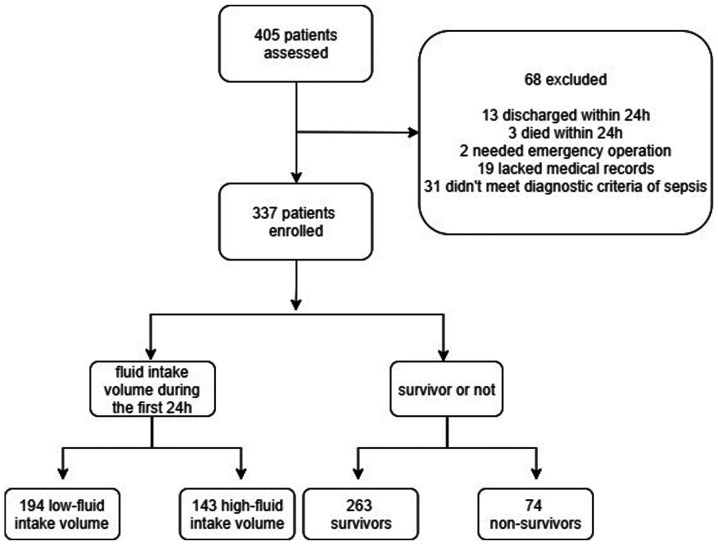
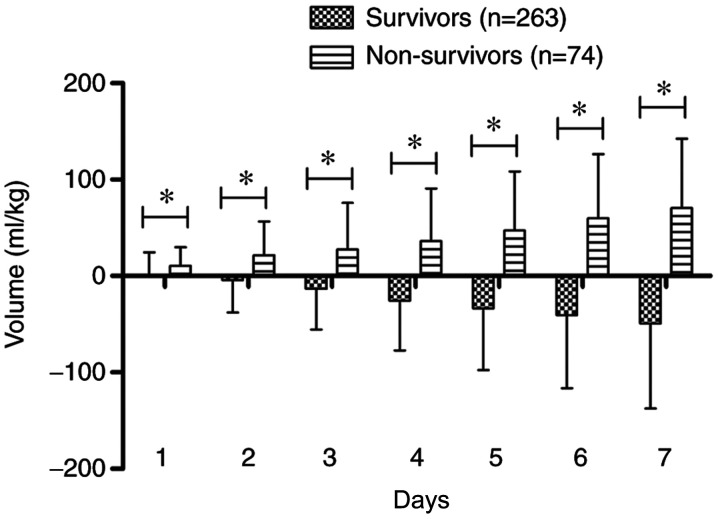
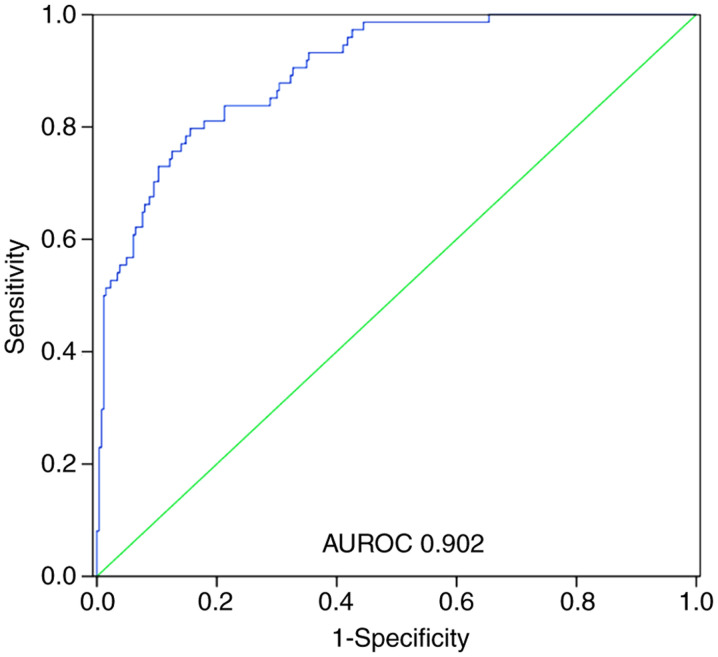
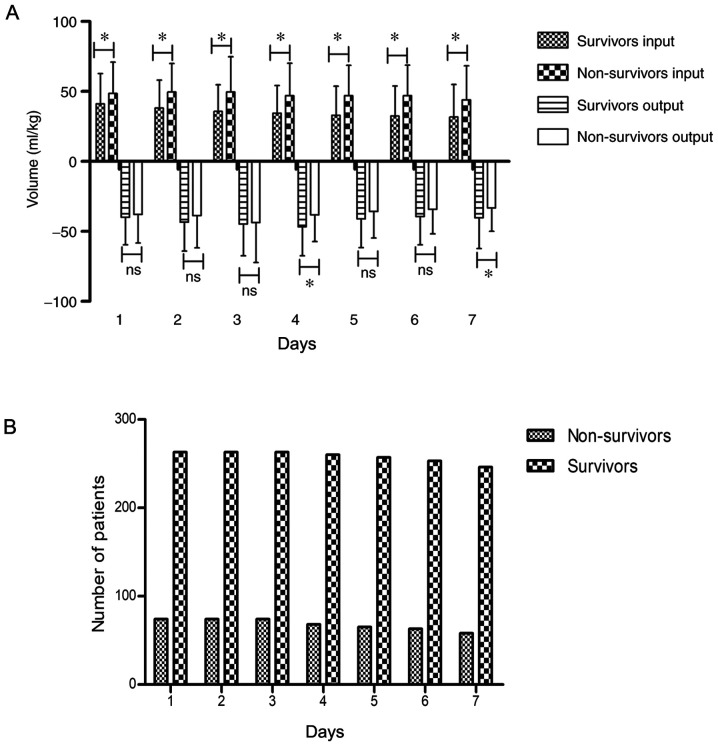
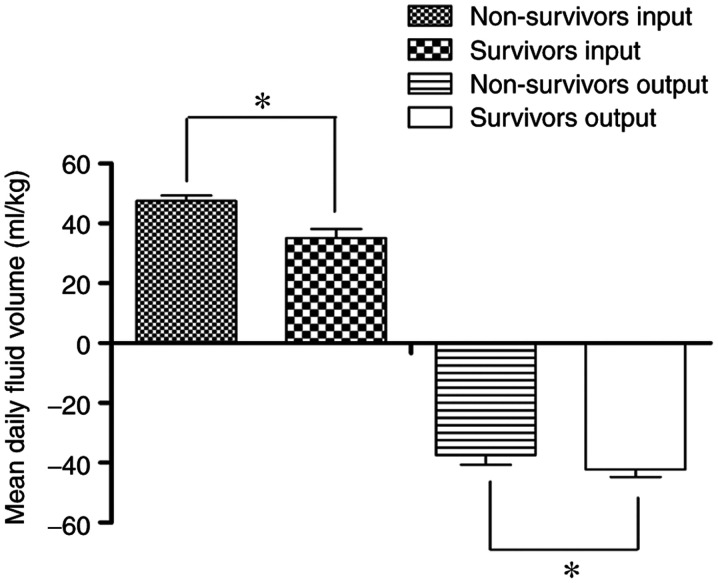
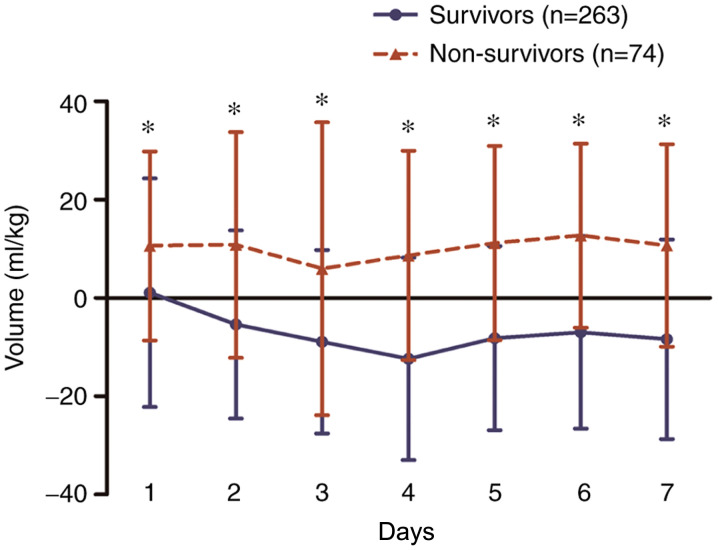
For patients with sepsis and septic shock, it remains controversial when to restrict fluid intake and achieve a negative fluid balance. The present study aimed to evaluate the effects of the fluid intake volume during the first 24 h as well as fluid balance for 7 days on the prognosis of sepsis or septic shock. A total of 337 patients diagnosed with sepsis or septic shock at Ruijin Hospital (Shanghai, China) were enrolled in the present retrospective study. Patients with a low fluid intake volume during the first 24 h (fluid intake, 28.1±10.6 ml/kg) had lower in-hospital mortality rates (18.0 vs. 27.3%, P=0.043) and a shorter duration of mechanical ventilation [0 (0-6) vs. 3 (0-11), P=0.025] than the high-fluid volume intake group (62.6±17.6 ml/kg). Furthermore, survivors exhibited a daily negative net fluid balance from the second day (48 h), whereas non-survivors had a daily positive net fluid balance for 7 days, where fluid balance volumes were significantly lower in survivors compared with those in non-survivors. Finally, binary logistic regression analysis was used to determine whether the mean daily fluid balance (P<0.001) and the Acute Physiologic and Chronic Health Evaluation II score (P=0.048) were independent prognostic factors for patients with sepsis or septic shock. It was indicated that a low fluid intake volume during the first 24 h and a persistent negative fluid balance from the second day were associated with favorable outcomes. The mean daily fluid balance was an independent prognostic factor or patients with sepsis or septic shock.
对于脓毒症和脓毒性休克患者,何时限制液体摄入并实现液体负平衡仍存在争议。本研究旨在评估脓毒症或脓毒性休克患者最初24小时的液体摄入量以及7天的液体平衡对预后的影响。本回顾性研究纳入了上海瑞金医院337例诊断为脓毒症或脓毒性休克的患者。最初24小时液体摄入量低的患者(液体摄入量为28.1±10.6ml/kg)的院内死亡率较低(18.0%对27.3%,P=0.043),机械通气时间较短[0(0-6)天对3(0-11)天,P=0.025],而高液体摄入量组(62.6±17.6ml/kg)则相反。此外,存活者从第二天(48小时)开始每日呈现液体净负平衡,而非存活者7天内每日液体净平衡为正,存活者的液体平衡量显著低于非存活者。最后,采用二元logistic回归分析确定平均每日液体平衡(P<0.001)和急性生理与慢性健康状况评分II(P=0.048)是否为脓毒症或脓毒性休克患者的独立预后因素。结果表明,最初24小时低液体摄入量以及从第二天开始持续的液体负平衡与良好预后相关。平均每日液体平衡是脓毒症或脓毒性休克患者的独立预后因素。