Department of Medical Oncology, Guangzhou First People's Hospital, School of Medicine, South China University of Technology, Guangzhou Guangdong, China.
Department of Medical Oncology, Guangzhou First People's Hospital, Guangzhou Medical University, Guangzhou, Guangdong, China 510180.
Dis Markers. 2021 Feb 24;2021:8895723. doi: 10.1155/2021/8895723. eCollection 2021.
Long noncoding RNA-based prognostic biomarkers have demonstrated great potential in the diagnosis and prognosis of cancer patients. However, systematic assessment of a multiple lncRNA-composed prognostic risk model is lacking in stomach adenocarcinoma (STAD). This study is aimed at constructing a lncRNA-based prognostic risk model for STAD patients.
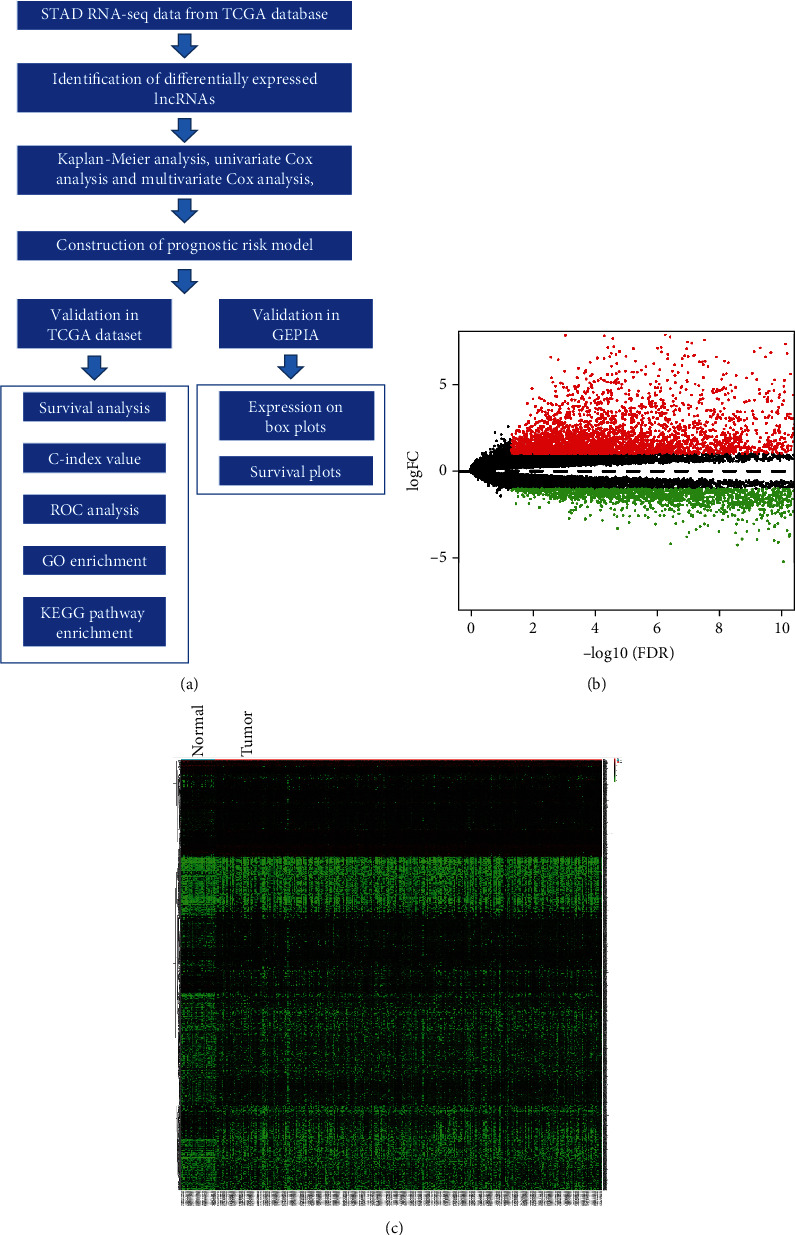
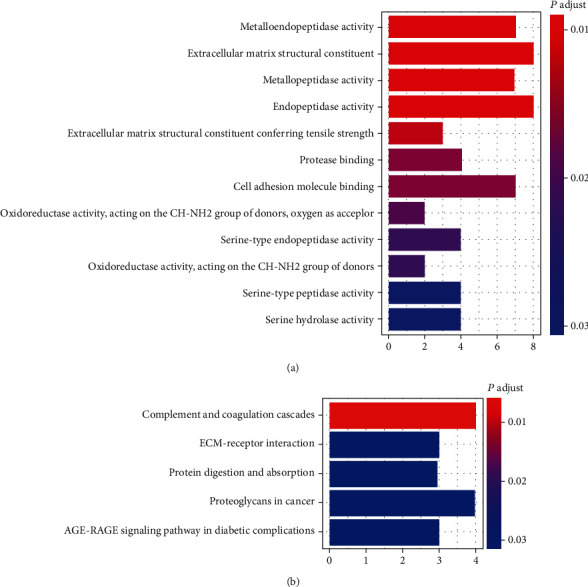
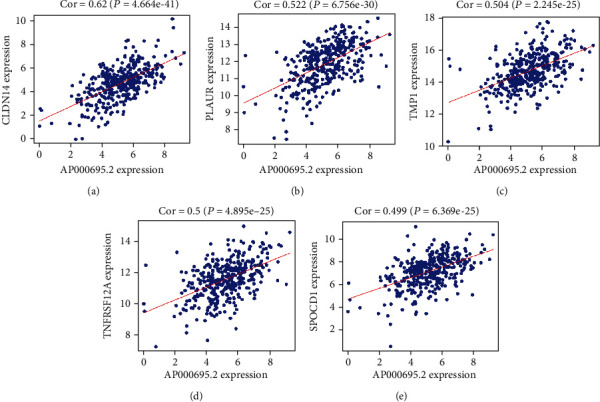
RNA sequencing data and clinical information of STAD patients were retrieved from The Cancer Genome Atlas (TCGA) database. Differentially expressed lncRNAs (DElncRNAs) were identified using the R software. Univariate and multivariate Cox regression analyses were performed to construct a prognostic risk model. The survival analysis, C-index, and receiver operating characteristic (ROC) curve were employed to assess the sensitivity and specificity of the model. The results were verified using the GEPIA online tool and our clinical samples. Pearson correlation coefficient analysis, Gene Ontology (GO), and Kyoto Encyclopedia of Genes and Genomes (KEGG) pathway enrichment were performed to indicate the potential biological functions of the selected lncRNA.
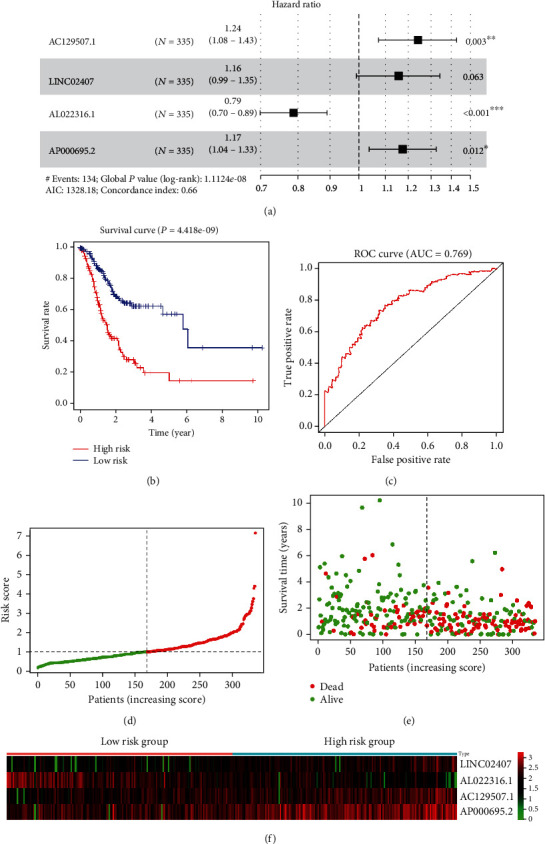
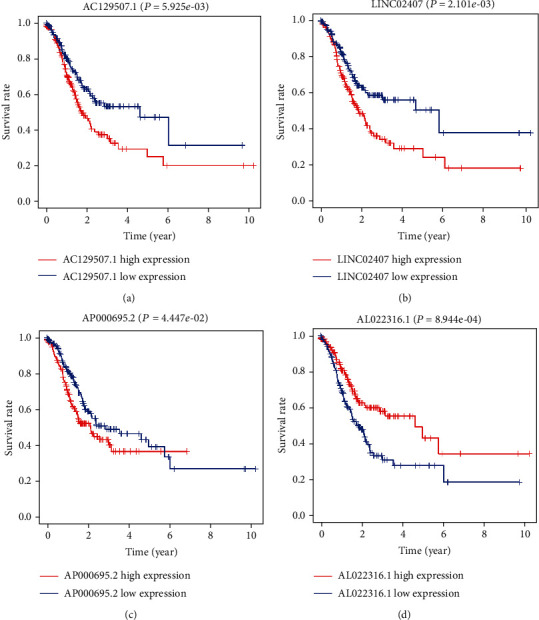
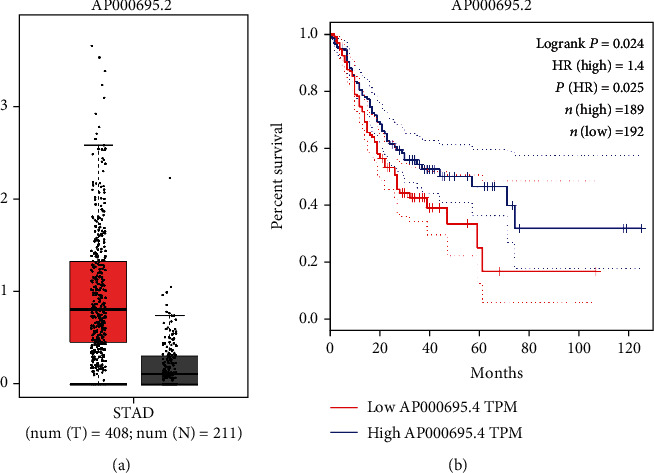
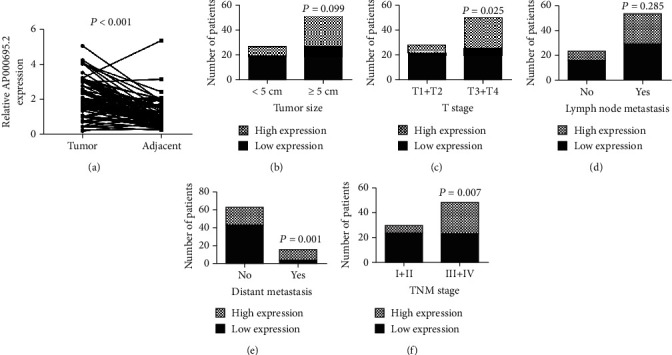
A total of 1917 DElncRNAs were identified from 343 cases of STAD tissues and 30 cases of noncancerous tissues. According to univariate and multivariable Cox regression analyses, four DElncRNAs (AC129507.1, LINC02407, AL022316.1, and AP000695.2) were selected to establish a prognostic risk model. There was a significant difference in the overall survival between high-risk patients and low-risk patients based on this risk model. The C-index of the model was 0.652. The area under the curve (AUC) for the ROC curve was 0.769. GEPIA results confirmed the expression and prognostic significance of AP000695.2 in STAD. Our clinical data confirmed that upregulated expression of AP000695.2 was correlated with the T stage, distant metastasis, and TNM stage in STAD. GO and KEGG analyses demonstrated that AP000695.2 was closely related to the tumorigenesis process.
In this study, we constructed a lncRNA-based prognostic risk model for STAD patients. Our study will provide novel insight into the diagnosis and prognosis of STAD patients.
长链非编码 RNA 为基础的预后生物标志物在癌症患者的诊断和预后方面显示出巨大潜力。然而,胃腺癌(STAD)中缺乏系统的基于多个 lncRNA 组成的预后风险模型评估。本研究旨在构建基于 lncRNA 的 STAD 患者预后风险模型。
从癌症基因组图谱(TCGA)数据库中检索 STAD 患者的 RNA 测序数据和临床信息。使用 R 软件鉴定差异表达的长链非编码 RNA(DElncRNAs)。使用单变量和多变量 Cox 回归分析构建预后风险模型。采用生存分析、C 指数和接受者操作特征(ROC)曲线评估模型的敏感性和特异性。使用 GEPIA 在线工具和我们的临床样本进行验证。Pearson 相关系数分析、基因本体论(GO)和京都基因与基因组百科全书(KEGG)通路富集分析用于指示选定 lncRNA 的潜在生物学功能。
从 343 例 STAD 组织和 30 例非癌组织中鉴定出 1917 个 DElncRNAs。根据单变量和多变量 Cox 回归分析,选择了 4 个 DElncRNAs(AC129507.1、LINC02407、AL022316.1 和 AP000695.2)来建立预后风险模型。根据该风险模型,高危患者和低危患者的总生存率存在显著差异。该模型的 C 指数为 0.652。ROC 曲线的 AUC 为 0.769。GEPIA 结果证实 AP000695.2 在 STAD 中的表达和预后意义。我们的临床数据证实,AP000695.2 的上调表达与 STAD 的 T 分期、远处转移和 TNM 分期相关。GO 和 KEGG 分析表明,AP000695.2 与肿瘤发生过程密切相关。
在这项研究中,我们构建了一个基于 lncRNA 的 STAD 患者预后风险模型。我们的研究将为 STAD 患者的诊断和预后提供新的见解。