Reding Kerryn W, Ghemigian Khristine, Carbone Salvatore, D'Agostino Ralph, Jordan Jennifer H, Meléndez Giselle, Lamar Zanetta S, Klepin Heidi D, Thomas Alexandra, Langford Dale, Vasu Sujethra, Hundley W Gregory
Department of Biobehavioral Nursing and Health Informatics University of Washington School of Nursing Washington Seattle USA.
Division of Public Health Sciences Fred Hutchinson Cancer Research Center Washington Seattle USA.
Obes Sci Pract. 2020 Oct 16;7(1):82-90. doi: 10.1002/osp4.454. eCollection 2021 Feb.
Prior studies have identified a relationship between body mass index (BMI) and intraperitoneal (IP) fat with heart failure; however, in prior studies of cancer patients receiving potentially cardiotoxic chemotherapy, elevations in BMI have not necessarily been associated with decrements in heart function. This study tested the hypothesis that IP fat may be associated with left ventricular ejection fraction (LVEF) decline among cancer patients receiving potentially cardiotoxic chemotherapy.
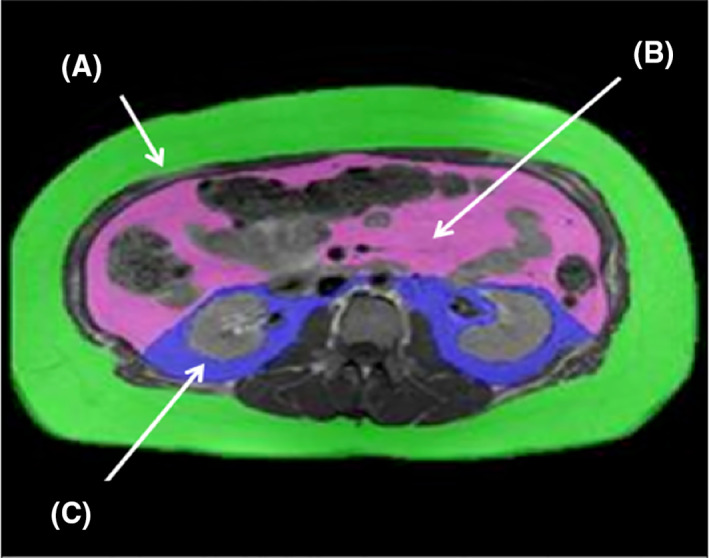
In this prospective study of 61 cancer patients (23 breast cancer, 32 lymphoma, and 6 sarcoma), IP fat and other assessments of body composition, and changes in LVEF from pre- to postcancer treatment using noninvasive magnetic resonance imaging was ascertained.
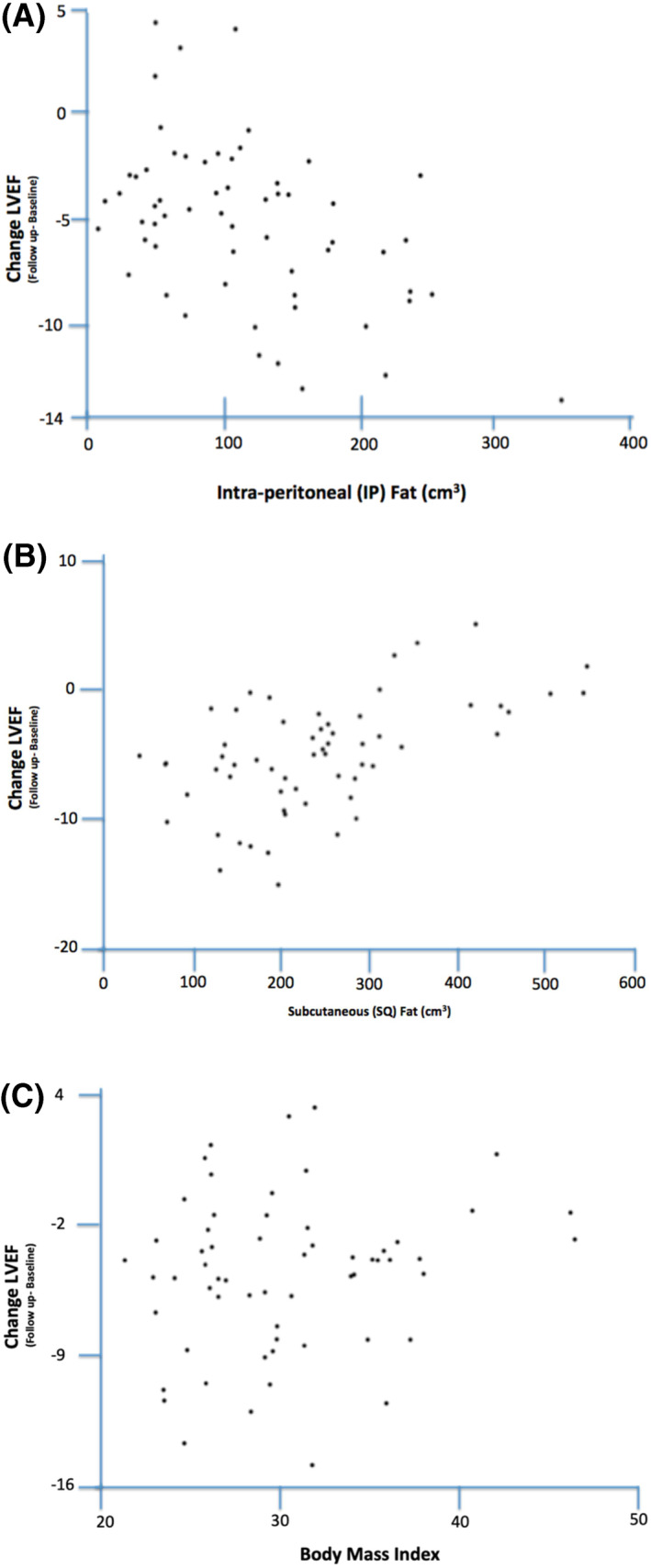
After accounting for age, baseline LVEF, and confounding variables, pre- to 24-month post-treatment LVEF changes were inversely correlated with IP fat ( = -0.33; = 0.02) and positively correlated with measures of subcutaneous (SQ) fat ( = 0.33; = 0.01). These LVEF changes were not correlated with BMI ( = 0.12; = 0.37).
Among patients receiving potentially cardiotoxic chemotherapy, pretreatment IP fat was associated with subsequent declines in LVEF. There was no association between BMI and LVEF decline. These findings may be related to a potential protective effect of SQ fat.
先前的研究已确定体重指数(BMI)和腹腔内(IP)脂肪与心力衰竭之间的关系;然而,在先前对接受潜在心脏毒性化疗的癌症患者的研究中,BMI升高不一定与心脏功能下降相关。本研究检验了以下假设:在接受潜在心脏毒性化疗的癌症患者中,IP脂肪可能与左心室射血分数(LVEF)下降有关。
在这项对61名癌症患者(23名乳腺癌患者、32名淋巴瘤患者和6名肉瘤患者)的前瞻性研究中,通过无创磁共振成像确定了IP脂肪和身体成分的其他评估指标,以及癌症治疗前后LVEF的变化。
在考虑年龄、基线LVEF和混杂变量后,治疗前至治疗后24个月的LVEF变化与IP脂肪呈负相关(r = -0.33;P = 0.02),与皮下(SQ)脂肪测量值呈正相关(r = 0.33;P = 0.01)。这些LVEF变化与BMI无关(r = 0.12;P = 0.37)。
在接受潜在心脏毒性化疗的患者中,治疗前的IP脂肪与随后的LVEF下降有关。BMI与LVEF下降之间没有关联。这些发现可能与SQ脂肪的潜在保护作用有关。