Zheng Guo-Dian, Xu Zhi-Yuan, Hu Can, Lv Hang, Xie Hua-Xia, Huang Ting, Zhang Yan-Qiang, Chen Gui-Ping, Fu Yu-Fei, Cheng Xiang-Dong
Department of Hepatobiliary Surgery, Zhejiang Provincial Hospital of Traditional Chinese Medicine, Hangzhou, China.
Department of Gastric Surgery, Institute of Cancer Research and Basic Medical Sciences of Chinese Academy of Sciences, Zhejiang Cancer Hospital, Cancer Hospital of University of Chinese Academy of Sciences, Hangzhou, China.
Front Mol Biosci. 2021 Feb 12;8:636566. doi: 10.3389/fmolb.2021.636566. eCollection 2021.
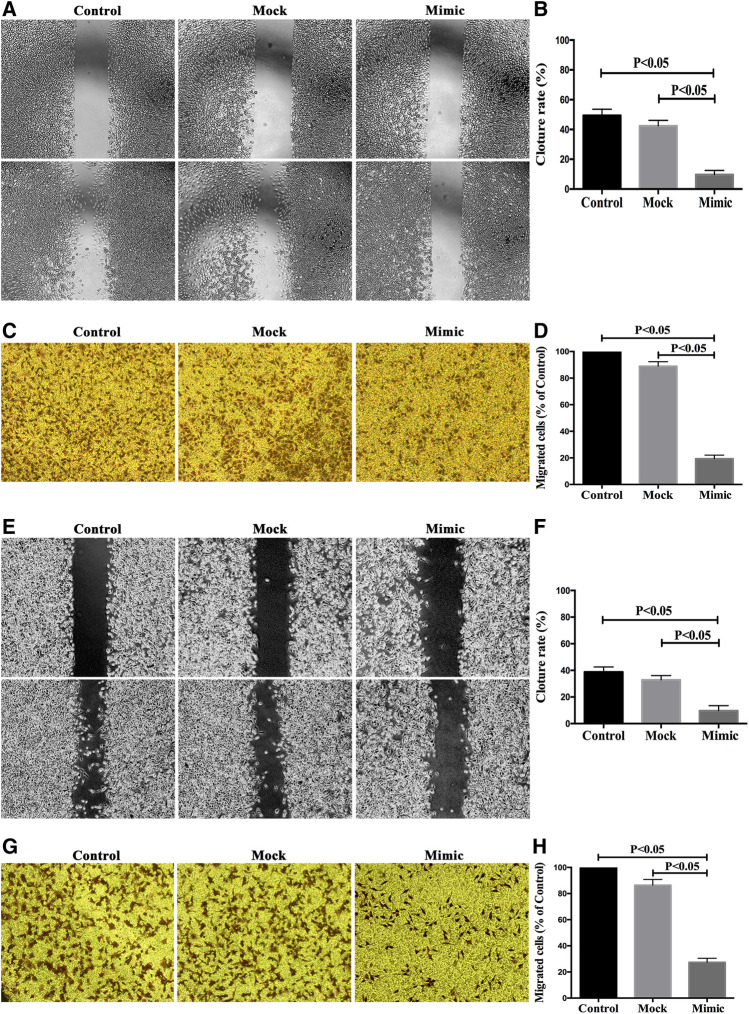
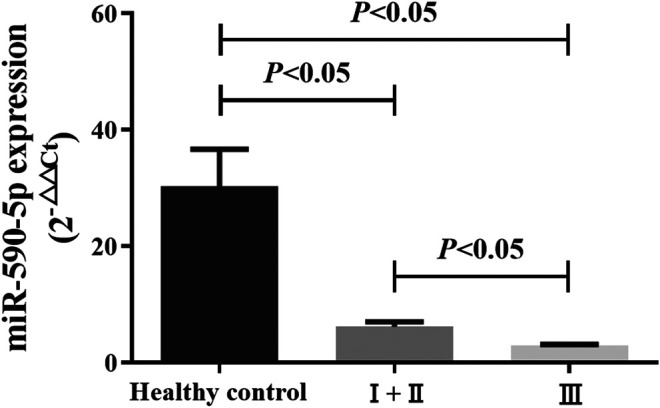
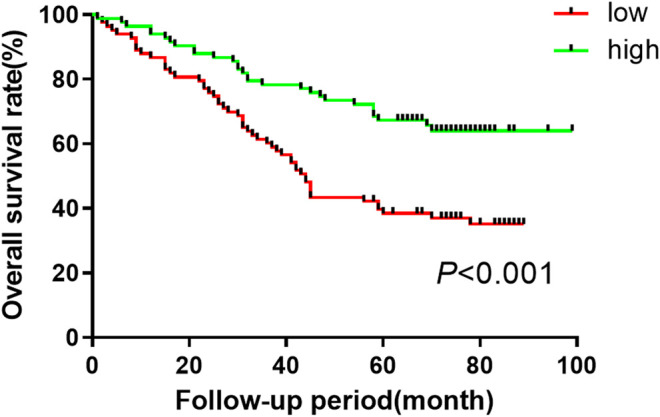
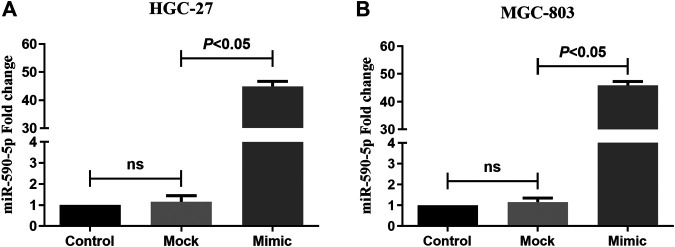
The purpose of this study is to explore the expression of miRNA-590-5p, an exosome of gastric cancer (GC), and to evaluate the suitability of miR-590-5p, an exosome with its own clinical characteristics. Serum samples from 168 gastric cancer patients and 50 matched controls were collected and exosomal RNAs were extracted. After that, miR-590-5p is analyzed by quantitative polymerase chain reaction (qRT-PCR), which is more related to clinical and pathological parameters and patient monitoring data. MGC-803 and HGC-27 cells were treated by miR-590-5p mimics, and then the changes of cell fluidity and invasiveness were monitored. The results showed that the expression level of miR-590-5p in exosomes of healthy observation group, early (I and II) stage group, and late stage (III) group was 30.34 ± 6.35, 6.19 ± 0.81, and 2.9 ± 0.19, respectively (all < 0.05). ROC (receiver-operating characteristic curve) showed that the AUC (area under the curve) of exosomal miR-590-5p was 0.810 with 63.7% sensitivity and 86% specificity. The expression of exosomal miR-590-5p in serum was related to clinical stage ( = 0.008), infiltration depth, and the expression level of ki-67 ( < 0.001). In addition, Kaplan-Meier analysis showed that the decrease of explicit level of exosomal miR-590-5p was related to the decrease of overall survival rate ( < 0.001). Cox regression analysis showed that miR-590-5p can be used as an independent predictor. Furthermore, upregulation of miR-590-5p inhibited cell migration and invasion in MGC-803 cells and HGC-27 cells. The serum expression level of exosomal miR-590-5p may be a biomarker, which is potentially useful and noninvasive for early detection and prediction of GC. In addition, miR-590-5p can play a role in eliminating carcinogens by actively regulating the malignant potential of gastric cancer.
本研究旨在探讨胃癌(GC)外泌体中miRNA-590-5p的表达情况,并评估具有自身临床特征的外泌体miR-590-5p的适用性。收集了168例胃癌患者和50例匹配对照的血清样本,并提取外泌体RNA。之后,通过定量聚合酶链反应(qRT-PCR)分析miR-590-5p,其与临床病理参数及患者监测数据的相关性更强。用miR-590-5p模拟物处理MGC-803和HGC-27细胞,然后监测细胞流动性和侵袭性的变化。结果显示,健康观察组、早期(I和II期)组及晚期(III期)组外泌体中miR-590-5p的表达水平分别为30.34±6.35、6.19±0.81和2.9±0.19(均P<0.05)。ROC(受试者工作特征曲线)显示,外泌体miR-590-5p的AUC(曲线下面积)为0.810,敏感性为63.7%,特异性为86%。血清中外泌体miR-590-5p的表达与临床分期(P = 0.008)、浸润深度及ki-67的表达水平相关(P<0.001)。此外,Kaplan-Meier分析显示,外泌体miR-590-5p表达水平的降低与总生存率的降低相关(P<0.001)。Cox回归分析显示,miR-590-5p可作为独立预测因子。此外,上调miR-590-5p可抑制MGC-803细胞和HGC-27细胞的迁移和侵袭。外泌体miR-590-5p的血清表达水平可能是一种生物标志物,对胃癌的早期检测和预测具有潜在的应用价值且为非侵入性。此外,miR-590-5p可通过积极调节胃癌的恶性潜能在消除致癌物方面发挥作用。