Wang Cheng, Wang Jianhua, Cui Wenjing, Liu Yongkang, Zhou Hao, Wang Yajie, Chen Xin, Chen Xiao, Wang Zhongqiu
Department of Radiology, The Affiliated Hospital of Nanjing University of Chinese Medicine, Nanjing, 210029, People's Republic of China.
Department of Radiology, Nanjing Drum Tower Hospital, The Affiliated Hospital of Nanjing University Medical School, Nanjing, 210029, People's Republic of China.
Onco Targets Ther. 2021 Feb 26;14:1441-1451. doi: 10.2147/OTT.S296816. eCollection 2021.
Pancreatic ductal adenocarcinoma (PDAC) is the fourth leading cause of cancer-related mortality and it is urgent to find biomarkers for early detection of PDAC. Exosomal miRNAs are useful biomarkers for cancer detection. The aims of this study were to investigate the potential role of serum exosomal miRNA in detection of PDAC and to analyze the correlation between the levels of exosome miRNA and the tumor biological behaviors.
Thirteen serum samples were collected from five patients with PDACs, three healthy individuals (HIs) and five benign pancreatic lesions (BP) for a high throughput profiling analysis to identify an altered miRNA expression patterns in PDAC. Candidate exosomal miRNAs were filtered based on a second independent cohort that included 17 PDACs and 12 benign pancreatic lesions by quantitative real-time polymerase chain reaction (qRT-PCR). Four miRNAs were selected for miRNA validation as PDAC biomarkers in a subsequent set of samples. The association between candidate exosomal miRNA and tumor behavior (tumor invasion or metastases) was evaluated in 17 PDACs. In vitro studies were performed to evaluate the role of candidate exosomal miRNA on cell viability, apoptosis and cell migration in two PDAC cell lines.
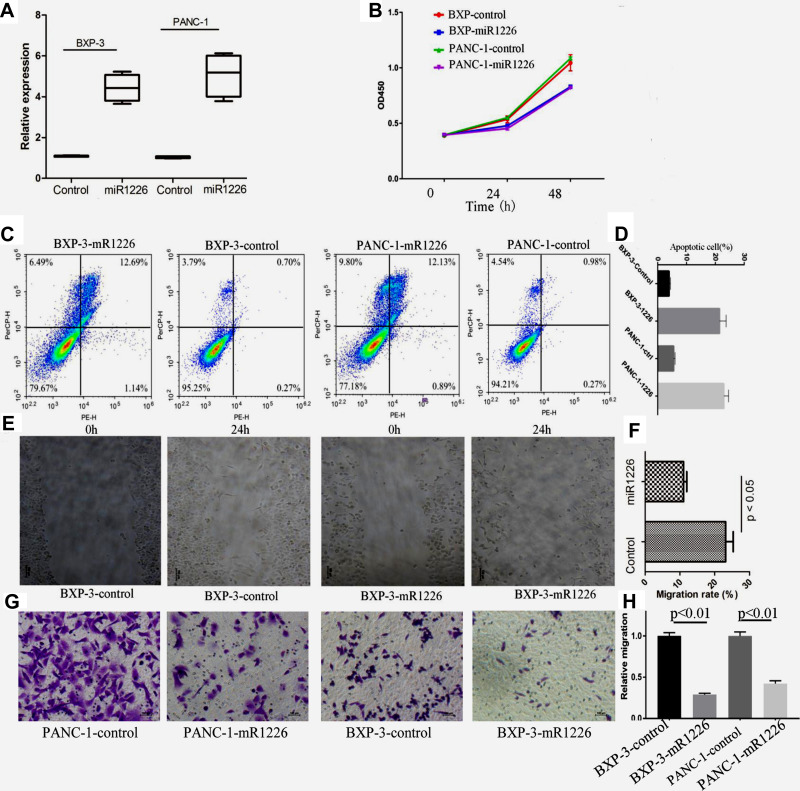
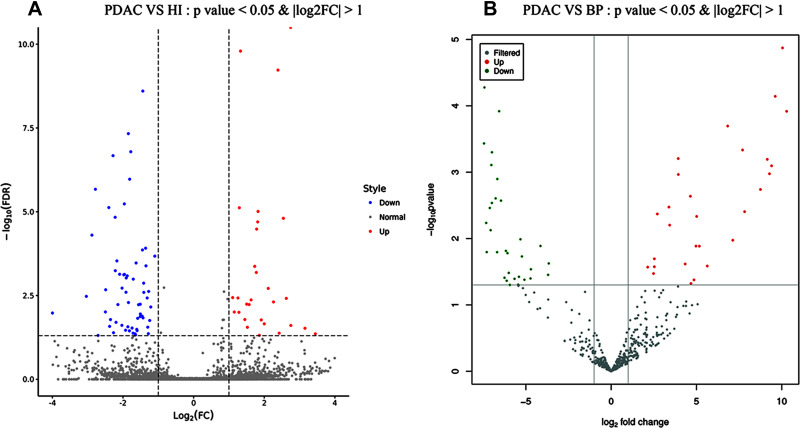
The expression of 11 miRNAs showed same trend between PDAC and BP, and between PDAC and HIs. Six of them were upregulated (miR-203b-5p, miR-342-5p, miR-337-5p, miR-149-5p, miR-877-5p, miR-203a-3p), and five were downregulated (miR-1226-3p, miR-3182, miR-625-3p, miR-624-5p, miR-664a-5p). miR-1226-3p was selected as the candidate exosomal biomarker for the PDAC detection. The expression of serum exosomal miRNA-1226-3p was downregulated in PDACs compared to the BPs (p = 0.025). miR-1226-3p had acceptable performance in predicting [area under the curve (AUC) = 0.74] PDAC. Exosomal miRNA-1226-3p level in PDAC with invasion or metastases was lower than that without invasion or metastases (p = 0.028). Transfection of miRNA-1226-3p significantly inhibited the proliferation of PANC-1 and BXP-3 cells, stimulated cell apoptosis and inhibited cell migration.
Serum exosomal miRNA-1226-3p is a potential biomarker in diagnosing and predicting the tumor invasion or metastases of PDAC.
胰腺导管腺癌(PDAC)是癌症相关死亡的第四大主要原因,因此迫切需要寻找用于早期检测PDAC的生物标志物。外泌体微小RNA(miRNA)是用于癌症检测的有用生物标志物。本研究的目的是探讨血清外泌体miRNA在PDAC检测中的潜在作用,并分析外泌体miRNA水平与肿瘤生物学行为之间的相关性。
收集了5例PDAC患者、3名健康个体(HI)和5例良性胰腺病变(BP)的13份血清样本,进行高通量分析以鉴定PDAC中miRNA表达模式的改变。通过定量实时聚合酶链反应(qRT-PCR),基于包括17例PDAC和12例良性胰腺病变的第二个独立队列筛选候选外泌体miRNA。在随后的一组样本中选择4种miRNA作为PDAC生物标志物进行miRNA验证。在17例PDAC中评估候选外泌体miRNA与肿瘤行为(肿瘤侵袭或转移)之间的关联。进行体外研究以评估候选外泌体miRNA对两种PDAC细胞系中细胞活力、凋亡和细胞迁移的作用。
11种miRNA在PDAC与BP之间以及PDAC与HI之间表现出相同的趋势。其中6种上调(miR-203b-5p、miR-342-5p、miR-337-5p、miR-149-5p、miR-877-5p、miR-203a-3p),5种下调(miR-1226-3p、miR-3182、miR-625-3p、miR-624-5p、miR-664a-5p)。miR-1226-3p被选为PDAC检测的候选外泌体生物标志物。与BP相比,PDAC中血清外泌体miRNA-l226-3p的表达下调(p = 0.025)。miR-1226-3p在预测PDAC方面具有可接受的性能[曲线下面积(AUC)= 0.74]。有侵袭或转移的PDAC中外泌体miRNA-1226-3p水平低于无侵袭或转移的PDAC(p = 0.028)。转染miRNA-1226-3p可显著抑制PANC-1和BXP-3细胞的增殖,刺激细胞凋亡并抑制细胞迁移。
血清外泌体miRNA-1226-3p是诊断和预测PDAC肿瘤侵袭或转移的潜在生物标志物。