Department of Public Health and Mortality Studies, International Institute for Population Sciences, Mumbai, India.
Department of Mathematical Demography & Statistics, International Institute for Population Sciences, Mumbai, India.
PLoS One. 2021 Mar 8;16(3):e0247943. doi: 10.1371/journal.pone.0247943. eCollection 2021.
Gender and health are two factors that shape the quality of life in old age. Previous available literature established an associaton between various demographic and socio-economic factors with the health and well-being of older adults in India; however, the influence of childless aged is neglected. Therefore, the study examined the gender differential in psychological health and subjective well-being among older adults, focusing on childless older adults.
This study utilized data from Building a Knowledge Base on Population Aging in India (BKPAI). Psychological health and subjective well-being were examined for 9541 older adults aged 60 years & above. Descriptive statistics and bivariate analysis were used to find the preliminary results. Further, multivariate analysis has been done to fulfill the objective of the study.
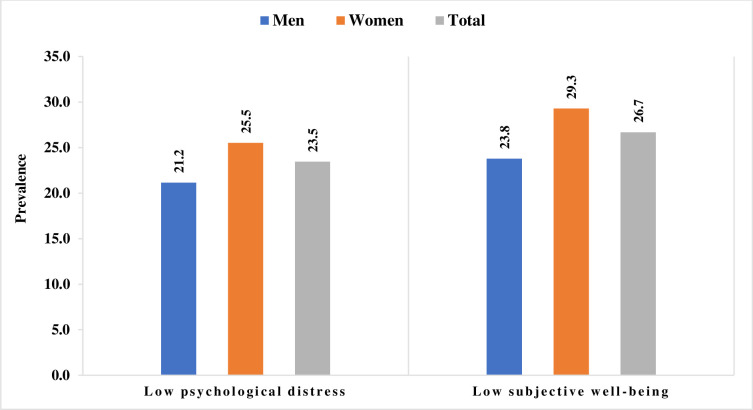
Around one-fifth (21.2%) of the men reported low psychological health, whereas around one-fourth (25.5%) of the women reported low psychological health. Further, around 24 per cent of men and 29 per cent of women reported low subjective well-being. Results found that low psychological well-being (OR = 1.87, C.I. = 1.16-3.01), as well as low subjective well-being (OR = 1.78, C.I. = 1.15-2.76), was higher in childless older women than in childless older men. Higher education, community involvement, good self-rated health, richest wealth quintile, and residing in urban areas significantly decrease the odds of low subjective well-being and low psychological well-being among older adults.
There is a need to improve older adults' psychological health and subjective well-being through expanded welfare provisions, especially for childless older adults. Moreover, there is an immediate requirement to cater to the needs of poor and uneducated older adults.
性别和健康是影响老年人生活质量的两个因素。之前的可用文献已经确定了各种人口和社会经济因素与印度老年人健康和幸福感之间的关系;然而,忽视了无子女老年人的影响。因此,本研究考察了性别差异对老年人心理健康和主观幸福感的影响,重点关注无子女的老年人。
本研究利用了印度人口老龄化知识基础建设(BKPAI)的数据。对 9541 名 60 岁及以上的老年人进行了心理健康和主观幸福感的调查。采用描述性统计和双变量分析来得出初步结果。进一步,进行了多变量分析以实现研究目标。
约五分之一(21.2%)的男性报告心理健康水平较低,而约四分之一(25.5%)的女性报告心理健康水平较低。此外,约 24%的男性和 29%的女性报告主观幸福感较低。研究结果发现,无子女的老年女性比无子女的老年男性心理健康水平较低(OR=1.87,CI=1.16-3.01)和主观幸福感较低(OR=1.78,CI=1.15-2.76)的可能性更高。较高的教育程度、社区参与度、自我报告的良好健康状况、最富裕的财富五分位数和居住在城市地区显著降低了老年人主观幸福感和心理健康水平较低的可能性。
需要通过扩大福利供给来改善老年人的心理健康和主观幸福感,特别是为无子女的老年人提供支持。此外,迫切需要满足贫困和未受教育的老年人的需求。