Augsburg University Hospital, Department of Gastroenterology, Rheumatology and Infectiology, Stenglinstr. 2, 86156 Augsburg, Germany.
Int Health. 2021 Dec 1;13(6):514-519. doi: 10.1093/inthealth/ihab006.
The most commonly cited argument for imposing or lifting various restrictions in the context of the coronavirus disease 2019 (COVID-19) pandemic is an assumed impact on the reproductive ratio of the pathogen. It has furthermore been suggested that less-developed countries are particularly affected by this pandemic. Empirical evidence for this is lacking.
Based on a dataset covering 170 countries, patterns of empirical 7-d reproductive ratios during the first months of the COVID-19 pandemic were analysed. Time trends and associations with socio-economic development indicators, such as gross domestic product per capita, physicians per population, extreme poverty prevalence and maternal mortality ratio, were analysed in mixed linear regression models using log-transformed reproductive ratios as the dependent variable.
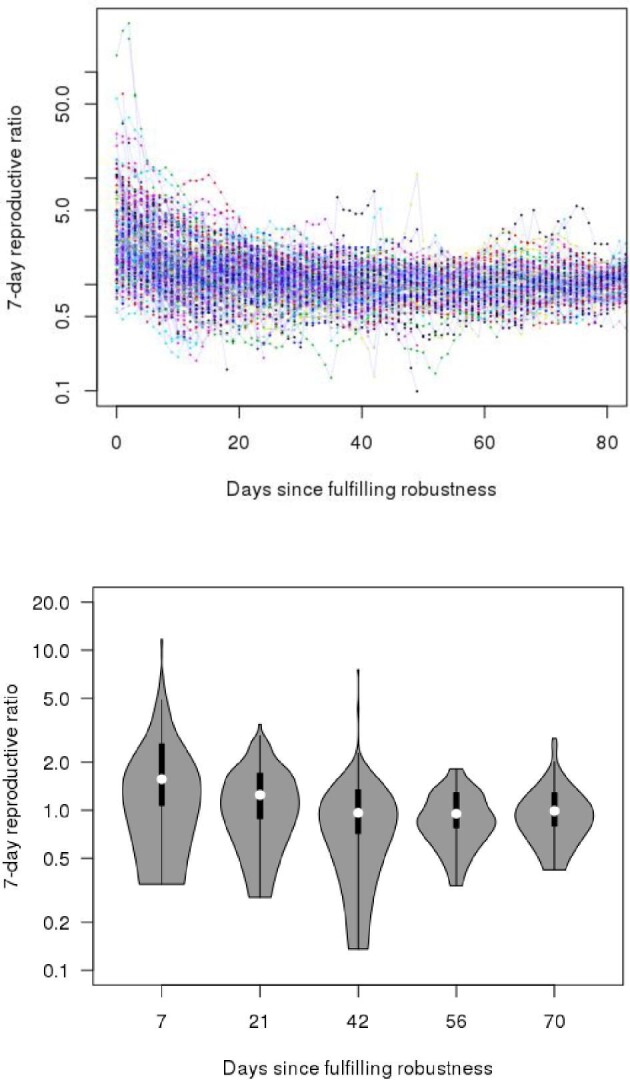
Reproductive ratios during the early phase of a pandemic exhibited high fluctuations and overall strong declines. Stable estimates were observed only several weeks into the pandemic, with a median reproductive ratio of 0.96 (interquartile range 0.72-1.34) 6 weeks into the analysis period. Unfavourable socio-economic indicators showed consistent associations with higher reproductive ratios, which were elevated by a factor of 1.29 (95% confidence interval 1.15 to 1.46), for example, in the countries in the highest compared with the lowest tertile of extreme poverty prevalence.
The COVID-19 pandemic has allowed for the first time description of the global patterns of reproductive ratios of a novel pathogen during pandemic spread. The present study reports the first quantitative empirical evidence that COVID-19 net transmissibility remains less controlled in socio-economically disadvantaged countries, even months into the pandemic. This needs to be addressed by the global scientific community as well as international politics.
在 2019 年冠状病毒病(COVID-19)大流行的背景下,提出实施或取消各种限制的最常被引用的论点是病原体繁殖率的假设影响。此外,有人认为欠发达国家受这一大流行的影响尤其严重。但缺乏这方面的经验证据。
本研究基于涵盖 170 个国家的数据集,分析了 COVID-19 大流行的最初几个月中经验性的 7 天繁殖率模式。使用对数转换后的繁殖率作为因变量,在混合线性回归模型中分析了时间趋势以及与人均国内生产总值、人口中每千人医生数、极端贫困发生率和孕产妇死亡率等社会经济发展指标的相关性。
大流行早期的繁殖率波动较大,总体呈明显下降趋势。仅在大流行开始数周后才观察到稳定的估计值,在分析期间的第 6 周,中位数繁殖率为 0.96(四分位间距 0.72-1.34)。不利的社会经济指标与较高的繁殖率始终存在关联,例如,在极端贫困发生率最高与最低三分之一的国家中,繁殖率升高了 1.29 倍(95%置信区间 1.15 至 1.46)。
COVID-19 大流行首次允许描述新型病原体在大流行传播过程中的全球繁殖率模式。本研究首次提供了定量的经验证据,表明即使在大流行数月后,COVID-19 的净传播性在社会经济处于不利地位的国家仍难以控制。全球科学界和国际政治都需要解决这个问题。