Zhang Bo, Zhang Xue, Schilling M Wes, Li Xiaofei, Tabler George T, Peebles E David, Zhai Wei
Department of Poultry Science, Mississippi State University, Mississippi State, MS, 39762.
Department of Food Science, Nutrition and Health Promotion, Mississippi State University, Mississippi State, MS, 39762.
Poult Sci. 2021 Apr;100(4):101033. doi: 10.1016/j.psj.2021.101033. Epub 2021 Jan 29.
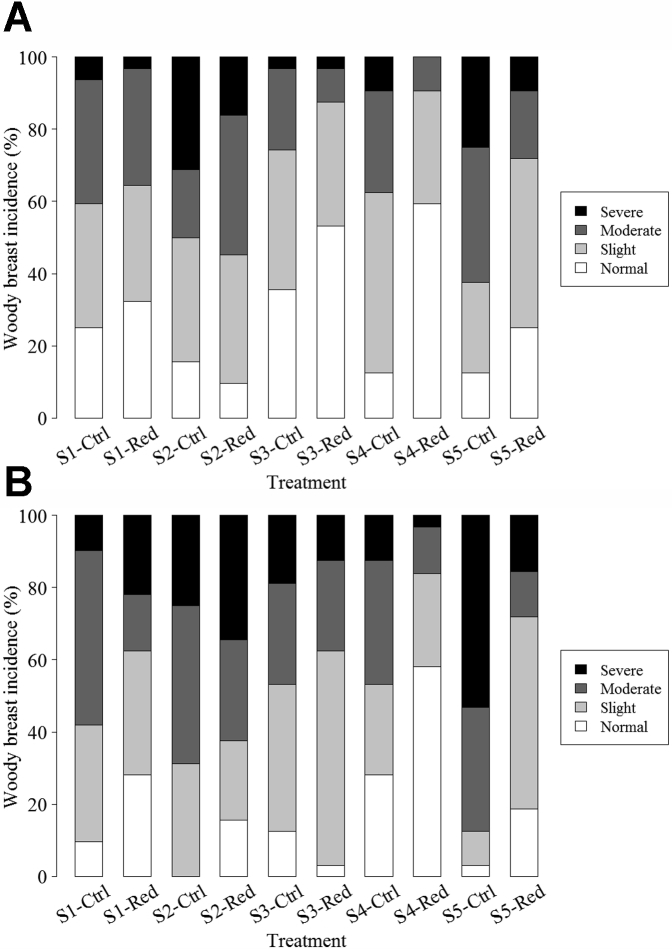
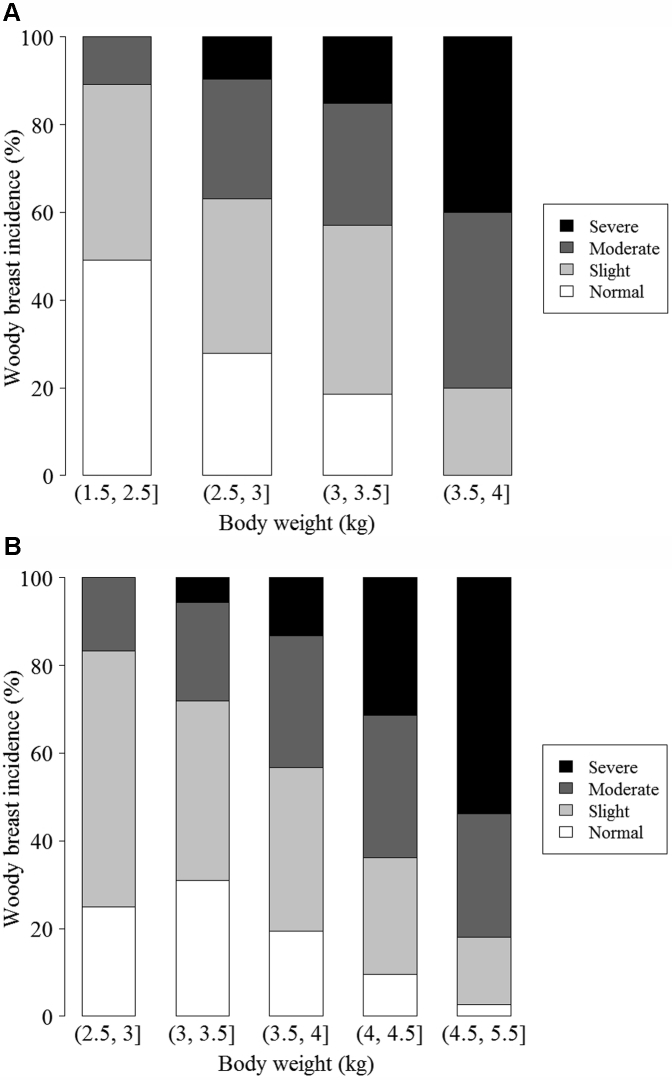
Genetic selection and advances in nutrition have improved broiler growth performance. However, meat quality issues have gained preference over increased growth rate. These meat quality issues may be reduced by lowering dietary amino acid (AA) content. In the present study, 5 common commercial broiler strains were fed either a control or an AA-reduced diet. The control diet was formulated to contain the highest digestible AA (lysine, total sulfur AA, and threonine) levels recommended for the 5 strains. The AA-reduced diet was formulated to contain 20% lower levels of these 3 digestible AA than in the control diet. This resulted in a 5 (strains) × 2 (AA levels) factorial arrangement. A total of 1,280 straight run broilers were randomly allocated to 8 replicate blocks. The AA reduction decreased absolute breast weights of 3 strains on day 42 and 2 strains on day 56, and decreased absolute weights of tender, wing, drumstick, and thigh on both day 42 and 56 for all 5 strains. However, the absolute fat pad weight and relative fat pad and thigh weights to BW were increased in the AA reduction treatments on both day 42 and 56. The AA reduction contributed to the lower breast meat pH on both day 42 and 56, which may have been directly related to decreased severe woody breast myopathy (WBM) incidence on day 42 and moderate WBM incidence on day 56. The severity of WBM was positively related to breast weight in all 10 treatments on both day 42 and 56, with the exception of birds in strain 3 on day 56 that were fed the AA-reduced diet. At the same time, AA reduction was more cost-effective when WBM incidence was considered in a theoretical model. In conclusion, WBM severity was associated with higher breast weight in birds of most strains fed either a control or AA-reduced diet. Dietary AA reduction decreased processing yields but decreased WBM incidence, which may be more economical.
遗传选择和营养方面的进步提高了肉鸡的生长性能。然而,肉质问题比生长速度的提高更受关注。通过降低日粮氨基酸(AA)含量,这些肉质问题可能会得到缓解。在本研究中,给5种常见的商业肉鸡品系饲喂对照日粮或低氨基酸日粮。对照日粮的配方含有为这5个品系推荐的最高可消化氨基酸(赖氨酸、总含硫氨基酸和苏氨酸)水平。低氨基酸日粮的配方中,这3种可消化氨基酸的含量比对照日粮低20%。这形成了一个5(品系)×2(氨基酸水平)的析因设计。总共1280只直选肉鸡被随机分配到8个重复组中。氨基酸含量降低使3个品系在42日龄时和2个品系在56日龄时的胸肌绝对重量降低,并且使所有5个品系在42日龄和56日龄时的嫩肉、翅膀、鸡腿和大腿的绝对重量降低。然而,在42日龄和56日龄时,低氨基酸处理组的脂肪垫绝对重量以及脂肪垫和大腿相对于体重的相对重量均增加。氨基酸含量降低导致42日龄和56日龄时胸肉pH值降低,这可能与42日龄时严重木质胸肌病(WBM)发病率降低以及56日龄时中度WBM发病率降低直接相关。在42日龄和56日龄时的所有10种处理中,除了56日龄时饲喂低氨基酸日粮的3号品系鸡外,WBM的严重程度与胸肌重量呈正相关。同时,在一个理论模型中考虑WBM发病率时,降低氨基酸含量更具成本效益。总之,在饲喂对照日粮或低氨基酸日粮的大多数品系鸡中,WBM的严重程度与较高的胸肌重量相关。日粮氨基酸含量降低会降低加工产量,但会降低WBM发病率,这可能更经济。