Dagnew Amare Belachew, Teferi Mulat Dagnew
College of Medicine and Health Sciences, Bahir Dar University, Bahir Dar, Ethiopia.
College of Medicine and Health Sciences, University of Gondar, Gondar, Ethiopia.
BMC Pregnancy Childbirth. 2021 Mar 8;21(1):194. doi: 10.1186/s12884-021-03662-3.
The prevalence of the World Health Organization (WHO) recommended infant feeding practices for HIV exposed infants is low in developing countries. There is no nationwide representative study was done in Ethiopia. Therefore, this study aimed to assess the pooled prevalence of WHO-recommended infant feeding practices among HIV-positive mothers in Ethiopia.
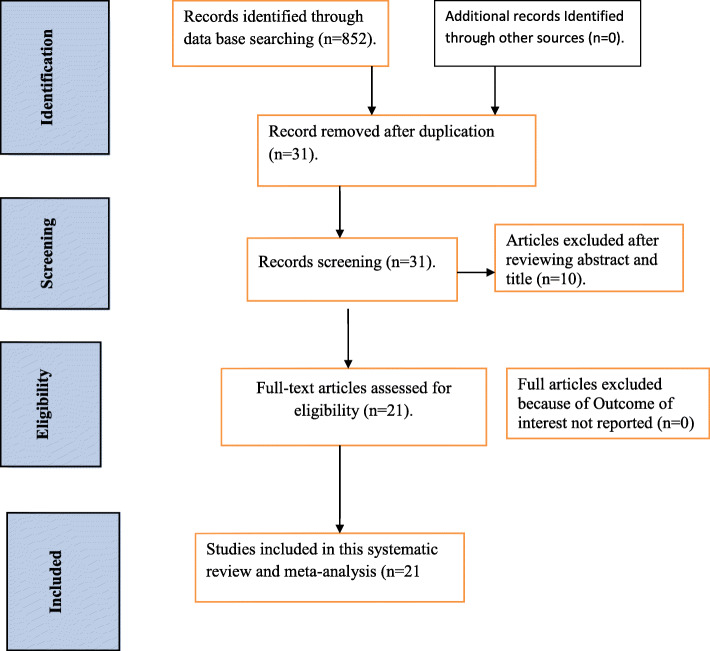
EMBASE, PubMed, Google Scholar, CINHAL, Web of Science, Cochrane library, and hand searches of references were extensively searched to find out the primary articles. This study was included in all primary articles published in peer review journals regarding the recommended infant feeding practices in Ethiopia. Reviewers were used a standardized Microsoft Excel format to extract the data and analyzed it with Stata 11 version software. The pooled prevalence of recommended infant feeding practices among HIV exposed infants was estimated by a random-effect model. The sources of variation between the studies were identified by the I statistics test. Furthermore, the source of heterogeneity was checked by subgroup and meta-regression analyses. Sensitivity analysis was also carried out for included articles to identify extreme values that affect the outcome of pooled results.
A total of twenty-one articles were included in this study. The random effect pooled prevalence of WHO-recommended infant feeding practices in Ethiopia was 82.76% (95% Confidence Interval [CI]: 75.4, 90.11) with the heterogeneity of I = 93.7 with a value of p < 0.001. The subgroup analysis result showed that the highest prevalence of WHO-recommended infant feeding practices was observed in the retrospective cohort study design, 89.45%, and the lowest prevalence was found in cross-sectional studies, 80.67%. Mothers who disclosed their HIV serostatus to their spouses OR = 2.88(2.27, 3.66) and attended antenatal care visits OR = 4.62(3.13, 6.83) were more likely to follow the WHO-recommended infant feeding practices than their counterparts.
Two out of ten HIV exposed infants received mixed feeding in Ethiopia. Health professionals should support and counsel HIV positive mothers to disclose their HIV serostatus to their spouses and advertisements in general or community health workers can get this message out to encourage using antenatal care services during the pregnancy period were recommended to increase the adoption of WHO recommended infant feeding practices and decrease their infant's risk of morbidity, including HIV infection.
在发展中国家,世界卫生组织(WHO)推荐的针对暴露于艾滋病病毒的婴儿的喂养方式的普及率较低。埃塞俄比亚尚未开展全国范围的代表性研究。因此,本研究旨在评估埃塞俄比亚感染艾滋病病毒的母亲中WHO推荐的婴儿喂养方式的合并普及率。
广泛检索了EMBASE、PubMed、谷歌学术、CINHAL、科学网、Cochrane图书馆,并进行了参考文献的手工检索,以找出相关的原始文章。本研究纳入了所有发表在同行评审期刊上的关于埃塞俄比亚推荐的婴儿喂养方式的原始文章。评审人员使用标准化的Microsoft Excel格式提取数据,并使用Stata 11版本软件进行分析。通过随机效应模型估计暴露于艾滋病病毒的婴儿中推荐的婴儿喂养方式的合并普及率。通过I²统计检验确定研究之间的变异来源。此外,通过亚组分析和Meta回归分析检查异质性来源。还对纳入的文章进行了敏感性分析,以识别影响合并结果的极端值。
本研究共纳入了21篇文章。埃塞俄比亚WHO推荐的婴儿喂养方式的随机效应合并普及率为82.76%(95%置信区间[CI]:75.4,90.11),异质性I² = 93.7,p值<0.001。亚组分析结果显示,回顾性队列研究设计中WHO推荐的婴儿喂养方式的普及率最高,为89.45%,横断面研究中最低,为80.67%。向配偶披露其艾滋病病毒血清学状态的母亲(比值比[OR]=2.88[2.27,3.66])和参加产前检查的母亲(OR=4.62[3.13,6.83])比其他母亲更有可能遵循WHO推荐的婴儿喂养方式。
在埃塞俄比亚,每十名暴露于艾滋病病毒的婴儿中有两名接受混合喂养。建议卫生专业人员支持并为感染艾滋病病毒的母亲提供咨询,使其向配偶披露自己的艾滋病病毒血清学状态,并且一般的广告宣传或社区卫生工作者可以传达此信息,以鼓励在孕期使用产前保健服务,从而提高对WHO推荐的婴儿喂养方式的采用率,并降低其婴儿发病的风险,包括感染艾滋病病毒的风险。