Aravindhan Surendar, Ejam Sura Salman, Lafta Methaq Hadi, Markov Alexander, Yumashev Alexei Valerievich, Ahmadi Majid
Department of Pharmacology, Saveetha dental College and hospital, Saveetha institute of medical and technical sciences, Chennai, India.
Department of Pathology, College of Medicine, University of Babylon, Babylon, Iraq.
Cancer Cell Int. 2021 Mar 8;21(1):158. doi: 10.1186/s12935-021-01836-9.
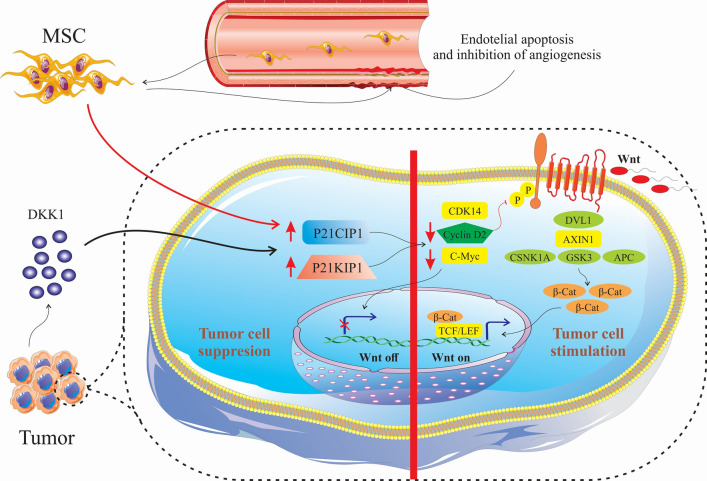
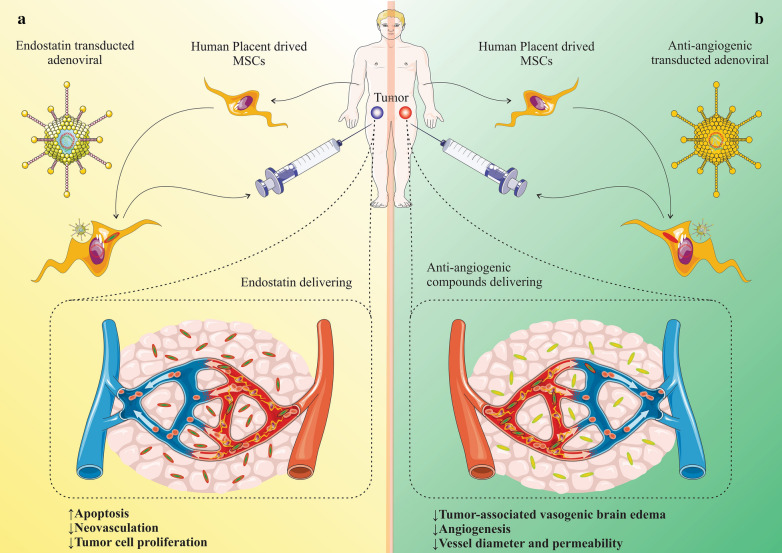
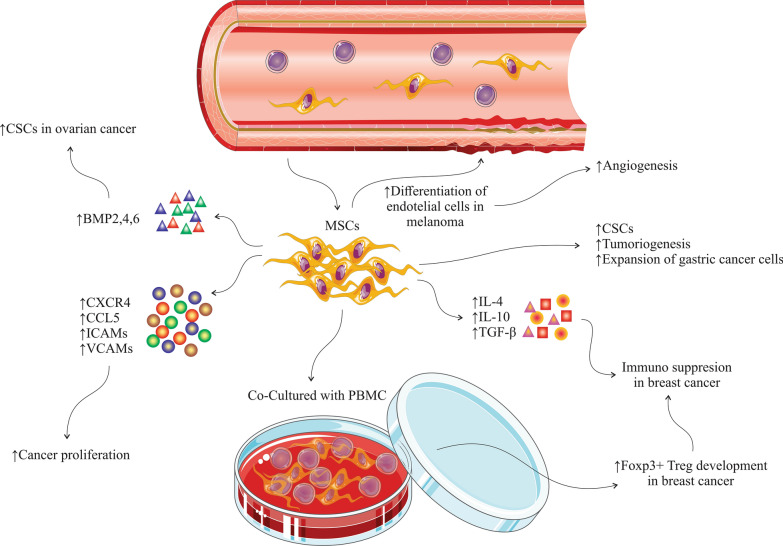
A crosstalk established between tumor microenvironment and tumor cells leads to contribution or inhibition of tumor progression. Mesenchymal stem cells (MSCs) are critical cells that fundamentally participate in modulation of the tumor microenvironment, and have been reported to be able to regulate and determine the final destination of tumor cell. Conflicting functions have been attributed to the activity of MSCs in the tumor microenvironment; they can confer a tumorigenic or anti-tumor potential to the tumor cells. Nonetheless, MSCs have been associated with a potential to modulate the tumor microenvironment in favouring the suppression of cancer cells, and promising results have been reported from the preclinical as well as clinical studies. Among the favourable behaviours of MSCs, are releasing mediators (like exosomes) and their natural migrative potential to tumor sites, allowing efficient drug delivering and, thereby, efficient targeting of migrating tumor cells. Additionally, angiogenesis of tumor tissue has been characterized as a key feature of tumors for growth and metastasis. Upon introduction of first anti-angiogenic therapy by a monoclonal antibody, attentions have been drawn toward manipulation of angiogenesis as an attractive strategy for cancer therapy. After that, a wide effort has been put on improving the approaches for cancer therapy through interfering with tumor angiogenesis. In this article, we attempted to have an overview on recent findings with respect to promising potential of MSCs in cancer therapy and had emphasis on the implementing MSCs to improve them against the suppression of angiogenesis in tumor tissue, hence, impeding the tumor progression.
肿瘤微环境与肿瘤细胞之间建立的串扰会导致肿瘤进展的促进或抑制。间充质干细胞(MSCs)是从根本上参与调节肿瘤微环境的关键细胞,并且据报道能够调节和决定肿瘤细胞的最终归宿。MSCs在肿瘤微环境中的活性具有相互矛盾的功能;它们可以赋予肿瘤细胞致瘤或抗肿瘤潜力。尽管如此,MSCs已被证明具有调节肿瘤微环境以利于抑制癌细胞的潜力,临床前和临床研究均已报道了令人鼓舞的结果。MSCs的有利特性包括释放介质(如外泌体)以及它们向肿瘤部位的天然迁移潜力,这使得药物能够有效递送,从而有效地靶向迁移的肿瘤细胞。此外,肿瘤组织的血管生成已被视为肿瘤生长和转移的关键特征。在通过单克隆抗体引入第一种抗血管生成疗法后,人们开始关注将操纵血管生成作为一种有吸引力的癌症治疗策略。此后,人们为通过干扰肿瘤血管生成来改进癌症治疗方法付出了巨大努力。在本文中,我们试图概述MSCs在癌症治疗中潜在的应用前景,并着重介绍如何利用MSCs来增强它们对肿瘤组织血管生成的抑制作用,从而阻止肿瘤进展。