Institute of Immunobiology, Medical Research Center, Kantonsspital St. Gallen, St. Gallen, Switzerland.
Institute of Experimental Immunology, University of Zürich, Zürich, Switzerland.
Eur J Immunol. 2021 May;51(5):1062-1070. doi: 10.1002/eji.202048984. Epub 2021 Mar 22.
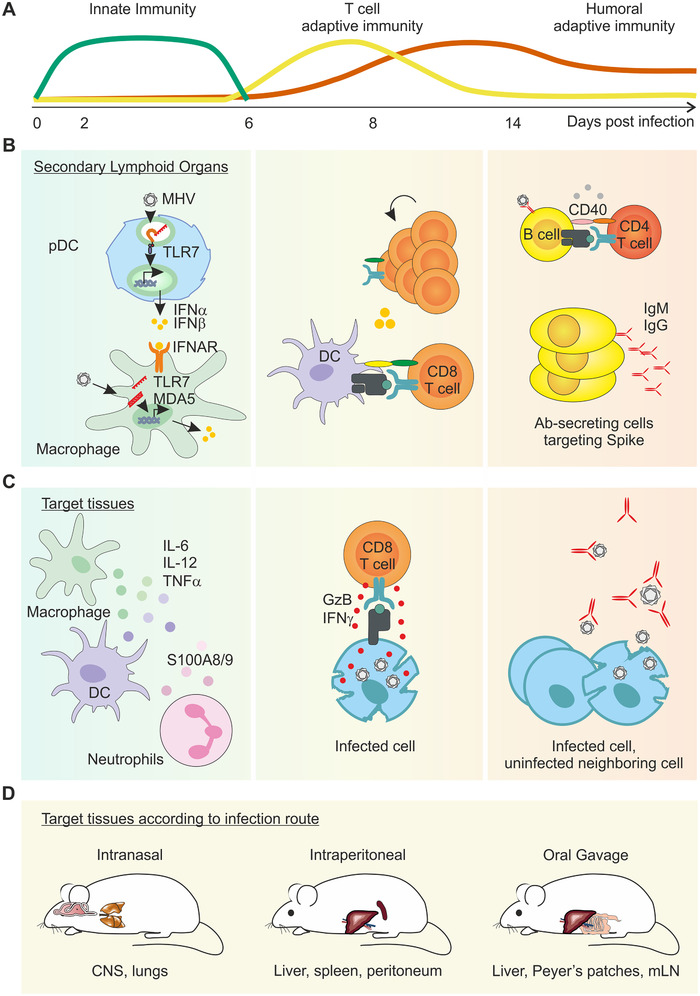
Coronaviruses (CoVs) represent enveloped, ss RNA viruses with the ability to infect a range of vertebrates causing mainly lung, CNS, enteric, and hepatic disease. While the infection with human CoV is commonly associated with mild respiratory symptoms, the emergence of SARS-CoV, MERS-CoV, and SARS-CoV-2 highlights the potential for CoVs to cause severe respiratory and systemic disease. The devastating global health burden caused by SARS-CoV-2 has spawned countless studies seeking clinical correlates of disease severity and host susceptibility factors, revealing a complex network of antiviral immune circuits. The mouse hepatitis virus (MHV) is, like SARS-CoV-2, a beta-CoV and is endemic in wild mice. Laboratory MHV strains have been extensively studied to reveal coronavirus virulence factors and elucidate host mechanisms of antiviral immunity. These are reviewed here with the aim to identify translational insights for SARS-CoV-2 learned from murine CoVs.
冠状病毒(CoV)是一种包膜、ssRNA 病毒,能够感染多种脊椎动物,主要引起肺部、中枢神经系统、肠道和肝脏疾病。虽然人类冠状病毒感染通常与轻微的呼吸道症状有关,但 SARS-CoV、MERS-CoV 和 SARS-CoV-2 的出现突出表明 CoV 有可能导致严重的呼吸道和全身疾病。SARS-CoV-2 造成的破坏性全球健康负担催生了无数研究,旨在寻找疾病严重程度的临床相关性和宿主易感性因素,揭示了抗病毒免疫回路的复杂网络。小鼠肝炎病毒(MHV)与 SARS-CoV-2 一样,是一种β-CoV,在野生鼠中流行。实验室 MHV 株已被广泛研究,以揭示冠状病毒毒力因子,并阐明宿主抗病毒免疫机制。本文对这些进行了综述,旨在从鼠源 CoV 中为 SARS-CoV-2 找到转化研究的见解。