Lewis-Sigler Institute for Integrative Genomics, Princeton University, Princeton, NJ 08540, USA.
Department of Pathology and Cell Biology, Columbia University Medical Center, New York, NY 10032, USA.
Science. 2021 Apr 23;372(6540):363-370. doi: 10.1126/science.abg8663. Epub 2021 Mar 9.
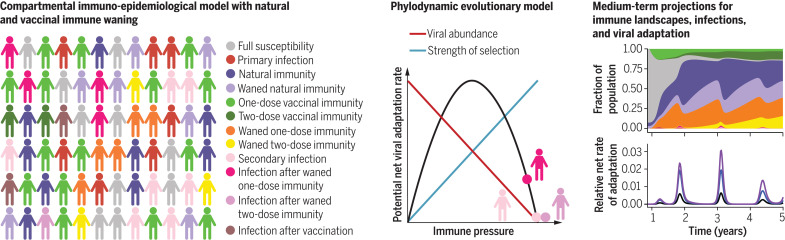
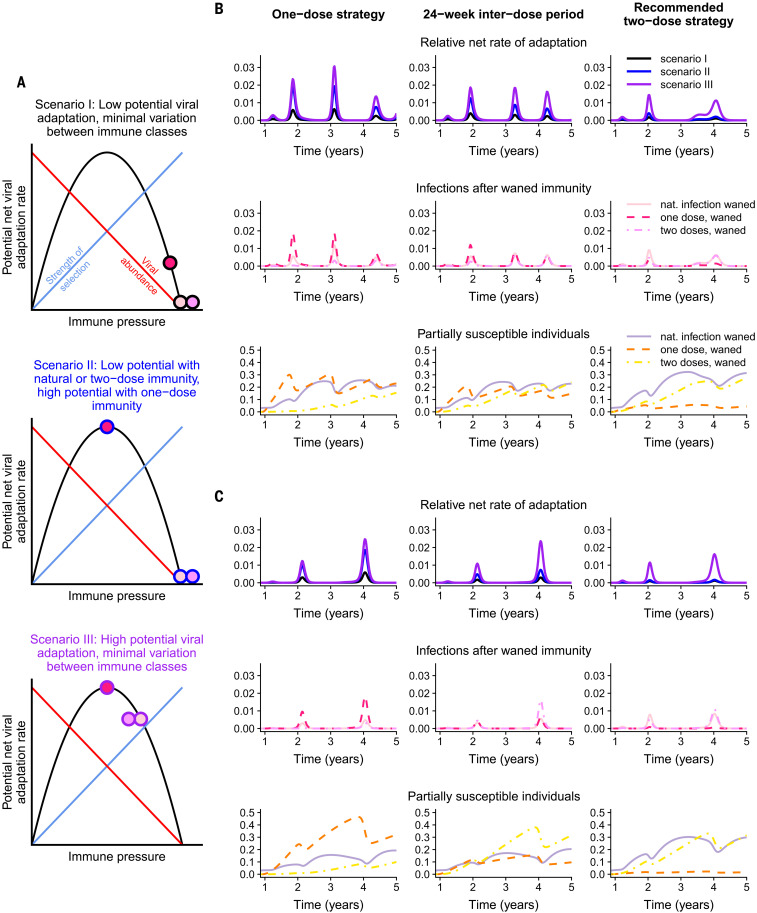
Given vaccine dose shortages and logistical challenges, various deployment strategies are being proposed to increase population immunity levels to severe acute respiratory syndrome coronavirus 2 (SARS-CoV-2). Two critical issues arise: How timing of delivery of the second dose will affect infection dynamics and how it will affect prospects for the evolution of viral immune escape via a buildup of partially immune individuals. Both hinge on the robustness of the immune response elicited by a single dose as compared with natural and two-dose immunity. Building on an existing immuno-epidemiological model, we find that in the short term, focusing on one dose generally decreases infections, but that longer-term outcomes depend on this relative immune robustness. We then explore three scenarios of selection and find that a one-dose policy may increase the potential for antigenic evolution under certain conditions of partial population immunity. We highlight the critical need to test viral loads and quantify immune responses after one vaccine dose and to ramp up vaccination efforts globally.
鉴于疫苗剂量短缺和物流方面的挑战,目前正在提出各种部署策略来提高人群对严重急性呼吸综合征冠状病毒 2 (SARS-CoV-2) 的免疫力。这涉及两个关键问题:第二剂疫苗的接种时间将如何影响感染动态,以及它将如何影响通过部分免疫个体的积累而导致病毒免疫逃逸进化的前景。这两个问题都取决于与自然感染和两剂疫苗接种相比,单剂疫苗所引起的免疫反应的稳健性。我们在现有的免疫流行病学模型基础上发现,短期内,集中接种一剂疫苗通常会减少感染,但长期结果取决于这种相对免疫稳健性。然后,我们探讨了三种选择情景,发现在部分人群免疫的某些条件下,一剂疫苗接种政策可能会增加抗原进化的可能性。我们强调迫切需要在接种一剂疫苗后测试病毒载量并量化免疫反应,并在全球范围内加大疫苗接种力度。