Lopez-Leon Sandra, Wegman-Ostrosky Talia, Perelman Carol, Sepulveda Rosalinda, Rebolledo Paulina, Cuapio Angelica, Villapol Sonia
Novartis Pharmaceuticals.
Instituto Nacional de Cancerología: Instituto Nacional de Cancerologia.
Res Sq. 2021 Mar 1:rs.3.rs-266574. doi: 10.21203/rs.3.rs-266574/v1.
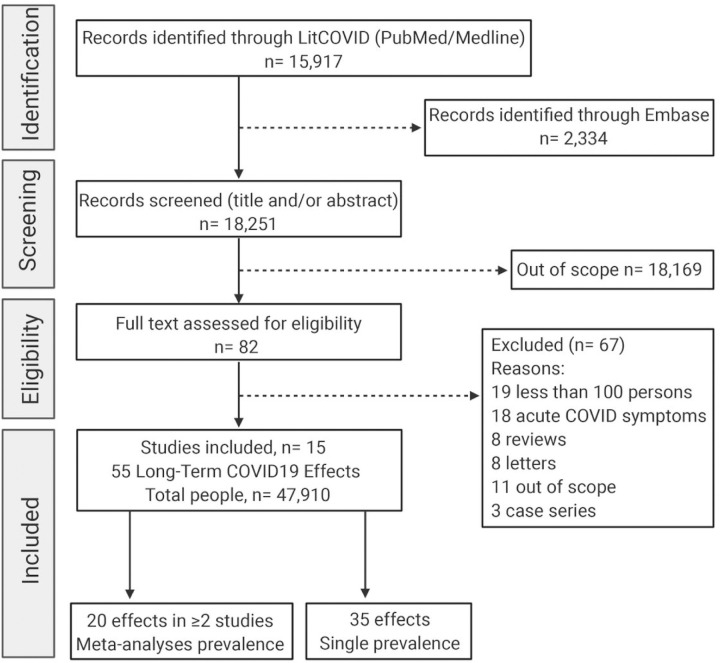
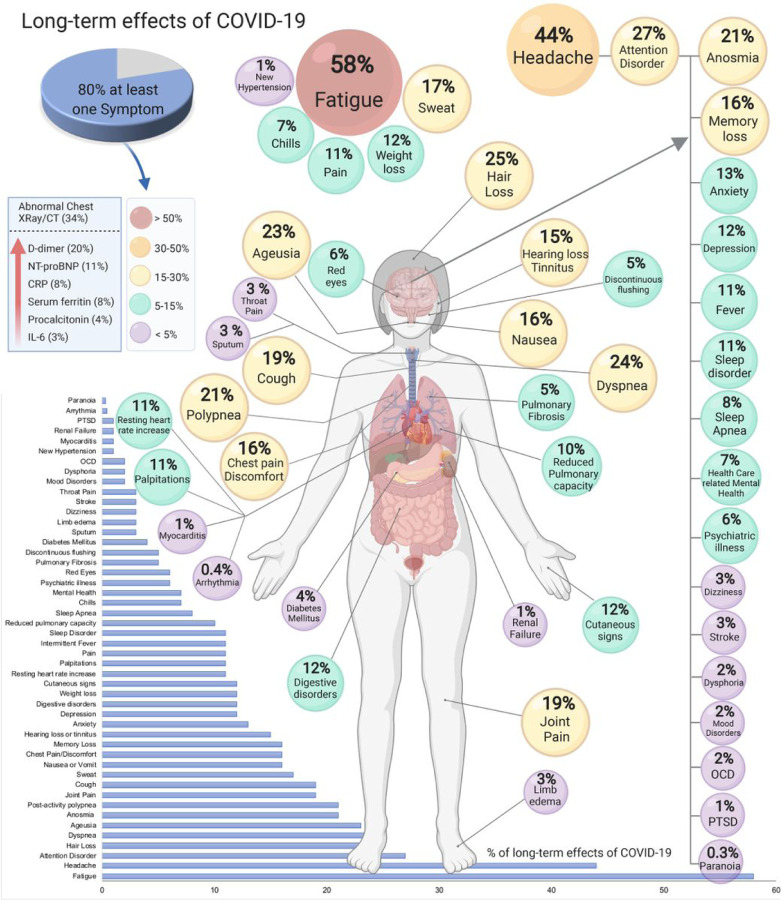
COVID-19, caused by SARS-CoV-2, can involve sequelae and other medical complications that last weeks to months after initial recovery, which has come to be called Long-COVID or COVID long-haulers. This systematic review and meta-analysis aims to identify studies assessing long-term effects of COVID-19 and estimates the prevalence of each symptom, sign, or laboratory parameter of patients at a post-COVID-19 stage. . LitCOVID (PubMed and Medline) and Embase were searched by two independent researchers. All articles with original data for detecting long-term COVID-19 published before 1 of January 2021 and with a minimum of 100 patients were included. For effects reported in two or more studies, meta-analyses using a random-effects model were performed using the MetaXL software to estimate the pooled prevalence with 95% CI. Heterogeneity was assessed using statistics. This systematic review followed Preferred Reporting Items for Systematic Reviewers and Meta-analysis (PRISMA) guidelines, although the study protocol was not registered. A total of 18,251 publications were identified, of which 15 met the inclusion criteria. The prevalence of 55 long-term effects was estimated, 21 meta-analyses were performed, and 47,910 patients were included. The follow-up time ranged from 14 to 110 days post-viral infection. The age of the study participants ranged between 17 and 87 years. It was estimated that 80% (95% CI 65-92) of the patients that were infected with SARS-CoV-2 developed one or more long-term symptoms. The five most common symptoms were fatigue (58%), headache (44%), attention disorder (27%), hair loss (25%), and dyspnea (24%). All meta-analyses showed medium (n=2) to high heterogeneity (n=13). . In order to have a better understanding, future studies need to stratify by sex, age, previous comorbidities, the severity of COVID-19 (ranging from asymptomatic to severe), and duration of each symptom. From the clinical perspective, multi-disciplinary teams are crucial to developing preventive measures, rehabilitation techniques, and clinical management strategies with whole-patient perspectives designed to address long COVID-19 care.
由严重急性呼吸综合征冠状病毒2(SARS-CoV-2)引起的2019冠状病毒病(COVID-19)可能会出现后遗症和其他医学并发症,这些症状在初次康复后会持续数周甚至数月,这就是所谓的“长期新冠”或“新冠长期患者”。本系统评价和荟萃分析旨在识别评估COVID-19长期影响的研究,并估计处于COVID-19后阶段患者的每种症状、体征或实验室参数的患病率。两名独立研究人员检索了LitCOVID(PubMed和Medline)以及Embase数据库。纳入所有在2021年1月1日前发表的、具有检测COVID-19长期影响原始数据且至少有100名患者的文章。对于两项或更多研究中报告的效应,使用MetaXL软件采用随机效应模型进行荟萃分析,以估计合并患病率及95%置信区间。使用统计量评估异质性。本系统评价遵循系统评价与荟萃分析的首选报告项目(PRISMA)指南,不过研究方案未进行注册。共识别出18251篇出版物,其中15篇符合纳入标准。估计了55种长期影响的患病率,进行了21项荟萃分析,纳入了47910名患者。随访时间为病毒感染后14至110天。研究参与者的年龄在17至87岁之间。据估计,感染SARS-CoV-2的患者中有80%(95%置信区间65%-92%)出现了一种或多种长期症状。最常见的五种症状为疲劳(58%)、头痛(44%)、注意力障碍(27%)、脱发(25%)和呼吸困难(24%)。所有荟萃分析均显示出中度异质性(n = 2)至高异质性(n = 13)。为了更好地理解,未来的研究需要按性别、年龄、既往合并症、COVID-19的严重程度(从无症状到重症)以及每种症状的持续时间进行分层。从临床角度来看,多学科团队对于制定预防措施、康复技术以及旨在解决长期COVID-19护理问题的全患者视角临床管理策略至关重要。