State Key Laboratory of Virology, Wuhan Institute of Virology, Center for Biosafety Mega-Science, Chinese Academy of Sciences, Wuhan, 430071, China.
University of the Chinese Academy of Sciences, Beijing, 100049, China.
Virol Sin. 2021 Aug;36(4):774-783. doi: 10.1007/s12250-021-00358-y. Epub 2021 Mar 10.
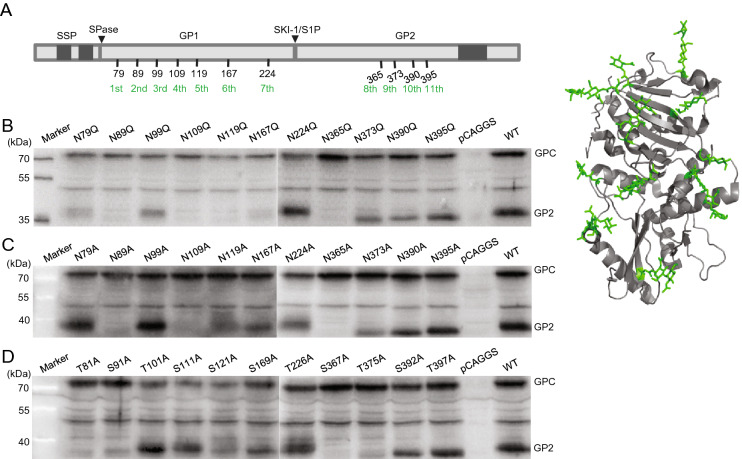
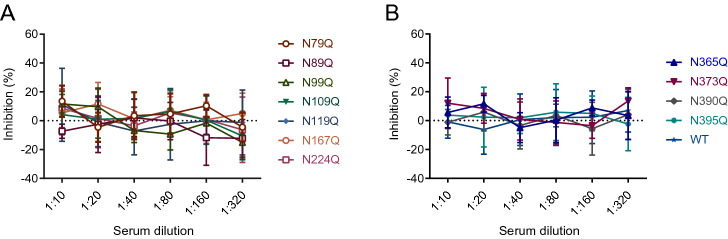
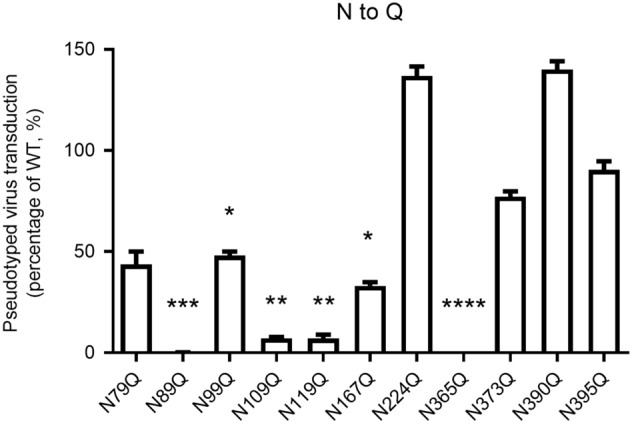
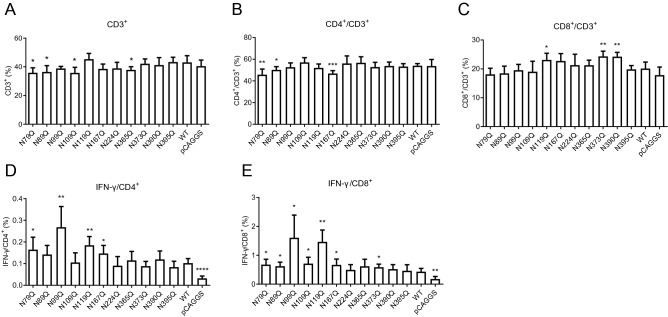
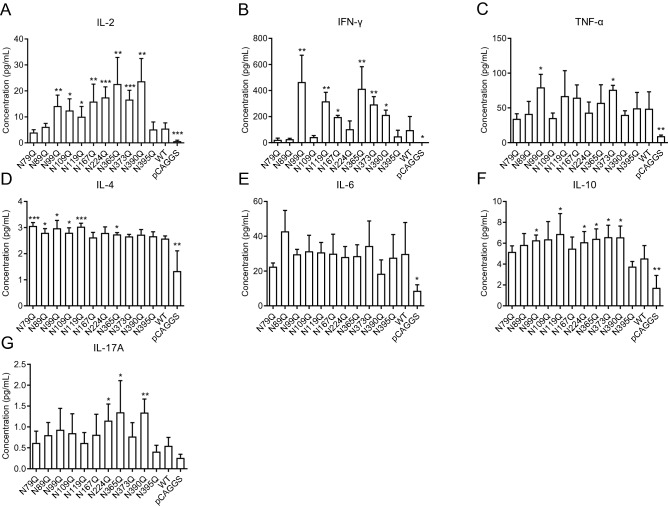
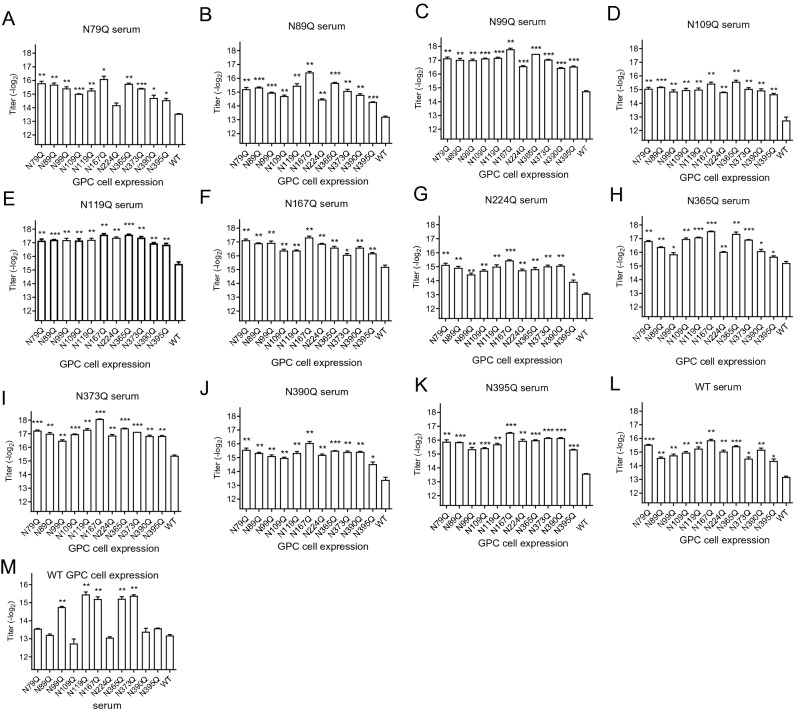
Lassa virus (LASV) belongs to the Mammarenavirus genus (family Arenaviridae) and causes severe hemorrhagic fever in humans. The glycoprotein complex (GPC) contains eleven N-linked glycans that play essential roles in GPC functionalities such as cleavage, transport, receptor recognition, epitope shielding, and immune response. We used three mutagenesis strategies (asparagine to glutamine, asparagine to alanine, and serine/tyrosine to alanine mutants) to abolish individual glycan chain on GPC and found that all the three strategies led to cleavage inefficiency on the 2nd (N89), 5th (N119), or 8th (N365) glycosylation motif. To evaluate N to Q mutagenesis for further research, it was found that deletion of the 2nd (N89Q) or 8th (N365Q) glycan completely inhibited the transduction efficiency of pseudotyped particles. We further investigated the role of individual glycan on GPC-mediated immune response by DNA immunization of mice. Deletion of the individual 1st (N79Q), 3rd (N99Q), 5th (N119Q), or 6th (N167Q) glycan significantly enhanced the proportion of effector CD4 cells, whereas deletion of the 1st (N79Q), 2nd (N89Q), 3rd (N99Q), 4th (N109Q), 5th (N119Q), 6th (N167Q), or 9th (N373Q) glycan enhanced the proportion of CD8 effector T cells. Deletion of specific glycan improves the Th1-type immune response, and abolishment of glycan on GPC generally increases the antibody titer to the glycan-deficient GPC. However, the antibodies from either the mutant or WT GPC-immunized mice show little neutralization effect on wild-type LASV. The glycan residues on GPC provide an immune shield for the virus, and thus represent a target for the design and development of a vaccine.
拉萨病毒(LASV)属于 Mammarenavirus 属(Arenaviridae 科),会导致人类严重的出血热。糖蛋白复合物(GPC)包含 11 个 N 连接聚糖,这些聚糖在 GPC 的功能中发挥着重要作用,如切割、运输、受体识别、表位屏蔽和免疫反应。我们使用三种诱变策略(天冬酰胺至谷氨酰胺、天冬酰胺至丙氨酸和丝氨酸/酪氨酸至丙氨酸突变体)来消除 GPC 上的单个聚糖链,发现所有三种策略都导致第 2 个(N89)、第 5 个(N119)或第 8 个(N365)糖基化模体的切割效率降低。为了评估 N 到 Q 突变体在进一步研究中的作用,发现删除第 2 个(N89Q)或第 8 个(N365Q)聚糖完全抑制了假型颗粒的转导效率。我们通过 DNA 免疫接种小鼠进一步研究了 GPC 介导的免疫反应中单个聚糖的作用。删除单个第 1 个(N79Q)、第 3 个(N99Q)、第 5 个(N119Q)或第 6 个(N167Q)聚糖显著增加了效应性 CD4 细胞的比例,而删除第 1 个(N79Q)、第 2 个(N89Q)、第 3 个(N99Q)、第 4 个(N109Q)、第 5 个(N119Q)、第 6 个(N167Q)或第 9 个(N373Q)聚糖增加了 CD8 效应 T 细胞的比例。删除特定聚糖可改善 Th1 型免疫反应,而 GPC 上聚糖的缺失通常会提高针对聚糖缺失的 GPC 的抗体滴度。然而,来自突变或 WT GPC 免疫接种小鼠的抗体对野生型 LASV 的中和作用很小。GPC 上的聚糖残基为病毒提供了免疫保护,因此成为疫苗设计和开发的目标。