Department of Community Health Nursing, Graduate School of Medicine, Yokohama City University, 3-9 Fukuura, Kanazawa-ku, Yokohama, Kanagawa, 221-0825, Japan.
BMC Geriatr. 2021 Mar 10;21(1):174. doi: 10.1186/s12877-021-02036-w.
Globally, the population of oldest-old (those aged ≥80 years) is rapidly growing. This change is likely to have a deep impact on societies. Resilience is a key concept related to facilitating adaptation, and can be applied, to aging-related change and losses, as well as promoting health and well-being in this population. However, no existing scales have been developed to measure resilience among oldest-old people. To address this, we developed a resilience scale for oldest-old age (RSO), and examined its reliability and validity.
The RSO is a self-administered questionnaire developed via a literature review, interviews with oldest-old individuals, and interviews with experts. The survey included 3000 community-dwelling oldest-old people who were recruited via random sampling in Yokohama city, Japan. Construct validity was determined using confirmatory factor analysis. Internal consistency was calculated using Cronbach's alpha. The revised Philadelphia Geriatric Center Morale Scale (PGC) and the self-anchoring scale to measure the feeling that life is worth living (SAS-WL) were used to assess the criterion-related validity of the RSO.
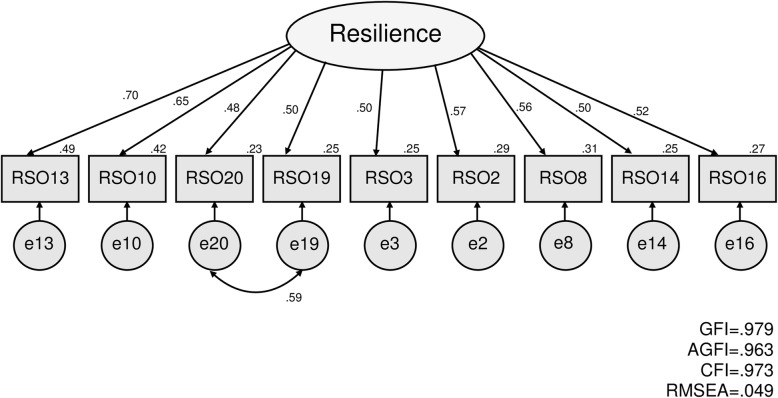
We received 1283 valid participant responses. Confirmatory factor analysis identified nine items from one factor of the RSO with a goodness of fit index of 0.979, adjusted goodness of fit index of 0.963, comparative fit index of 0.973, and root mean square error of approximation of 0.049. Cronbach's alpha was 0.800. The total RSO score was positively correlated with the PGC (r = .492, p < 0.001) and the SAS-WL (r = .559, p < 0.001).
The RSO demonstrated adequate reliability and validity for assessing individual resilience among oldest-old people. Thus, the scale is potentially useful for promoting health and well-being in oldest-old age.
全球范围内,最年长人群(年龄≥80 岁)的数量正在迅速增长。这一变化可能会对社会产生深远影响。韧性是一个与促进适应相关的关键概念,它既可以应用于与衰老相关的变化和损失,也可以促进这一年龄段人群的健康和幸福。然而,目前还没有开发出衡量最年长人群韧性的量表。为了解决这个问题,我们开发了一个最年长年龄的韧性量表(RSO),并检验了其信度和效度。
RSO 是一个通过文献回顾、对最年长个体的访谈以及对专家的访谈开发的自我管理问卷。该调查包括通过随机抽样在日本横滨市招募的 3000 名社区居住的最年长人群。使用验证性因子分析来确定结构效度。使用 Cronbach's alpha 计算内部一致性。修订后的费城老年中心士气量表(PGC)和自我锚定量表来衡量生活值得过的感觉(SAS-WL)用于评估 RSO 的效标关联效度。
我们收到了 1283 份有效参与者的回复。验证性因子分析确定了 RSO 有九个项目来自于一个因素,拟合优度指数为 0.979,调整拟合优度指数为 0.963,比较拟合指数为 0.973,近似均方根误差为 0.049。Cronbach's alpha 为 0.800。RSO 的总分与 PGC(r=0.492,p<0.001)和 SAS-WL(r=0.559,p<0.001)呈正相关。
RSO 显示出评估最年长人群个体韧性的充分信度和效度。因此,该量表在促进最年长年龄的健康和幸福方面具有潜在的应用价值。