Versus Arthritis Centre for Genetics and Genomics, Centre for Musculoskeletal Research, Manchester Academic Health Sciences Centre, The University of Manchester, Manchester, UK.
NIHR Manchester BRC, Manchester University Foundation Trust, Manchester, UK.
Arthritis Res Ther. 2021 Mar 10;23(1):80. doi: 10.1186/s13075-021-02451-9.
Despite the success of TNF-inhibitor therapy in rheumatoid arthritis treatment, up to 40% of patients fail to respond adequately. This study aimed to identify transcriptome-based biomarkers of adalimumab response in rheumatoid arthritis (RA) to aid timely switching in non-responder patients and provide a better mechanistic understanding of the pathways involved in response/non-response.
The Affymetrix Human Transcriptome Array 2.0 (HTA) was used to measure the transcriptome in whole blood at pre-treatment and at 3 months in EULAR good- and non-responders to adalimumab therapy. Differential expression of transcripts was analysed at the transcript level using multiple linear regression. Differentially expressed genes were validated in independent samples using OpenArray™ RT-qPCR.
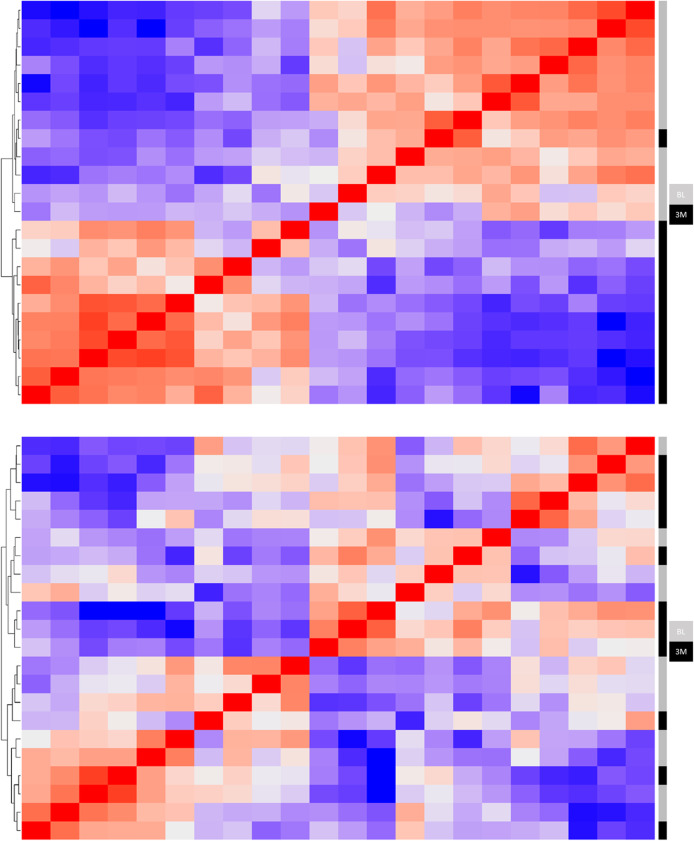
In total, 813 transcripts were differentially expressed between pre-treatment and 3 months in adalimumab good-responders. No significant differential expression was observed between good- and non-responders at either time-point and no significant changes were observed in non-responders between time-points. OpenArray™ RT-qPCR was performed for 104 differentially expressed transcripts in good-responders, selected based on magnitude of effect or p value or based on prior association with RA or the immune system, validating differential expression for 17 transcripts.
An early transcriptome signature of DAS28 response to adalimumab has been identified and replicated in independent datasets. Whilst treat-to-target approaches encourage early switching in non-responsive patients, registry evidence suggests that this does not always occur. The results herein could guide the development of a blood test to distinguish responders from non-responders at 3 months and support clinical decisions to switch non-responsive patients to an alternative therapy.
尽管 TNF 抑制剂治疗在类风湿关节炎治疗中取得了成功,但仍有多达 40%的患者无法充分应答。本研究旨在确定类风湿关节炎患者阿达木单抗应答的基于转录组的生物标志物,以帮助及时对无应答患者进行转换,并更好地了解应答/无应答相关途径的机制。
使用 Affymetrix Human Transcriptome Array 2.0(HTA)在 EULAR 应答良好和无应答的阿达木单抗治疗患者的治疗前和 3 个月时测量全血转录组。使用多元线性回归分析在转录本水平上分析转录本的差异表达。使用 OpenArray™ RT-qPCR 在独立样本中验证差异表达基因。
在阿达木单抗应答良好的患者中,治疗前和 3 个月时共有 813 个转录本存在差异表达。在任何时间点,应答良好和无应答者之间均未观察到明显的差异表达,并且无应答者在时间点之间也未观察到明显变化。对来自应答良好患者的 104 个差异表达转录本进行了 OpenArray™ RT-qPCR 检测,这些转录本是基于效应幅度或 p 值选择的,或者基于先前与 RA 或免疫系统的关联选择的,验证了 17 个转录本的差异表达。
已经确定了阿达木单抗应答的 DAS28 早期转录组特征,并在独立数据集得到了复制。虽然针对目标的治疗方法鼓励无应答患者尽早转换,但登记证据表明,这并不总是发生。本文的结果可以指导开发一种血液测试,以在 3 个月时区分应答者和无应答者,并支持临床决策将无应答患者转换为替代疗法。