Mallery Donna L, Kleinpeter Alex B, Renner Nadine, Faysal K M Rifat, Novikova Mariia, Kiss Leo, Wilson Miranda S C, Ahsan Bilal, Ke Zunlong, Briggs John A G, Saiardi Adolfo, Böcking Till, Freed Eric O, James Leo C
MRC Laboratory of Molecular Biology, Francis Crick Avenue, Cambridge CB2 0QH, UK.
Virus-Cell Interaction Section, HIV Dynamics and Replication Program, Center for Cancer Research, National Cancer Institute, Frederick, MD 21702-1201, USA.
Sci Adv. 2021 Mar 10;7(11). doi: 10.1126/sciadv.abe4716. Print 2021 Mar.
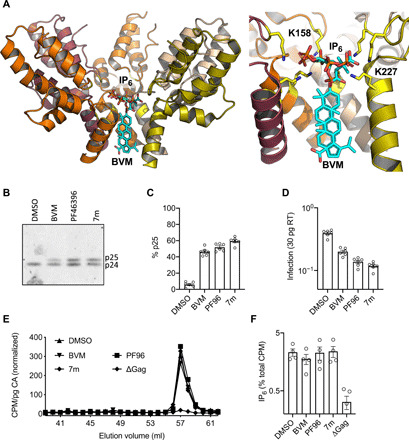
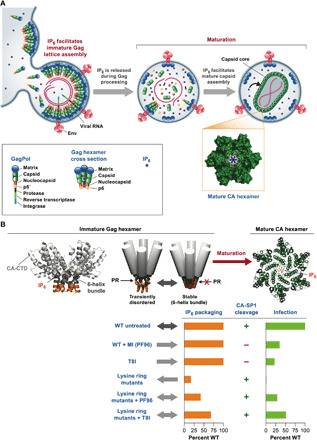
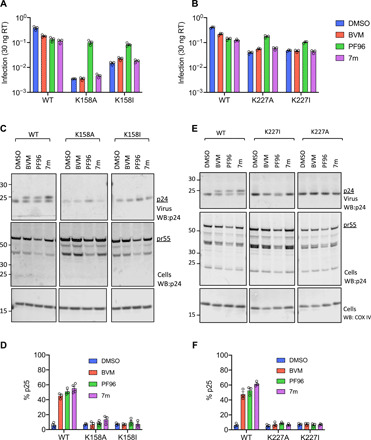
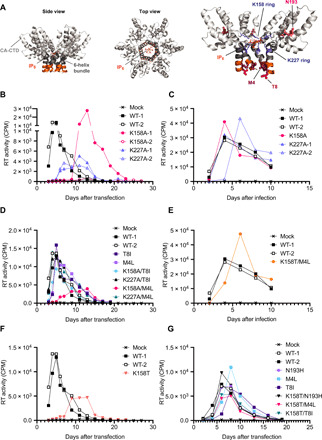
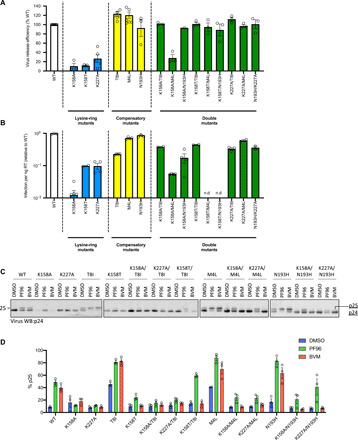
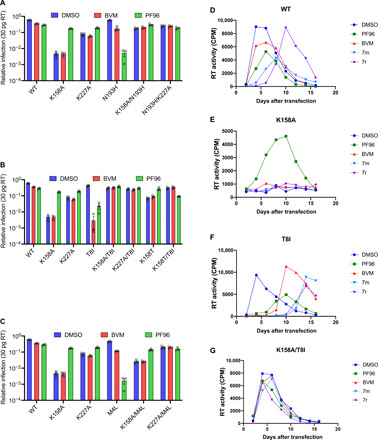
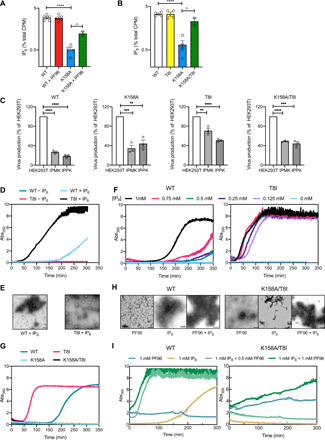
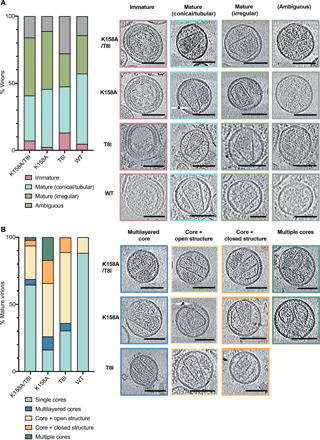
HIV virion assembly begins with the construction of an immature lattice consisting of Gag hexamers. Upon virion release, protease-mediated Gag cleavage leads to a maturation event in which the immature lattice disassembles and the mature capsid assembles. The cellular metabolite inositiol hexakisphosphate (IP) and maturation inhibitors (MIs) both bind and stabilize immature Gag hexamers, but whereas IP promotes virus maturation, MIs inhibit it. Here we show that HIV is evolutionarily constrained to maintain an immature lattice stability that ensures IP packaging without preventing maturation. Replication-deficient mutant viruses with reduced IP recruitment display increased infectivity upon treatment with the MI PF46396 (PF96) or the acquisition of second-site compensatory mutations. Both PF96 and second-site mutations stabilise the immature lattice and restore IP incorporation, suggesting that immature lattice stability and IP binding are interdependent. This IP dependence suggests that modifying MIs to compete with IP for Gag hexamer binding could substantially improve MI antiviral potency.
HIV病毒粒子组装始于由Gag六聚体构成的未成熟晶格的构建。病毒粒子释放时,蛋白酶介导的Gag裂解引发成熟过程,在此过程中未成熟晶格解体,成熟衣壳组装形成。细胞代谢物肌醇六磷酸(IP)和成熟抑制剂(MIs)均能结合并稳定未成熟的Gag六聚体,但IP促进病毒成熟,而MIs抑制病毒成熟。我们在此表明,HIV在进化上受到限制,以维持一种未成熟晶格稳定性,这种稳定性可确保IP包装,同时又不妨碍成熟过程。IP募集减少的复制缺陷型突变病毒在用MI PF46396(PF96)处理后或获得第二位点补偿性突变时,感染力增加。PF96和第二位点突变均可稳定未成熟晶格并恢复IP掺入,这表明未成熟晶格稳定性和IP结合是相互依赖的。这种对IP的依赖性表明,修饰MIs使其与IP竞争Gag六聚体结合,可能会显著提高MI的抗病毒效力。