Neuroscience and Mental Health Group, Institute of Cognitive Neuroscience, 17-19 Queen Square, University College London, WC1N 3AZ, London, UK.
School of Physiology and Pharmacology, Biomedical Sciences Building, University Walk, University of Bristol, BS8 1TD, Bristol, UK.
Psychol Med. 2020 Jan;50(2):237-246. doi: 10.1017/S0033291718004117. Epub 2019 Jan 26.
Mood and anxiety disorders are ubiquitous but current treatment options are ineffective for many sufferers. Moreover, a number of promising pre-clinical interventions have failed to translate into clinical efficacy in humans. Improved treatments are unlikely without better animal-human translational pipelines. Here, we translate a rodent measure of negative affective bias into humans, exploring its relationship with (1) pathological mood and anxiety symptoms and (2) transient induced anxiety.
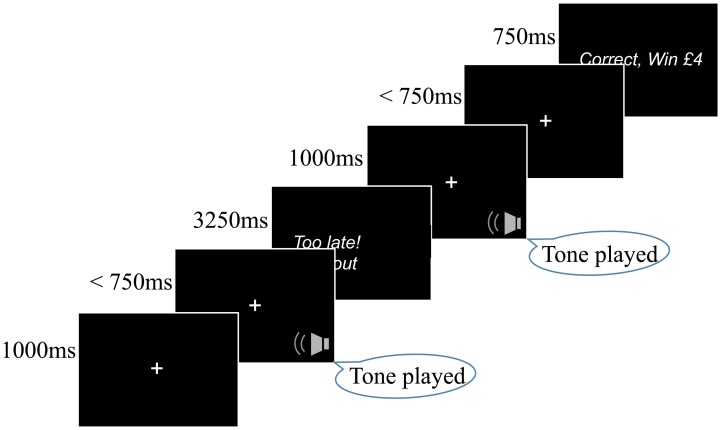
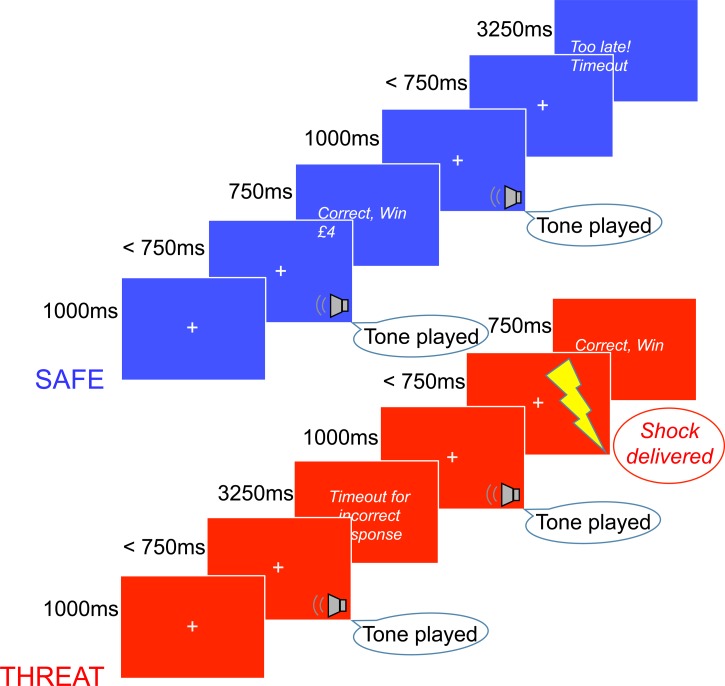
Adult participants (age = 29 ± 11) who met criteria for mood or anxiety disorder symptomatology according to a face-to-face neuropsychiatric interview were included in the symptomatic group. Study 1 included N = 77 (47 = asymptomatic [female = 21]; 30 = symptomatic [female = 25]), study 2 included N = 47 asymptomatic participants (25 = female). Outcome measures were choice ratios, reaction times and parameters recovered from a computational model of reaction time - the drift diffusion model (DDM) - from a two-alternative-forced-choice task in which ambiguous and unambiguous auditory stimuli were paired with high and low rewards.
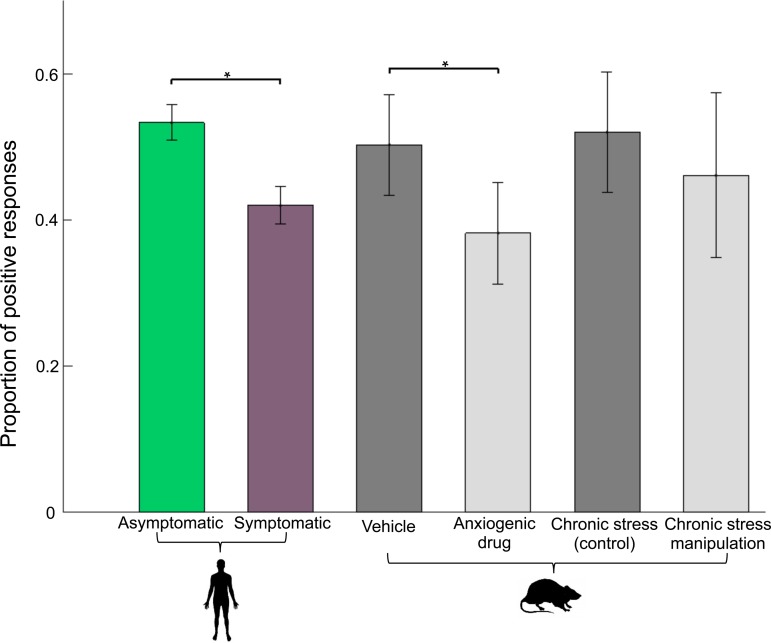
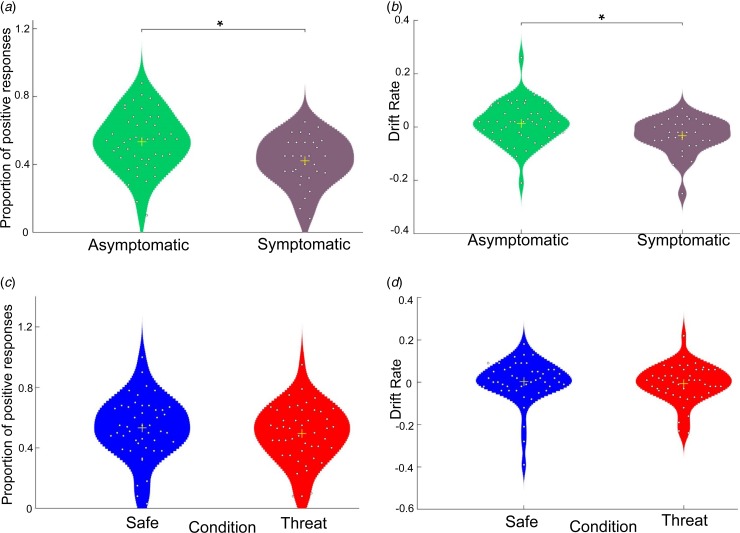
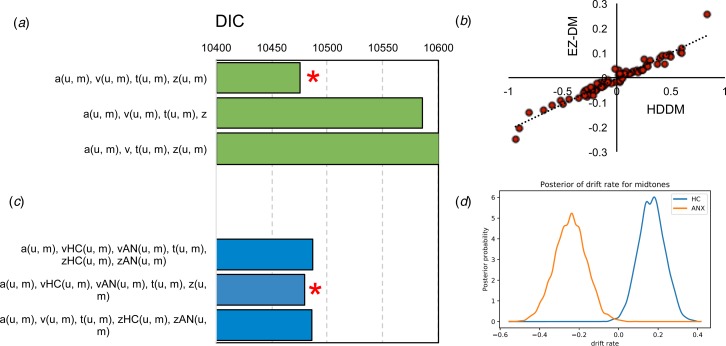
Both groups showed over 93% accuracy on unambiguous tones indicating intact discrimination, but symptomatic individuals demonstrated increased negative affective bias on ambiguous tones [proportion high reward = 0.42 (s.d. = 0.14)] relative to asymptomatic individuals [0.53 (s.d. = 0.17)] as well as a significantly reduced DDM drift rate. No significant effects were observed for the within-subjects anxiety-induction.
Humans with pathological anxiety symptoms directly mimic rodents undergoing anxiogenic manipulation. The lack of sensitivity to transient anxiety suggests the paradigm might be more sensitive to clinically relevant symptoms. Our results establish a direct translational pipeline (and candidate therapeutics screen) from negative affective bias in rodents to pathological mood and anxiety symptoms in humans.
情绪和焦虑障碍普遍存在,但目前的治疗选择对许多患者无效。此外,许多有前途的临床前干预措施未能在人类中转化为临床疗效。如果没有更好的动物-人类转化管道,就不太可能开发出更好的治疗方法。在这里,我们将啮齿动物的负性情感偏差测量方法转化为人类,探索其与(1)病理性情绪和焦虑症状以及(2)短暂诱导的焦虑之间的关系。
符合面对面神经精神访谈中情绪或焦虑障碍症状标准的成年参与者(年龄=29±11 岁)被纳入症状组。研究 1 纳入了 N=77 名(47 名无症状[女性=21 名];30 名有症状[女性=25 名]),研究 2 纳入了 N=47 名无症状参与者(25 名女性)。研究结果包括选择率、反应时间和从计算反应时间模型(DDM)中恢复的参数,该模型是从一个双选择强制选择任务中得出的,该任务将模糊和清晰的听觉刺激与高回报和低回报配对。
两组在明确的音调上的准确率均超过 93%,表明其区分能力完整,但有症状的个体在模糊音调上表现出更大的负性情感偏差[高回报的比例=0.42(s.d.=0.14)],而无症状的个体为 0.53(s.d.=0.17)],并且 DDM 漂移率显著降低。在焦虑诱发的情况下,没有观察到显著的影响。
患有病理性焦虑症状的人类直接模仿接受焦虑诱发处理的啮齿动物。对短暂焦虑的敏感性降低表明,该范式可能对临床相关症状更敏感。我们的研究结果建立了从啮齿动物的负性情感偏差到人类病理性情绪和焦虑症状的直接转化管道(和候选治疗药物筛选)。