Minakova Elena, Sarafinovska Simona, Mikati Marwa O, Barclay Kia M, McCullough Katherine B, Dougherty Joseph D, Al-Hasani Ream, Maloney Susan E
Department of Pediatrics, Washington University in St. Louis, St. Louis, MO, United States.
Department of Genetics, Washington University in St. Louis, St. Louis, MO, United States.
Front Behav Neurosci. 2021 Feb 22;15:615798. doi: 10.3389/fnbeh.2021.615798. eCollection 2021.
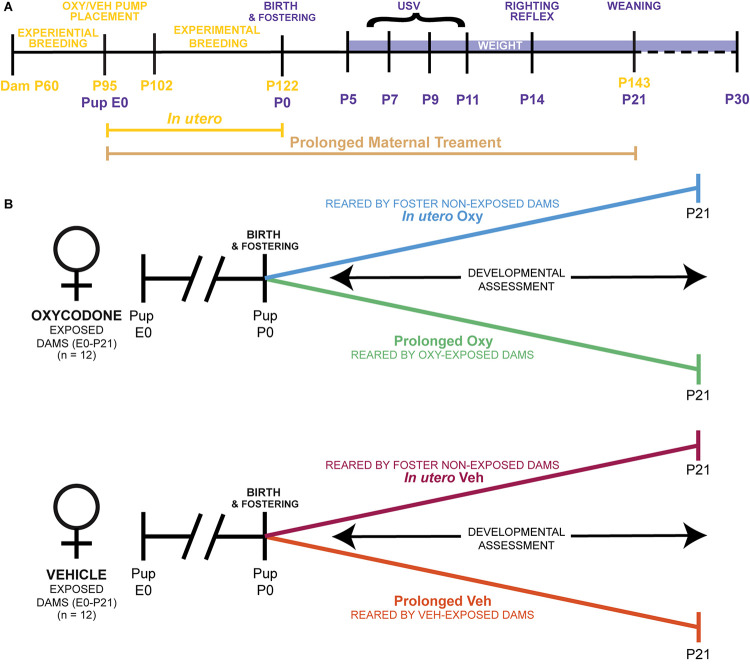
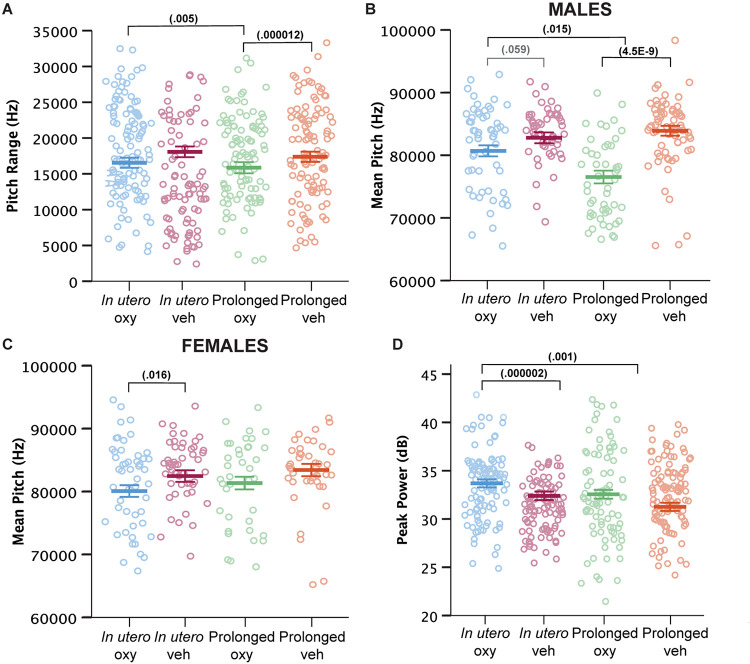
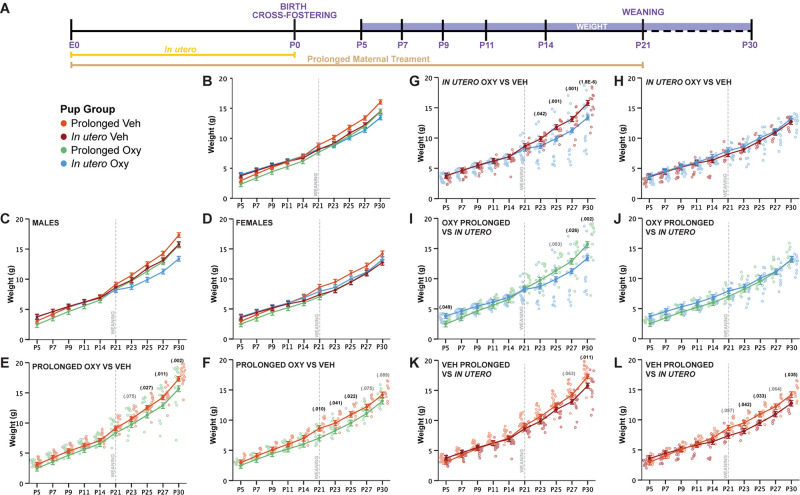
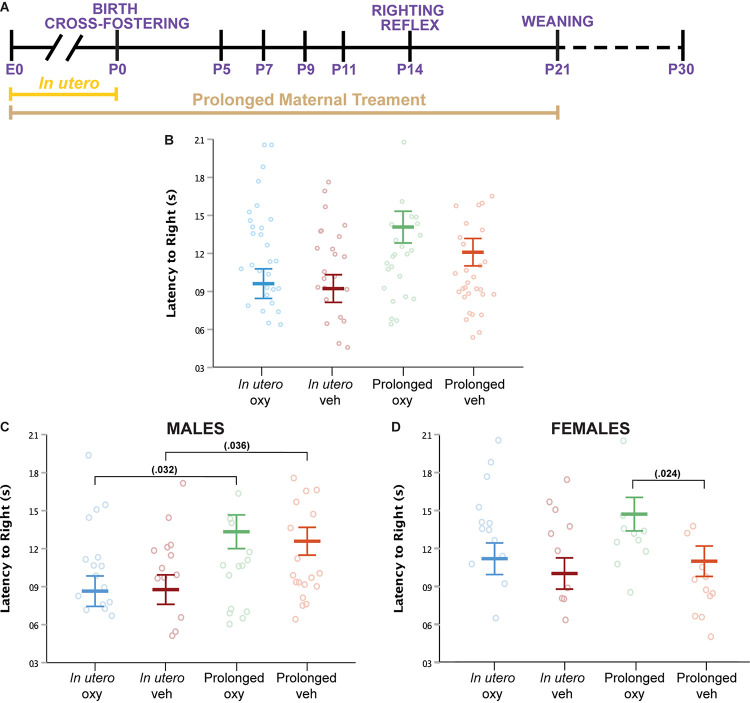
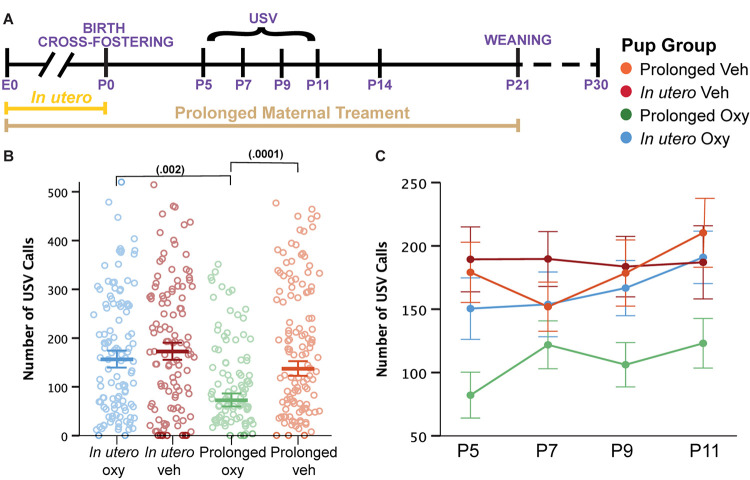
Nationwide, opioid misuse among pregnant women has risen four-fold from 1999 to 2014, with commensurate increase in neonates hospitalized for neonatal abstinence syndrome (NAS). NAS occurs when a fetus exposed to opioids goes into rapid withdrawal after birth. NAS treatment via continued post-natal opioid exposure has been suggested to worsen neurodevelopmental outcomes. We developed a novel model to characterize the impact of and prolonged post-natal oxycodone (Oxy) exposure on early behavior and development. Via subcutaneous pump implanted before breeding, C57BL/6J dams were infused with Oxy at 10 mg/kg/day from conception through pup-weaning. At birth, oxy-exposed pups were either cross-fostered (paired with non-Oxy exposed dams) to model opioid abstinence ( Oxy) or reared by their biological dams still receiving Oxy to model continued post-natal opioid exposure (prolonged Oxy). Offspring from vehicle-exposed dams served as cross-fostered ( Veh) or biologically reared (prolonged Veh) controls. Oxy exposure resulted in sex-dependent weight reductions and altered spectrotemporal features of isolation-induced ultrasonic vocalization (USV). Meanwhile, prolonged Oxy pups exhibited reduced weight and sex-differential delays in righting reflex. Specifically, prolonged Oxy female offspring exhibited increased latency to righting. Prolonged Oxy pups also showed decreases in number of USV calls and changes to spectrotemporal USV features. Overall, ontogenetic Oxy exposure was associated with impaired attainment of gross and sensorimotor milestones, as well as alterations in communication and affective behaviors, indicating a need for therapeutic interventions. The model developed here will enable studies of withdrawal physiology and opioid-mediated mechanisms underlying these neurodevelopmental deficits.
在全国范围内,从1999年到2014年,孕妇阿片类药物滥用情况增加了四倍,因新生儿戒断综合征(NAS)住院的新生儿数量也相应增加。当暴露于阿片类药物的胎儿出生后迅速出现戒断症状时,就会发生NAS。有人提出,通过产后持续暴露于阿片类药物来治疗NAS可能会使神经发育结局恶化。我们开发了一种新模型,以表征产前和产后长期暴露于羟考酮(Oxy)对早期行为和发育的影响。通过在繁殖前植入皮下泵,从受孕到幼崽断奶,给C57BL/6J母鼠每天注射10mg/kg的Oxy。出生时,暴露于Oxy的幼崽要么被交叉寄养(与未暴露于Oxy的母鼠配对)以模拟阿片类药物戒断(Oxy组),要么由仍接受Oxy的亲生母鼠抚养以模拟产后持续暴露于阿片类药物(长期Oxy组)。暴露于赋形剂的母鼠的后代作为交叉寄养(Veh组)或亲生抚养(长期Veh组)对照。Oxy暴露导致体重出现性别依赖性减轻,并改变了隔离诱导的超声波发声(USV)的频谱时间特征。同时,长期Oxy组的幼崽体重减轻,翻正反射出现性别差异延迟。具体而言,长期Oxy组的雌性后代翻正延迟增加。长期Oxy组的幼崽USV叫声数量也减少,且USV频谱时间特征发生改变。总体而言,个体发育过程中暴露于Oxy与粗大运动和感觉运动里程碑的获得受损以及沟通和情感行为的改变有关,这表明需要进行治疗干预。这里开发的模型将有助于研究这些神经发育缺陷背后的戒断生理和阿片类药物介导的机制。