Azam Mudsser, Gaind Rajni, Yadav Gulshan, Sharma Amit, Upmanyu Kirti, Jain Manisha, Singh Ruchi
ICMR-National Institute of Pathology, New Delhi, India.
Department of Microbiology, VMMC and Safdarjung Hospital, New Delhi, India.
Front Microbiol. 2021 Feb 22;12:609840. doi: 10.3389/fmicb.2021.609840. eCollection 2021.
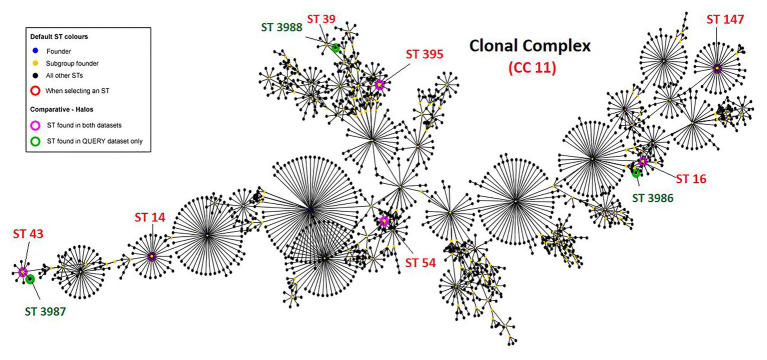
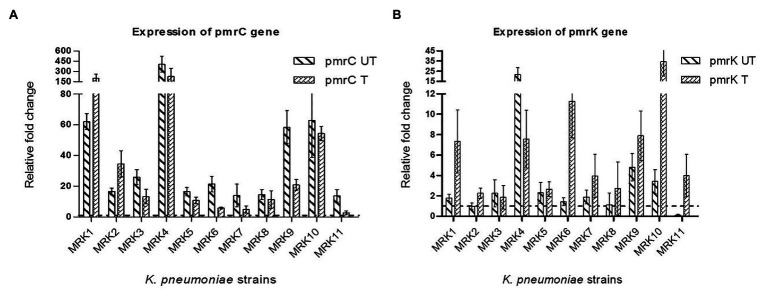
The resistance to colistin and carbapenems in infections have been associated with increased morbidity and mortality worldwide. A retrospective observational study was conducted to determine the prevalence and molecular events contributing to colistin resistance. Clinical samples were screened for colistin resistance and underlying mechanisms were studied by PCR-based amplification and sequence analysis of genes of two-component regulatory system ( and ), regulatory transmembrane protein-coding , and mobilized colistin resistance genes (). Gene expression of and was analyzed by qRT-PCR, and the genetic relationship was assessed by MLST. The putative effect of amino-acid substitutions was predicted by a combination of bioinformatics tools. Of 335 spp. screened, 11 (3.2%) were identified as colistin-resistant (MIC range, 8 to >128 μg/ml). isolates belonged to clonal complex-11 (CC11) with sequence types (STs): 14, 16, 43, 54, 147 and 395, whereby four isolates conferred three novel STs (3986, 3987 and 3988) profiles. Sequence analysis revealed non-synonymous potentially deleterious mutations in (T151A), (del87-90, del263-264, L30Q, and A351D), (G53S), (D150V, T157P, L237R, G250C, A252G, R315P, and Q331H), and (C28G) genes. The gene in three strains was disrupted by insertion sequences encoding IS-like and IS/IS family-like transposase genes. All 11 isolates showed an elevation in the transcription level of gene. Mobilized colistin-resistance () genes were not detected. All but one of the colistin-resistant isolates was also resistant to carbapenems; β-lactamase genes , , and were detected in eight, five, and nine isolates, respectively. All the studied colistin- and carbapenem-resistant isolates were genetically distinct, and various mechanisms of colistin resistance were detected, indicating its spontaneous emergence in this bacterial species.
在全球范围内,感染中对黏菌素和碳青霉烯类药物的耐药性与发病率和死亡率的增加有关。进行了一项回顾性观察研究,以确定黏菌素耐药性的流行情况及其分子机制。对临床样本进行黏菌素耐药性筛查,并通过基于PCR的扩增以及对双组分调节系统( 和 )、调节性跨膜蛋白编码基因 、以及可移动黏菌素耐药基因( )进行序列分析,来研究潜在机制。通过qRT-PCR分析 和 的基因表达,并通过多位点序列分型(MLST)评估遗传关系。通过多种生物信息学工具组合预测氨基酸替换的假定效应。在筛查的335株 菌株中,有11株(3.2%)被鉴定为对黏菌素耐药(MIC范围为8至>128μg/ml)。 分离株属于克隆复合体-11(CC11),序列类型(STs)为:14、16、43、54、147和395,其中四株分离株呈现三种新的STs(3986、3987和3988)图谱。序列分析揭示了 (T151A)、 (del87-90、del263-264、L30Q和A351D)、 (G53S)、 (D150V、T157P、L237R、G250C、A252G、R315P和Q331H)以及 (C28G)基因中存在非同义的潜在有害突变。三株菌株中的 基因被编码IS样和IS/IS家族样转座酶基因的插入序列破坏。所有11株分离株均显示 基因转录水平升高。未检测到可移动黏菌素耐药( )基因。除一株外,所有黏菌素耐药分离株也对碳青霉烯类药物耐药;分别在八株、五株和九株分离株中检测到β-内酰胺酶基因 、 和 。所有研究的黏菌素和碳青霉烯类耐药 分离株在遗传上均不同,并且检测到多种黏菌素耐药机制,表明其在该细菌物种中自发出现。