Jung Hui-Jung, Seo Incheol, Jha Bijay Kumar, Suh Seong-Il, Baek Won-Ki
Department of Microbiology, School of Medicine, Keimyung University, Dalseogu, Daegu 42601, Republic of Korea.
Department of Microbiology, Dongguk University College of Medicine, Gyeongju 38066, Republic of Korea.
Oncol Lett. 2021 Apr;21(4):335. doi: 10.3892/ol.2021.12596. Epub 2021 Feb 25.
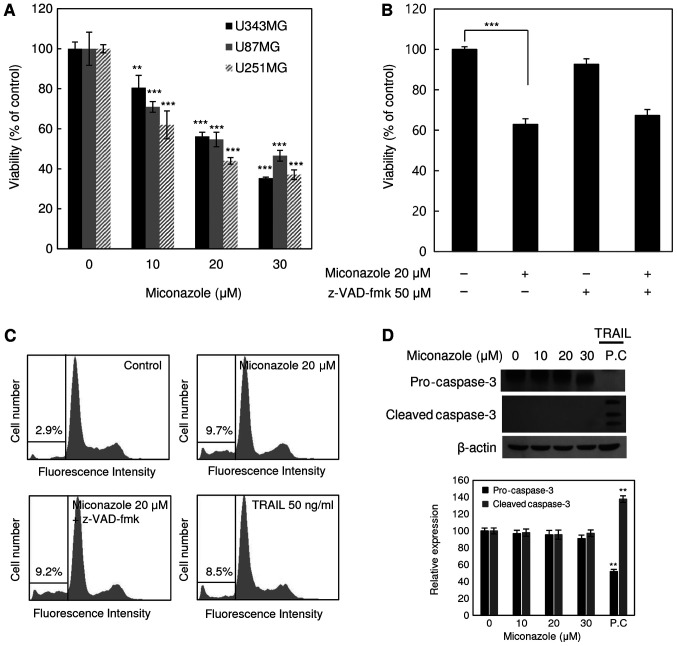
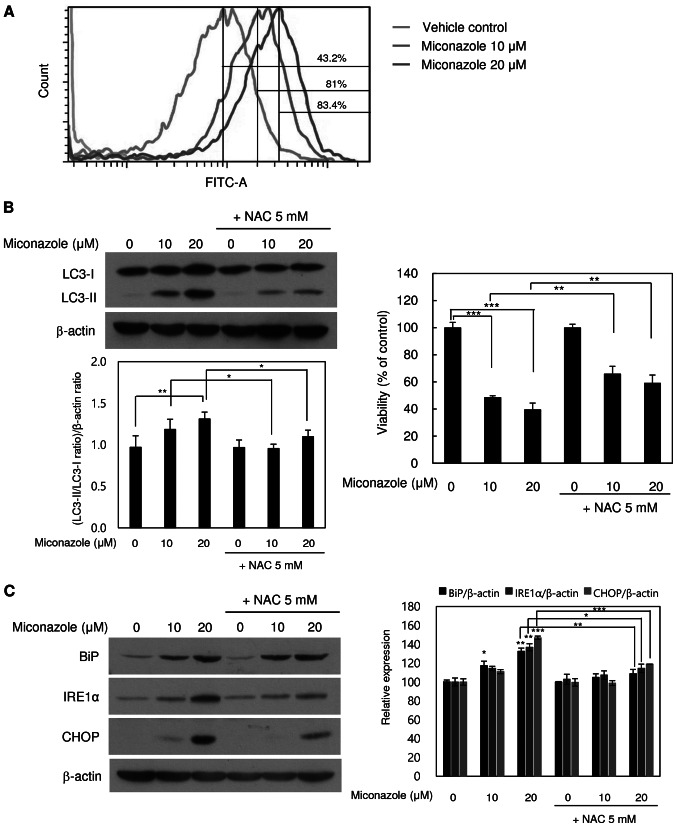
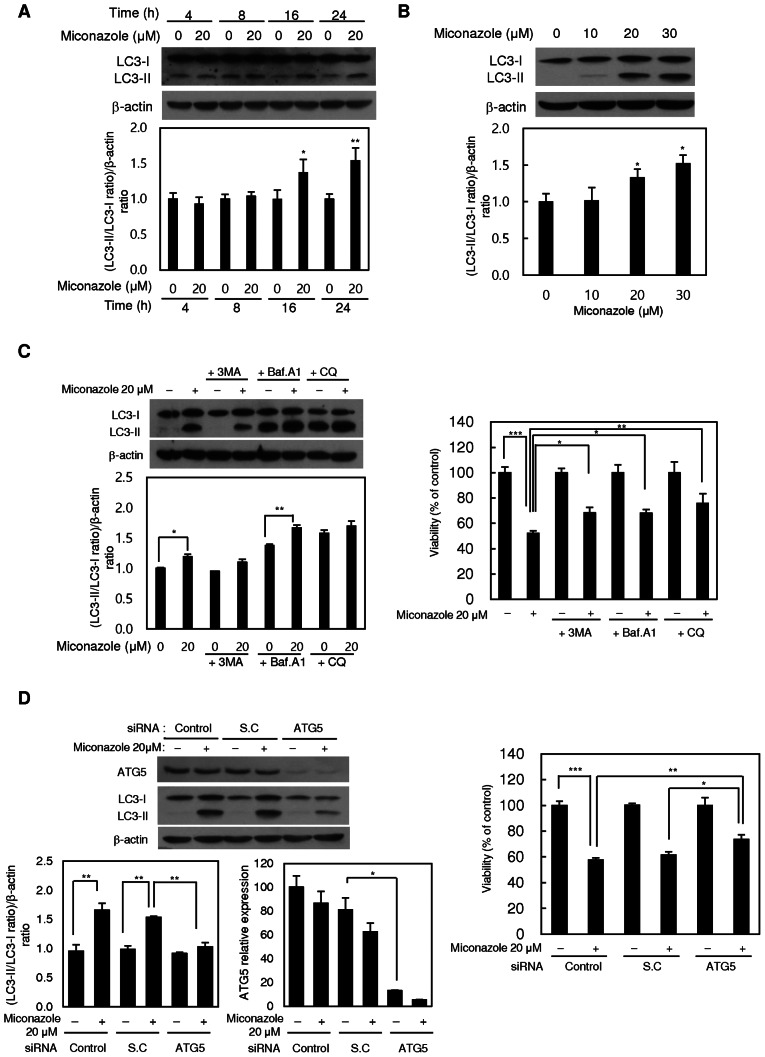
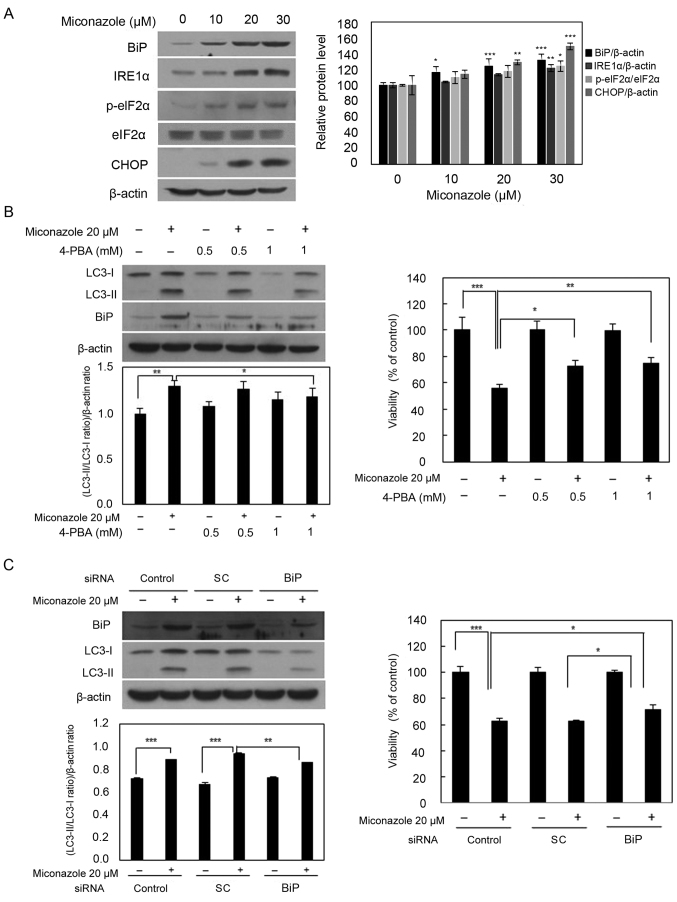
Miconazole is an antifungal agent that is used for the treatment of superficial mycosis. However, recent studies have indicated that miconazole also exhibits potent anticancer effects in various types of cancer via the activation of apoptosis. The main aim of the present study was to observe the effect of miconazole on autophagic cell death of cancer cells. Cytotoxicity was measured by viable cell counting after miconazole treatment in glioblastoma cell lines (U343MG, U87MG and U251MG). Induction of autophagy was analyzed by examining microtubule-associated protein light chain 3 (LC3)-II expression levels using western blotting and by detecting GFP-LC3 translocation using a fluorescence microscope. Intracellular ROS production was measured using a fluorescent probe, 2',7'-dichlorodihydrofluorescein diacetate. It was found that miconazole induced autophagic cell death in the U251MG glioblastoma cell line via the generation of reactive oxygen species (ROS) and endoplasmic reticulum (ER) stress response. An association between miconazole-induced ROS production and autophagy was also identified; in particular, pretreatment of the cells with a ROS scavenger resulted in a reduction in the levels of LC3-II. Miconazole-induced ER stress was associated with increases in binding immunoglobulin protein (BiP), inositol-requiring enzyme 1α (IRE1α) and CHOP expression, and phospho-eIF2α levels. The inhibition of ER stress via treatment with 4-phenylbutyric acid or BiP knockdown reduced miconazole-induced autophagy and cell death. These findings suggest that miconazole induces autophagic cell death by inducing an ROS-dependent ER stress response in U251MG glioma cancer cells and provide new insights into the potential antiproliferative effects of miconazole.
咪康唑是一种用于治疗浅表真菌病的抗真菌药物。然而,最近的研究表明,咪康唑还通过激活细胞凋亡在各种类型的癌症中表现出强大的抗癌作用。本研究的主要目的是观察咪康唑对癌细胞自噬性细胞死亡的影响。在胶质母细胞瘤细胞系(U343MG、U87MG和U251MG)中用咪康唑处理后,通过活细胞计数测量细胞毒性。通过蛋白质印迹法检测微管相关蛋白轻链3(LC3)-II的表达水平,并使用荧光显微镜检测GFP-LC3转位,分析自噬的诱导情况。使用荧光探针2',7'-二氯二氢荧光素二乙酸酯测量细胞内活性氧(ROS)的产生。研究发现,咪康唑通过产生活性氧(ROS)和内质网(ER)应激反应,在U251MG胶质母细胞瘤细胞系中诱导自噬性细胞死亡。还确定了咪康唑诱导的ROS产生与自噬之间的关联;特别是,用ROS清除剂预处理细胞导致LC3-II水平降低。咪康唑诱导的内质网应激与结合免疫球蛋白蛋白(BiP)、肌醇需求酶1α(IRE1α)和CHOP表达的增加以及磷酸化eIF2α水平有关。用4-苯基丁酸处理或敲低BiP抑制内质网应激可减少咪康唑诱导的自噬和细胞死亡。这些发现表明,咪康唑通过在U251MG胶质瘤癌细胞中诱导ROS依赖性内质网应激反应来诱导自噬性细胞死亡,并为咪康唑潜在的抗增殖作用提供了新的见解。