Clinical Governance and Systems, icddr,b, Dhaka, Bangladesh.
Biostatistics Division, College of Public Health, The Ohio State University, Columbus, Ohio, USA.
J Glob Health. 2021 Jan 31;11:04006. doi: 10.7189/jogh.11.04006.
Developing countries account for 99.0% of the 2.7 million neonatal deaths occurring worldwide each year. Umbilical cord infection contributes greatly to this predicament, but evidence shows that 7.1% chlorhexidine solution (CHX) can substantially reduce the risk of infection. To address this challenge, this study aimed to determine the effect of a social and behavioral change communication (SBCC) intervention on promoting the use of WHO recommended CHX as well as on improving the knowledge, attitude, and practices of rural communities regarding umbilical cord care in hard-to-reach areas of Bangladesh.
A pretest-posttest quasi-experimental study was conducted in two unions of Jamalpur district during 2017-2019 among 748 pregnant women in their third trimester. The SBCC intervention was implemented through town-hall meetings (n = 3), community meetings (n = 30), and door-to-door meetings (n = 22 223) in Dangdhora union, which served as the intervention group, while Hativanga union was kept as a real-time comparator group. Qualitative data were collected from a total of 200 respondents, where 100 participants were chosen from both intervention and control groups. Statistical analysis was carried out in R and outcomes with values less than 0.05 at 95% confidence intervals (CIs) were presented.
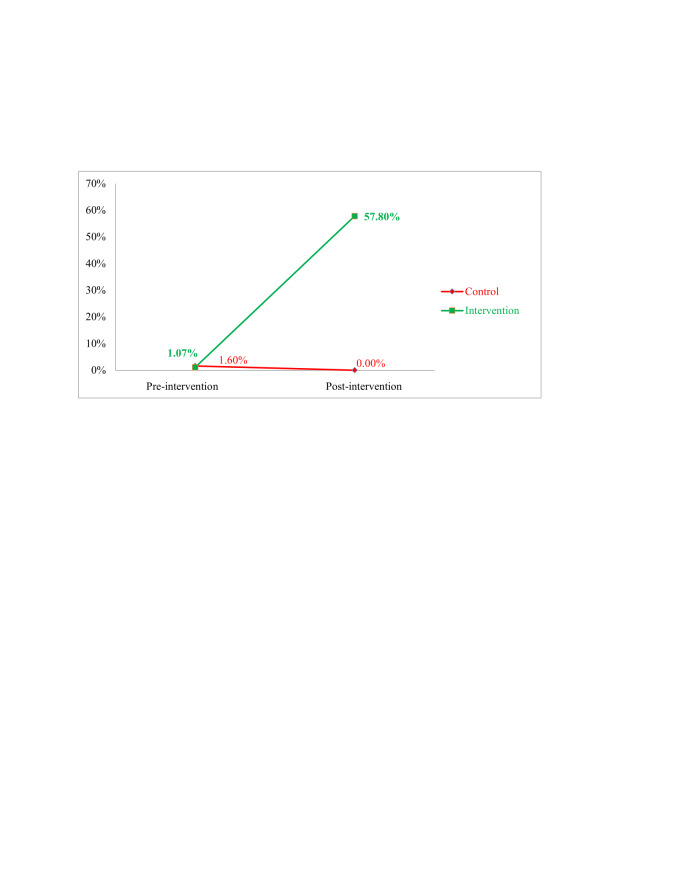
Following SBCC intervention, significant ( < 0.001) improvements were observed in the intervention group with regards to the primary objective: CHX use increased from 1.07% to 57.80%, while CHX use decreased from 1.6% to 0.0% in the control group. Meaningful improvements were also observed in relation to knowledge (29.0% to 43.0%), attitude (53.0% to 90.0%), and practices (25.0% to 70.0%) of rural communities regarding cord care. Marked improvements were also observed in the intervention group related to understanding causes of cord infections; importance of cord cleanliness; use of antiseptic and other preventive measures; care-seeking behavior; and ensuring hygienic childbirth.
This pioneer study revealed that SBCC interventions led to an increase in CHX use and improved the knowledge, attitude and practices of Bangladeshi communities regarding cord care and cord infection. This indicates that SBCC intervention is indeed an effective and feasible method for reducing infant mortality rates in hard-to-reach populations and achieving SDG goal 3.2.
发展中国家占全球每年 270 万例新生儿死亡人数的 99.0%。脐带感染是造成这种困境的主要原因,但有证据表明,7.1%洗必泰溶液(CHX)可显著降低感染风险。为应对这一挑战,本研究旨在确定社会和行为改变沟通(SBCC)干预对促进使用世界卫生组织推荐的 CHX 以及改善孟加拉国偏远地区农村社区脐带护理知识、态度和实践的影响。
2017 年至 2019 年,在 Jamalpur 区的两个联盟中进行了一项预测试后准实验研究,共有 748 名处于妊娠晚期的孕妇参加。在 Dangdhora 联盟实施了 SBCC 干预措施,包括镇民大会(n=3)、社区会议(n=30)和挨家挨户会议(n=22223),该联盟为干预组,而 Hativanga 联盟为实时对照组。从总共 200 名受访者中收集了定性数据,其中从干预组和对照组各选择了 100 名参与者。在 R 中进行了统计分析,在 95%置信区间(CI)中,结果为 0.05 时呈现。
在实施 SBCC 干预后,干预组在主要目标方面取得了显著(<0.001)的改善:CHX 的使用率从 1.07%增加到 57.80%,而对照组则从 1.6%下降到 0.0%。农村社区在脐带护理方面的知识(从 29.0%到 43.0%)、态度(从 53.0%到 90.0%)和实践(从 25.0%到 70.0%)也有了有意义的提高。干预组在理解脐带感染原因、脐带清洁的重要性、使用消毒剂和其他预防措施、寻求医疗保健行为以及确保卫生分娩方面也有了显著改善。
这项开创性研究表明,SBCC 干预措施导致 CHX 的使用增加,并改善了孟加拉国社区对脐带护理和脐带感染的知识、态度和实践。这表明,SBCC 干预确实是一种有效和可行的方法,可以降低难以到达的人群的婴儿死亡率,实现可持续发展目标 3.2。