Ochi Yuri, Kubo Toru, Baba Yuichi, Nakashima Yasuteru, Ueda Motoko, Takahashi Asa, Miyagawa Kazuya, Noguchi Tatsuya, Hirota Takayoshi, Yamasaki Naohito, Kitaoka Hiroaki
Department of Cardiology and Geriatrics, Kochi Medical School, Kochi University Nankoku Japan.
Circ Rep. 2020 Apr 29;2(6):314-321. doi: 10.1253/circrep.CR-20-0031.
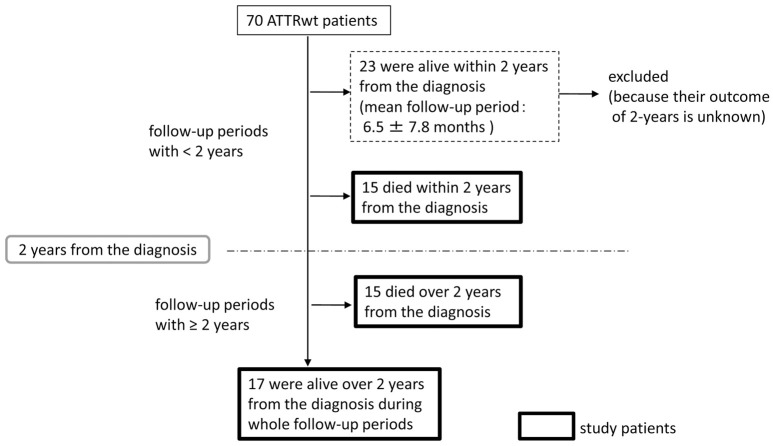
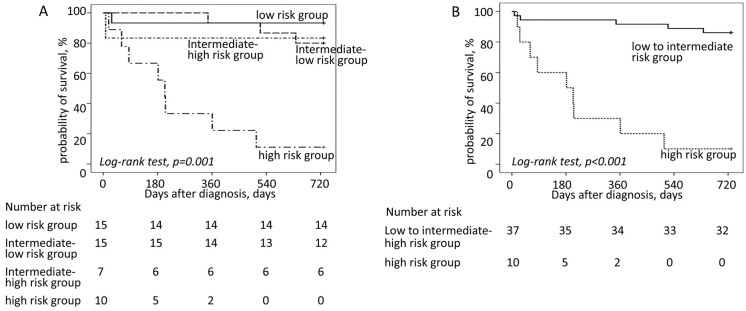
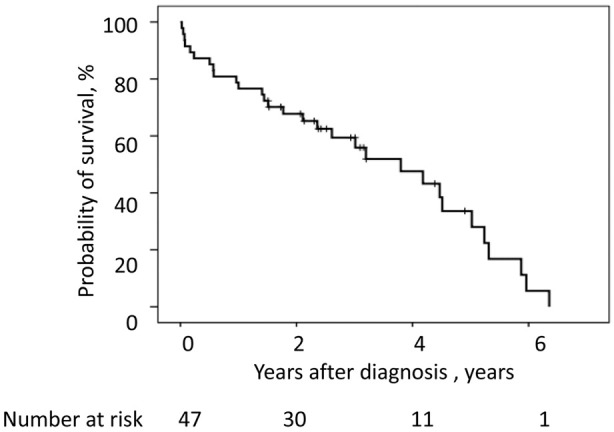
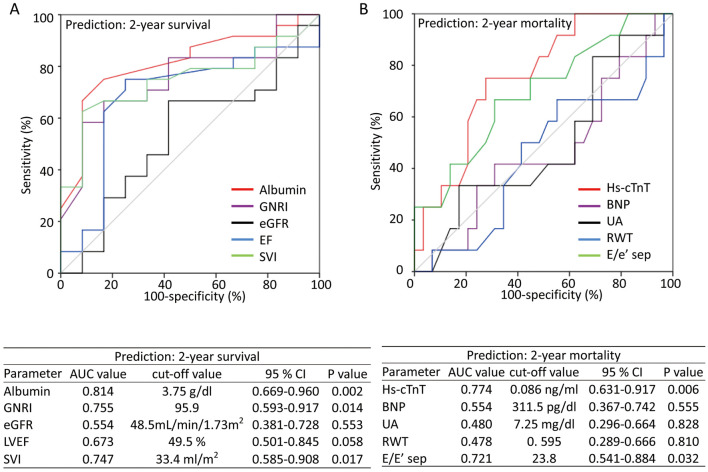
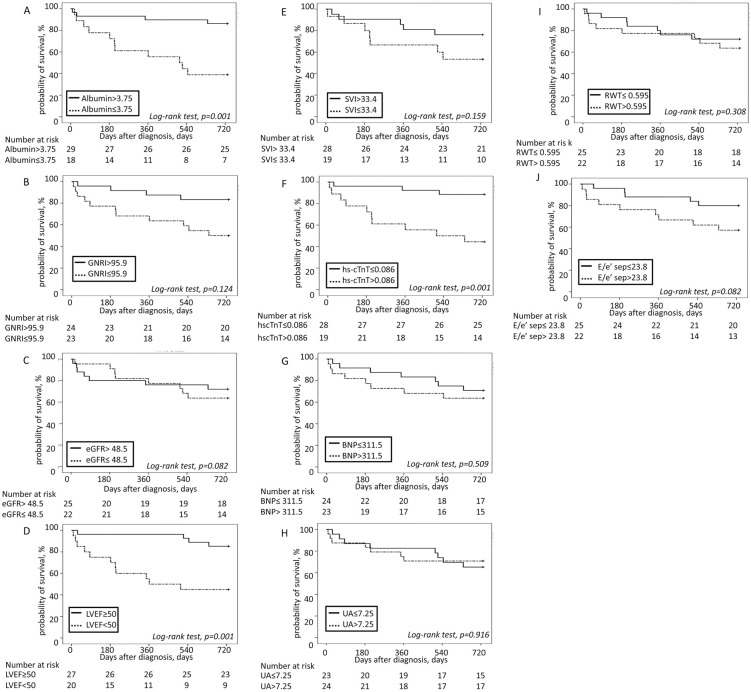
The prognostic factors in Japanese patients with wild-type transthyretin amyloidosis (ATTRwt) have not been elucidated. In this study we retrospectively analyzed the clinical characteristics and outcomes of 47 patients with ATTRwt (mean (±SD) age at diagnosis 80.3±4.6 years; 41 males). Fifteen patients died within 2 years of their diagnosis. Receiver operating characteristic and Kaplan-Meier analyses revealed that the best predictors of 2-year mortality were low serum albumin (≤3.75 g/dL), elevated high-sensitivity cardiac troponin T (hs-cTnT; >0.086 ng/mL), and reduced left ventricular ejection fraction (LVEF; <50%). According to the total number of these 3 risk factors, patients were stratified into 4 subgroups: low risk (no risk factors; n=15), intermediate-low risk (1 risk factor; n=15), intermediate-high risk (2 risk factors; n=7), and high risk (3 risk factors; n=10). The estimated 2-year survival rate of patients classified as low risk, intermediate-low risk, intermediate-high risk, and high risk was 93%, 80%, 83%, and 11%, respectively (P<0.001). Low serum albumin, elevated hs-cTnT, and reduced LVEF are associated with a worse prognosis in Japanese patients with ATTRwt. The combination of these factors may be useful for predicting medium-term mortality in patients with ATTRwt.
野生型转甲状腺素蛋白淀粉样变性(ATTRwt)日本患者的预后因素尚未阐明。在本研究中,我们回顾性分析了47例ATTRwt患者的临床特征和结局(诊断时平均(±标准差)年龄80.3±4.6岁;41例男性)。15例患者在诊断后2年内死亡。受试者工作特征曲线和Kaplan-Meier分析显示,2年死亡率的最佳预测因素是低血清白蛋白(≤3.75 g/dL)、高敏心肌肌钙蛋白T升高(hs-cTnT;>0.086 ng/mL)和左心室射血分数降低(LVEF;<50%)。根据这3个危险因素的总数,患者被分为4个亚组:低风险(无危险因素;n=15)、中低风险(1个危险因素;n=15)、中高风险(2个危险因素;n=7)和高风险(3个危险因素;n=10)。低风险、中低风险、中高风险和高风险患者的估计2年生存率分别为93%﹑80%﹑83%和11%(P<0.001)。低血清白蛋白、hs-cTnT升高和LVEF降低与ATTRwt日本患者的预后较差相关。这些因素相结合可能有助于预测ATTRwt患者的中期死亡率。