Department of Cognition, Emotion, and Methods in Psychology, Faculty of Psychology, University of Vienna, Vienna, Austria.
Department of Psychiatry, Psychotherapy and Psychosomatics, Psychiatric Hospital, University of Zürich, Zürich, Switzerland.
PLoS One. 2021 Mar 11;16(3):e0247997. doi: 10.1371/journal.pone.0247997. eCollection 2021.
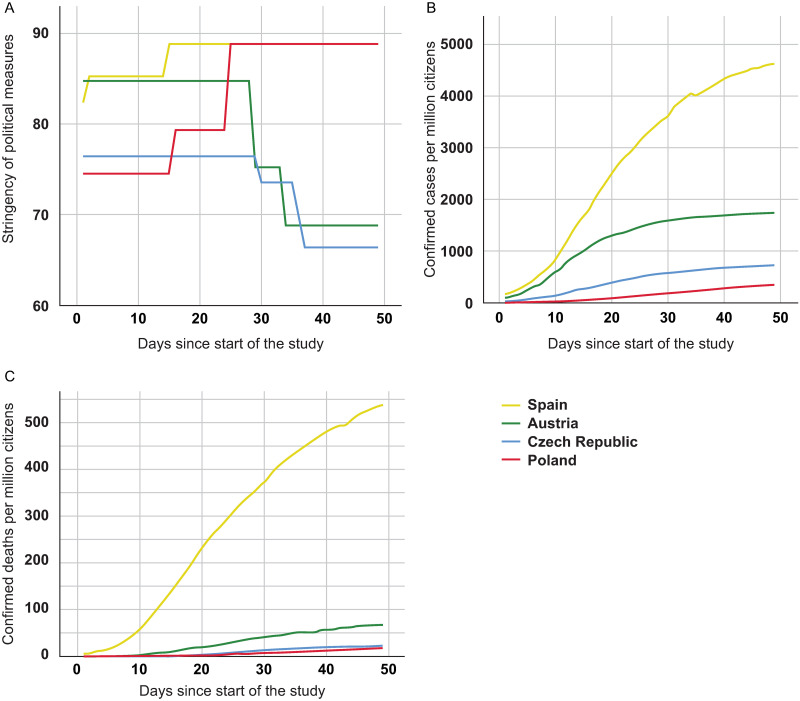
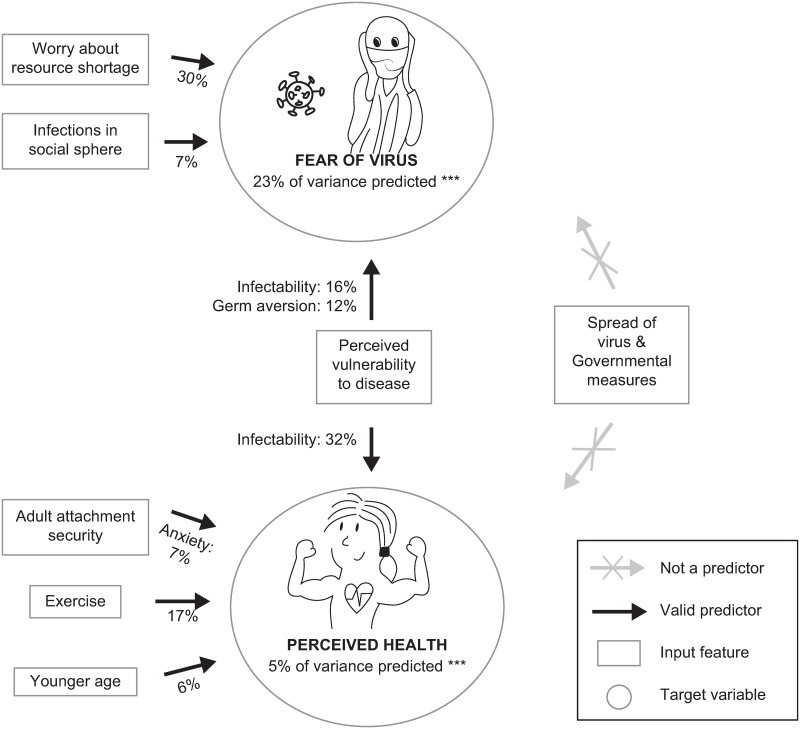
During medical pandemics, protective behaviors need to be motivated by effective communication, where finding predictors of fear and perceived health is of critical importance. The varying trajectories of the COVID-19 pandemic in different countries afford the opportunity to assess the unique influence of 'macro-level' environmental factors and 'micro-level' psychological variables on both fear and perceived health. Here, we investigate predictors of fear and perceived health using machine learning as lockdown restrictions in response to the COVID-19 pandemic were introduced in Austria, Spain, Poland and Czech Republic. Over a seven-week period, 533 participants completed weekly self-report surveys which measured the target variables subjective fear of the virus and perceived health, in addition to potential predictive variables related to psychological factors, social factors, perceived vulnerability to disease (PVD), and economic circumstances. Viral spread, mortality and governmental responses were further included in the analysis as potential environmental predictors. Results revealed that our models could accurately predict fear of the virus (accounting for approximately 23% of the variance) using predictive factors such as worrying about shortages in food supplies and perceived vulnerability to disease (PVD), where interestingly, environmental factors such as spread of the virus and governmental restrictions did not contribute to this prediction. Furthermore, our results revealed that perceived health could be predicted using PVD, physical exercise, attachment anxiety and age as input features, albeit with smaller effect sizes. Taken together, our results emphasize the importance of 'micro-level' psychological factors, as opposed to 'macro-level' environmental factors, when predicting fear and perceived health, and offer a starting point for more extensive research on the influences of pathogen threat and governmental restrictions on the psychology of fear and health.
在医学大流行期间,需要通过有效的沟通来激励采取保护行为,而找到恐惧和感知健康的预测因素至关重要。不同国家 COVID-19 大流行的不同轨迹为评估“宏观环境”因素和“微观心理”变量对恐惧和感知健康的独特影响提供了机会。在这里,我们使用机器学习来研究恐惧和感知健康的预测因素,因为奥地利、西班牙、波兰和捷克共和国在应对 COVID-19 大流行时引入了封锁限制。在七周的时间里,533 名参与者完成了每周的自我报告调查,这些调查衡量了目标变量,即对病毒的主观恐惧和感知健康,以及与心理因素、社会因素、对疾病的易感性(PVD)和经济状况有关的潜在预测变量。病毒传播、死亡率和政府应对措施也被纳入分析,作为潜在的环境预测因素。结果表明,我们的模型可以使用诸如担心食品供应短缺和对疾病的易感性(PVD)等预测因素准确预测对病毒的恐惧(可解释约 23%的方差),有趣的是,病毒传播和政府限制等环境因素并没有对这一预测做出贡献。此外,我们的结果还表明,使用 PVD、体育锻炼、依恋焦虑和年龄作为输入特征,可以预测感知健康,但效果较小。总的来说,我们的研究结果强调了“微观心理”因素的重要性,而不是“宏观环境”因素,当预测恐惧和感知健康时,这为更广泛地研究病原体威胁和政府限制对恐惧和健康心理学的影响提供了一个起点。